




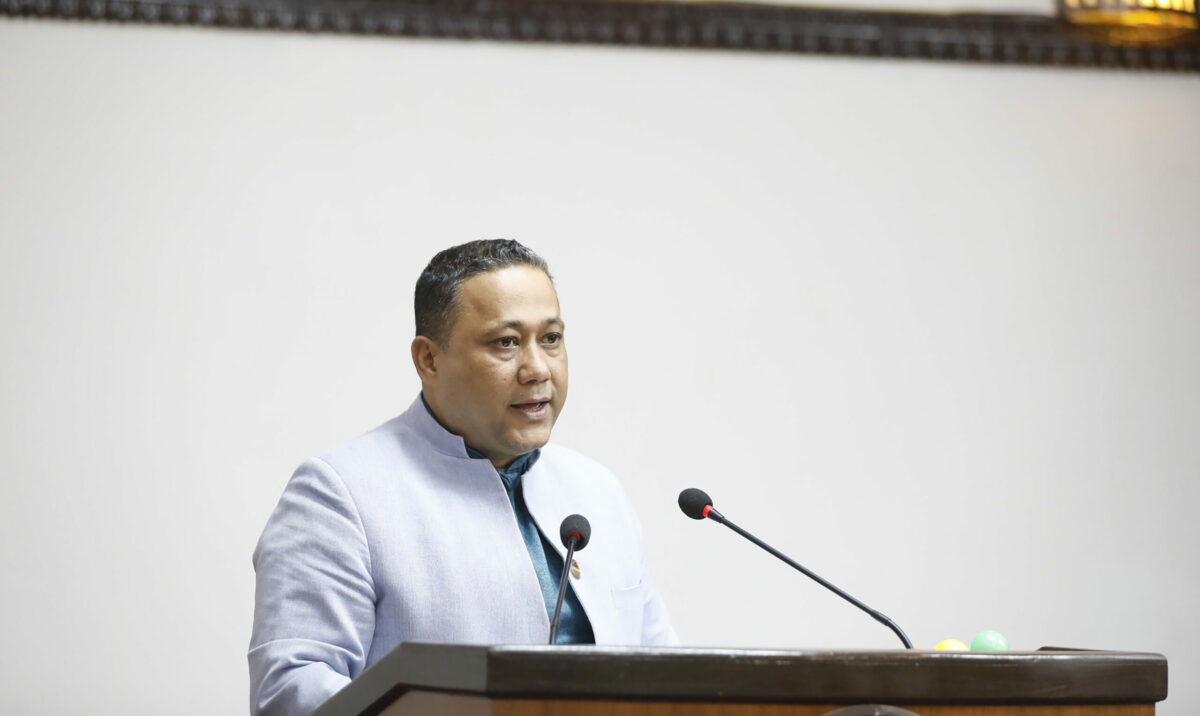
KATHMANDU: Foreign Minister Shishir Khanal has stressed that Nepal’s diplomacy should make a direct contribution to the country’s economic transformation, saying the government is placing special emphasis on effective and results-oriented development diplomacy.
Speaking at the fifth edition of the Prof. Yadunath Khanal Lecture Series, organized by the Ministry of Foreign Affairs on Monday, Khanal said Nepal’s diplomatic missions abroad are increasingly focusing on economic diplomacy, trade promotion, investment, tourism, technology partnerships, and expanding market access.
“Ultimately, foreign policy must serve the welfare, aspirations and prosperity of the people,” he said.
The foreign minister noted that strategic competition among major powers is intensifying globally, while economic instruments, supply chains and critical infrastructure are playing an increasingly influential role in international relations.
He also said emerging technologies, including artificial intelligence and the digital economy, are reshaping the global distribution of power and opportunity.
“For countries like Nepal, these changes present both challenges and opportunities,” Khanal said.
He observed that the multilateral system, which has long provided an important framework for global security, is facing growing pressure. Despite this, he said new opportunities are emerging for cooperation, connectivity, technology and economic partnerships, adding that Nepal must navigate the changing international environment with clarity, confidence and sound judgment.
Khanal emphasized that Nepal’s foreign policy should continue to adapt to evolving global realities while remaining firmly anchored in the country’s national interests.
Foreign policy rooted in core principles
The minister reaffirmed Nepal’s commitment to the purposes and principles of the United Nations Charter, the principles of Panchsheel, non-alignment and peaceful coexistence, saying these values continue to guide the country’s external relations.
He argued that non-alignment should not be interpreted as passivity or isolation. Instead, he said it requires active engagement, sound decision-making and the ability to assess international developments through the lens of Nepal’s own national interests.
Referring to the views of the late Professor Yadunath Khanal, he noted that diplomacy gains credibility through political stability and tangible economic progress.
Khanal said the Nepali people are seeking greater opportunities, development and prosperity, and that foreign policy must increasingly support those national aspirations.
He added that the government has placed good governance and rapid economic growth at the center of its priorities.
“The younger generation, in particular, expects results, opportunities and accountable institutions,” he said.
‘Geopolitics is a permanent reality’
Describing geopolitics as a permanent reality for Nepal, Khanal cautioned against viewing every issue solely through a geopolitical lens.
He said overly cautious or narrow interpretations of external developments can sometimes limit Nepal’s ability to pursue legitimate opportunities for development and international cooperation.
In an increasingly interconnected world, he said geography should not be regarded merely as a constraint but as a bridge connecting ideas, markets, people and opportunities.
“Our geographic position offers significant potential for connectivity, trade, investment and regional cooperation,” he said.
Khanal said this approach has guided the government’s recent diplomatic engagements with neighboring countries.
Referring to his recent visits to India and China, he said discussions focused on practical cooperation and partnerships based on mutual interests.
The foreign minister also highlighted the government’s responsibility to protect Nepali citizens living abroad.
He noted that millions of Nepalis are employed or residing overseas, contributing not only to the economies of their host countries but also to Nepal’s economy and society.
“Their safety, dignity and well-being remain among the highest priorities of our foreign policy,” he said.
The lecture series was established to encourage informed discussions on Nepal’s foreign policy and the challenges and opportunities the country faces in a changing global environment.
The event also featured a keynote address by former Prime Minister Baburam Bhattarai, who spoke on the opportunities and limitations of Nepal’s foreign policy amid evolving geopolitical and geo-economic trends. This year’s theme was “Nepal’s Foreign Policy: Navigating Geopolitical and Geo-economic Trends.”




Comment