




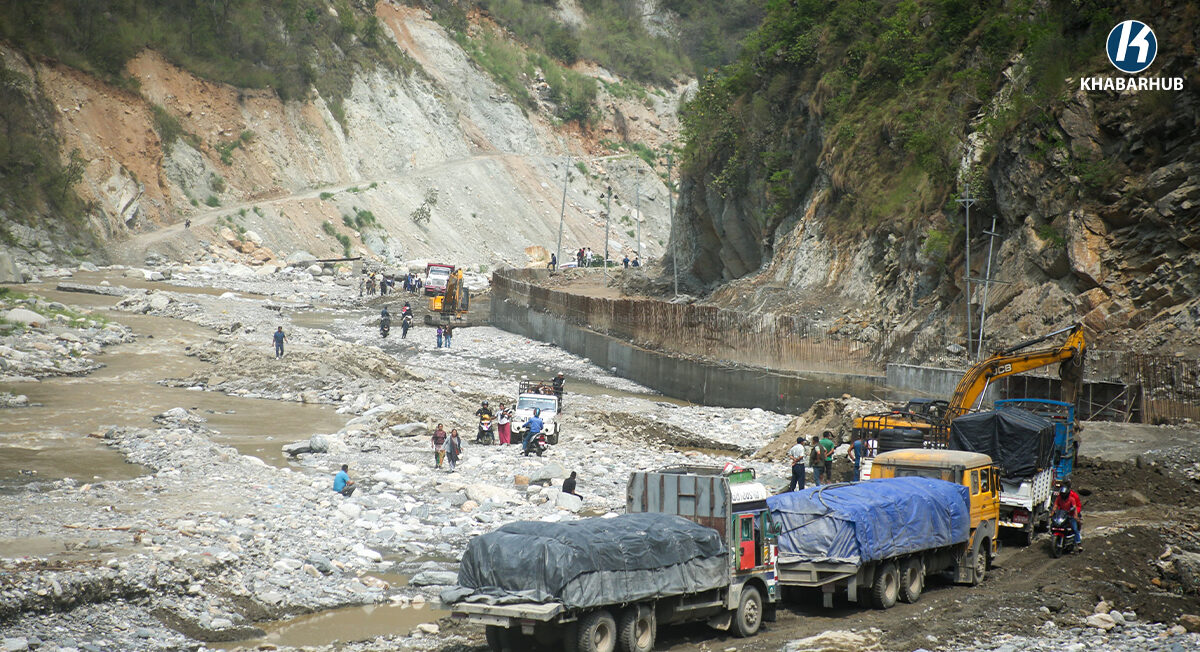
BANEPA: The Khurkot-Bhakundebesi section of the BP Highway remains closed today due to landslides and erosion caused by the Roshi River following continuous rainfall.
Chief District Officer Gopal Kumar Adhikari said traffic has not yet resumed along the section as efforts to clear the obstructions are still underway.
A team from the Division Road Office, Bhaktapur, has been working since early this morning to restore traffic. Adhikari said that if weather conditions remain favorable, the road could potentially reopen by tomorrow (Tuesday) afternoon.
The latest disruption has once again highlighted the recurring problems of floods, landslides, and river erosion affecting the BP Highway during the monsoon season.
The highway is currently undergoing permanent reconstruction after extensive damage was reported along the Kavre section following flooding in the Roshi River and landslides triggered by incessant rainfall two year ago. Temporary diversions were constructed at several locations to facilitate traffic after large sections of the highway were washed away.
The BP Highway is a vital transportation link connecting the eastern and central parts of the country with the federal capital, Kathmandu. The highway was constructed with technical and financial assistance from the Japan International Cooperation Agency (JICA).
It serves as a crucial link between the Terai and eastern districts and the capital, supporting transportation, trade, and daily life. Consequently, disruptions to the highway directly affect passengers and drivers, as well as local communities and businesses.
Although traffic is currently operating through temporary diversions constructed at locations where the road was washed away by the 2081 BS floods, travel remains difficult. Drivers say the diversions become muddy during the rainy season and dusty during dry weather.
Binod Dahal, a regular driver on the BP Highway, said the condition of the diversions has created daily hardships.
“Beyond the misery caused by mud and dust on these temporary diversions, the road’s poor condition means the undercarriages of small vehicles constantly scrape the ground. Not only are the vehicles damaged, but we are also forced to transport passengers while putting their lives at risk,” he said.
Local residents living along the highway face similar challenges. According to Buddha Lama, a resident of Kaldhunga in Roshi Rural Municipality-11, the floods caused extensive damage to both the settlement and the road.
“This road, which runs right past our homes, was our primary economic lifeline. However, the floods devastated both the settlement and the road. While traffic is somehow moving through the temporary diversions now, the problems of dust and mud persist, along with the constant fear of flooding whenever it rains,” he said.
Lama emphasized the need for strong, permanent infrastructure to provide a lasting solution for the area.
Calls have also grown for reconstruction efforts to go beyond temporary repairs and focus instead on developing safe, durable infrastructure.
Roshi Rural Municipality Chairperson Dinesh Lama said authorities must learn from the disaster and ensure that future infrastructure is designed to minimize risks.
“The state needs to immediately secure the necessary resources for the reconstruction of the BP Highway. When rebuilding the highway, authorities must consult both the public and local governments to ensure the construction of a robust structure capable of withstanding natural disasters. Locals expect the government—which has pledged to complete the reconstruction within two years—to carefully consider our suggestions and proceed with the work based on thorough technical studies,” he said.
He also proposed rerouting the highway away from certain high-risk areas and toward safer terrain as a possible long-term solution.
Amid public inconvenience and growing concern among local authorities, the Road Division Office, Bhaktapur, under the Department of Roads, has accelerated reconstruction and upgrading works along the BP Highway.
According to Er. Suman Yogesh, Chief of the Road Division Office, Bhaktapur, reconstruction is progressing in four separate packages covering a total of 25.11 kilometers between Barkhekhola and Bhakundebesi.
Under Package 1, the 3.22-kilometer Barkhekhola–Piple section is being reconstructed with grant assistance from the Japan International Cooperation Agency (JICA). The project has been contracted to Japan’s Shimizu Corporation, with Nippon Koei Co. Ltd. and Yahiyo Engineering Corporation (JV) serving as consultants. The section is targeted for completion within two years.
Under Package 2, the 2.30-kilometer Piple–Dalabesi section is being constructed by Uma & Company/Bhandari Amar Jyoti JV. The estimated cost of the project was NPR 1.21 billion, while the contract was awarded for NPR 688.04 million. Physical progress on the section has reached 40 percent.
Package 3 covers the 8.50-kilometer Dalabesi–Charsaybesi section, which is being constructed by Khanir-A-Wan-Kamal Jit JV, Kathmandu. Against an estimated cost of NPR 2.45 billion, the contract was signed for NPR 1.42 billion. Physical progress has reached 46 percent.
Similarly, Package 4 covers the 11.09-kilometer Charsaybesi–Bhakundebesi section and is being constructed by Lama-Nava Kantipur JV, Kathmandu. The project was estimated to cost NPR 2.52 billion but was contracted for NPR 1.33 billion. According to Division Chief Yogesh, physical progress has reached 35 percent.
Measures to Protect the Highway
Priority has also been given to constructing technical structures designed to protect the highway from floods and landslides. According to Yogesh, RCC cantilever walls are being constructed at high-risk locations.
Of the planned 6,300 meters of such structures, 3,760 meters have been completed so far. Work on the 1,145 meters of planned micropiles has been completed in full. Similarly, 2,189 meters, or 38 percent, of the planned 5,740 meters of plum concrete work have been completed, while 4,105 meters, or 70 percent, of the planned 5,900 meters of stone masonry have been completed.
The Road Division Office said gravel-standard roads have been prepared at vulnerable locations to minimize traffic disruptions during the monsoon. RCC cantilever walls with a minimum height of 4.5 meters are being constructed in high-risk areas as part of these efforts.
The office has also kept 13 excavators, six loaders, and 11 tipper trucks on standby at various locations to respond quickly to sudden obstructions and landslides. The equipment has been stationed at areas including Chaukidanda, Katunjebesi, Charsaybesi, Gimtibesi–Narke, Chiuribas–Boksikuna, Kaldhunga, Dalabesi, and other locations prone to dry landslides.
Temporary Diversions Remain Vulnerable
While permanent reconstruction is progressing, temporary diversion routes remain vulnerable to flooding and erosion.
The recent rainfall has also triggered landslides and debris flows at several locations along the BP Highway. The Roshi River has eroded portions of both the highway and temporary diversions, disrupting vehicular movement at Chaukidanda in Namobuddha Municipality-6, Charsaybesi in Roshi Rural Municipality-7, Gimdibesi in Ward No. 8, and Mamti in Ward No. 11.
After the Roshi River eroded the diversion at Chaukidanda, vehicles heading east from Kathmandu were halted at Dhulikhel. The current closure of the Khurkot–Bhakundebesi section is a direct result of obstructions caused by rainfall, landslides, and river erosion.
Balancing Immediate Access and Long-Term Safety
The reconstruction of the BP Highway presents a dual challenge: maintaining road connectivity in the short term while ensuring long-term safety and resilience.
The task is not simply to restore the flood-damaged highway to its previous condition but to construct infrastructure capable of withstanding future disasters. The floods of 2081 caused extensive damage to the highway, while the floods of 2082 exposed the limitations of temporary diversions. The heavy rains and subsequent landslides in 2083 have once again damaged diversion routes and disrupted traffic, even as permanent reconstruction continues under the four construction packages.
For travelers, however, the ongoing construction offers little immediate relief from the difficulties created by the monsoon. Mud and dust continue to make travel difficult, drivers face hazardous road conditions, and communities along the highway remain concerned about the safety and reliability of the route.
The immediate priority is therefore to complete the ongoing reconstruction works within the stipulated timeframe while developing long-term solutions for high-risk sections. The reconstruction of the BP Highway will ultimately fulfill its purpose only when it provides citizens with a safe, reliable, and convenient route throughout the year.






Comment