




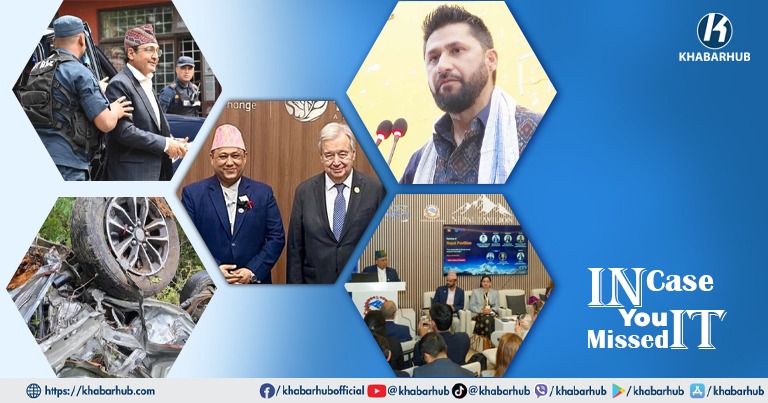
KATHMANDU: The past week offered a revealing picture of Nepal’s opportunities and challenges, both at home and on the international stage. From advocating for mountain communities at the United Nations Climate Change Conference (COP-31) to political developments in Madhesh, judicial appointments, disaster-related tragedies and efforts to strengthen international partnerships, the week’s events highlighted the complex priorities confronting the country.
A particularly significant development was Nepal’s effort to place mountain-related climate concerns at the centre of international negotiations at COP-31 in Antalya, Türkiye. Although Nepal and Bhutan’s joint proposal to establish a separate mountain agenda was not formally accepted, Nepal’s continued diplomatic engagement demonstrated its determination to ensure that the concerns of mountain countries receive greater international recognition.
Foreign Minister Shisir Khanal’s position that mountain issues must be reflected in the conference’s final decision was important because the consequences of global warming are increasingly visible across the Himalayas. Melting glaciers, unstable glacial lakes, changing river systems, landslides and extreme weather events are threatening settlements, infrastructure, agriculture and livelihoods. Nepal’s recent experience of floods and landslides further illustrates how climate-related disasters can undermine years of development gains within a short period.
Prime Minister Balendra Shah’s instructions to RSP lawmakers preparing for a visit to China reflected the government’s interest in connecting party-level diplomatic engagement with national development priorities. His emphasis on technology, trade, tourism, agricultural modernisation and economic cooperation was appropriate.
The government’s emphasis on scientific research, mountain-specific indicators and dedicated climate finance frameworks is therefore timely. However, diplomatic recognition alone will not address the vulnerabilities of mountain communities. Nepal must translate its international advocacy into concrete financial commitments, research partnerships, stronger disaster preparedness and effective adaptation programmes.
Climate finance and justice remain Nepal’s central concerns
Another important dimension of Nepal’s participation at COP-31 was its emphasis on climate justice. Foreign Minister Khanal argued that adaptation should not be viewed merely as a technical or environmental issue but as a matter of fairness and responsibility.
This argument reflects a longstanding concern among developing and least developed countries: those contributing least to global greenhouse gas emissions often experience some of the most severe consequences of climate change. Nepal is a clear example. Despite its limited contribution to global emissions, the country faces substantial risks from glacial melting, floods, landslides, droughts and increasingly unpredictable weather patterns.
Nepal’s demand for predictable, accessible and grant-based climate finance is therefore justified. Loans can increase the financial burden on countries already struggling with development challenges, whereas grants can provide resources for adaptation without adding to public debt.
The call by the Least Developed Countries (LDCs) to increase adaptation finance at least threefold also deserves serious international attention. Nevertheless, the effectiveness of climate finance depends not only on the volume of funding but also on how quickly and fairly it reaches vulnerable communities. Local governments and community institutions need greater access to resources, technical expertise and decision-making authority.
Foreign Minister Khanal’s meeting with UN Secretary-General Antonio Guterres further reinforced Nepal’s efforts to connect climate diplomacy with practical international cooperation. Discussions on flood recovery, early warning systems, climate finance and global governance reforms provided an opportunity to highlight Nepal’s needs at the highest diplomatic level.
Disaster-resilient infrastructure emerges as a development priority
The call by Information and Communications Minister Dr. Bikram Timilsina for stronger international cooperation in developing disaster-resilient communication infrastructure highlighted another important aspect of Nepal’s climate vulnerability.
Recent floods and landslides have demonstrated that disasters do not only destroy homes, roads, bridges and hydropower facilities; they also disrupt communication networks that are essential for emergency response and public safety.
Reliable communication systems are particularly important in mountainous and remote areas, where geographical difficulties can delay rescue operations and the delivery of essential services. When communication infrastructure fails during a disaster, authorities face additional difficulties in assessing damage, coordinating rescue teams and providing timely information to affected communities.
Nepal’s participation in the International Telecommunication Union’s Plenipotentiary Conference in Doha therefore provided an important platform to promote international cooperation in this sector.
However, the country needs to move beyond policy commitments and prioritise practical investment in resilient telecommunications infrastructure. Greater coordination among government agencies, telecommunications providers and international development partners will be essential to ensure that communication services remain operational during emergencies.
Political developments expose challenges of coalition governance
On the domestic political front, the resignation of Madhesh Province Chief Minister Krishna Prasad Yadav demonstrated once again the fragility of coalition governments in Nepal’s federal political structure.
Yadav stepped down after the withdrawal of support by the CPN-UML and the Nepali Communist Party weakened his coalition and made it impossible to secure the required majority in the Provincial Assembly.
His resignation before the confidence vote reflected the political reality that continuing in office without sufficient parliamentary support would have served little purpose. His statement that public service and people’s trust were more important than retaining power was also a reminder that political positions should ultimately remain accountable to democratic institutions.
The development, however, raises broader questions about political stability and the effectiveness of provincial governments. Frequent changes in coalition arrangements can disrupt administrative continuity, delay development projects and weaken public confidence in provincial institutions.
Federalism was introduced to bring governance closer to citizens and ensure more balanced development across the country. But its success depends on stable institutions, responsible political leadership and cooperation among political parties. Political bargaining that repeatedly undermines provincial governments risks weakening the very purpose of federal governance.
The coming government formation process in Madhesh will therefore be an important test of whether political parties can prioritise administrative stability and public service over short-term political calculations.
RSP faces expectations of accountability and responsible leadership
The remarks by Rastriya Swatantra Party (RSP) Chair Rabi Lamichhane ruling out any dispute between his party and the government also attracted attention during the week.
Lamichhane maintained that criticism and suggestions were part of democratic practice rather than evidence of political division. His position reflects an important principle: political parties supporting a government should retain the ability to question its decisions and demand accountability.
However, the relationship between a political party and the government it supports requires clarity. Constructive criticism should contribute to better policymaking rather than become a source of uncertainty or political confrontation.
Lamichhane’s remarks in Janakpurdham were particularly significant because he linked the party’s political credibility to tangible improvements in the lives of people in Madhesh. His statement that he would not seek votes in future elections if people failed to experience meaningful improvements was a strong political commitment.
More importantly, his warning against individuals demanding money by promising election tickets highlights the need for transparency in candidate selection and internal party management. Public confidence in a relatively new political force depends not only on its promises of change but also on its ability to maintain integrity within its own organisation.
Meanwhile, Prime Minister Balendra Shah’s instructions to RSP lawmakers preparing for a visit to China reflected the government’s interest in connecting party-level diplomatic engagement with national development priorities. His emphasis on technology, trade, tourism, agricultural modernisation and economic cooperation was appropriate.
Such visits can provide valuable opportunities to exchange experiences and build relationships. Nevertheless, their success should be measured by practical outcomes rather than the number of meetings held or places visited. Nepal must ensure that engagement with neighbouring countries serves its long-term economic and strategic interests.
Judicial appointments and the importance of institutional credibility
President Ram Chandra Paudel’s appointment of four new judges to the Supreme Court was another notable development.
The conviction of Naresh Bhatt by a jury in Virginia, the United States, for the first-degree murder of his wife, Mamta Kafle Bhatt, was another major development with particular significance for the Nepali community at home and abroad.
The appointments are significant at a time when public expectations of judicial independence, accountability and timely justice remain high. The Supreme Court plays a central role in interpreting the Constitution, protecting fundamental rights and maintaining the balance of power among state institutions.
Strengthening the judiciary through appropriate appointments is necessary, but institutional credibility cannot depend on appointments alone. The judiciary must also address delays in case disposal, improve access to justice and ensure that its decisions are impartial and consistent.
The release of former Deputy Prime Minister Top Bahadur Rayamajhi following a reduction in his prison term under provisions applicable to senior citizens also brought attention to the relationship between individual rights and the administration of justice.
The case highlights the importance of applying legal provisions consistently, regardless of an individual’s political background or public position. Public confidence in the justice system depends on equal treatment under the law and transparent implementation of judicial decisions.
Road safety tragedy exposes persistent weaknesses
One of the most tragic events of the week was the electric vehicle accident in Makwanpur, which claimed 14 lives and left six others injured.
The passenger vehicle plunged approximately 500 metres off the road along the Bhimphedi-Kulekhani-Kathmandu route while travelling from Kathmandu to Sarlahi. The scale of the tragedy, particularly the loss of several members of the same community, once again exposed Nepal’s persistent road safety challenges.
Road accidents in Nepal are often discussed in terms of immediate causes, but the broader problem involves a combination of unsafe road conditions, vehicle standards, driver behaviour, enforcement gaps and inadequate emergency response systems.
Mountain and hill roads are especially vulnerable because of steep slopes, narrow sections, unstable terrain and limited protective infrastructure. These conditions require more rigorous safety assessments, regular maintenance, appropriate barriers and effective traffic monitoring.
The past week’s events have therefore offered both opportunities and warnings. Nepal has the diplomatic platforms, political institutions and international partnerships to advance its interests. The real test, however, will be whether these opportunities can be converted into concrete improvements in people’s lives and a more resilient, accountable and prosperous nation.
The loss of 14 lives should not be treated simply as another road accident statistic. It should prompt a serious review of passenger transport safety, particularly on routes connecting remote settlements with major urban centres.
Preventive measures, stronger enforcement of vehicle safety standards and improved emergency medical services are essential to reducing such avoidable tragedies.
International justice brings closure, but not complete answers
The conviction of Naresh Bhatt by a jury in Virginia, the United States, for the first-degree murder of his wife, Mamta Kafle Bhatt, was another major development with particular significance for the Nepali community at home and abroad.
The verdict followed a lengthy investigation and trial involving forensic evidence, surveillance footage, digital records and witness testimony. The jury also convicted Bhatt of concealing and defiling his wife’s body.
The case attracted widespread attention because Mamta, a Nepali-origin nurse, disappeared in July 2024, leaving her family and community searching for answers. Although the verdict represents an important step towards accountability, the continued absence of her remains means that some questions surrounding the case remain unresolved.
The case also highlights the importance of supporting victims of domestic abuse, taking reports of violence seriously and ensuring that law enforcement agencies respond effectively to concerns about personal safety.
For Nepali communities abroad, the case serves as a reminder that migrant life and professional opportunities must be accompanied by access to support systems, legal protection and community awareness about domestic violence.
A week that calls for action beyond political and diplomatic commitments
Taken together, the week’s developments reveal a country confronting several interconnected challenges. Nepal is seeking greater international support to address climate vulnerability while simultaneously dealing with political instability, infrastructure weaknesses, institutional accountability and public safety concerns.
Its participation in COP-31 and other international forums demonstrates a growing willingness to articulate national priorities and engage with global partners. Yet international recognition must translate into tangible benefits, particularly for communities facing the immediate consequences of climate change.
At home, the political developments in Madhesh and the RSP’s statements on accountability underline the importance of responsible leadership and democratic discipline. Similarly, judicial appointments and the application of legal provisions must strengthen public confidence in state institutions.
The Makwanpur accident, meanwhile, is a painful reminder that development cannot be measured solely through economic growth, infrastructure expansion or international engagement. Protecting human lives, ensuring public safety and providing reliable essential services must remain equally important priorities.
Ultimately, Nepal needs to bridge the gap between commitments and implementation. Whether in climate diplomacy, provincial governance, infrastructure development or the justice system, meaningful progress will depend on institutional accountability, effective coordination and sustained political will.
The past week’s events have therefore offered both opportunities and warnings. Nepal has the diplomatic platforms, political institutions and international partnerships to advance its interests. The real test, however, will be whether these opportunities can be converted into concrete improvements in people’s lives and a more resilient, accountable and prosperous nation.






Comment