




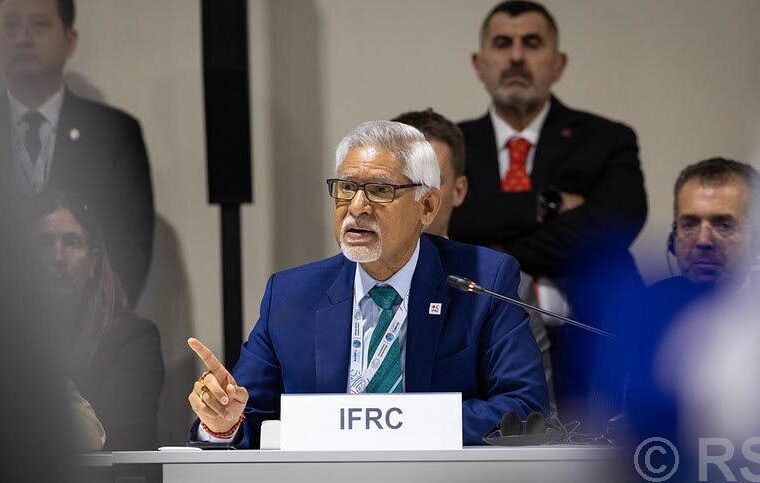
KATHMANDU: Jagan Chapagain, Secretary-General of the International Federation of Red Cross and Red Crescent Societies (IFRC), has called for stronger links between early warning systems and timely preparedness measures to protect people from natural disasters.
“Preparedness measures helped 9.6 million people in 54 countries protect their lives and livelihoods ahead of disasters in 2025 alone. This demonstrates why early warnings must be linked to timely action. It is not only a humanitarian responsibility but also a farsighted and prudent investment,” he said.
Delivering the keynote address at a special session on ‘Early Warning for All’ during the 31st Conference of the Parties to the United Nations Framework Convention on Climate Change (COP-31) in Antalya, Turkey, Chapagain highlighted significant progress in global disaster preparedness since the initiative was launched in 2022.
According to Chapagain, the number of countries developing policy frameworks for disaster preparedness has more than doubled, increasing from 35 to 75. He noted that approximately 40 percent of countries worldwide now have established mechanisms for issuing early warnings and initiating preparedness measures before disasters strike.
“Investing in preparedness before a disaster strikes means protecting lives, livelihoods and human dignity. It also helps prevent the enormous economic and human losses that follow disasters. There is growing evidence that forecast-based preparedness can be implemented on a large scale,” he said.
Chapagain also drew attention to the gap between receiving early warnings and taking appropriate protective action. Citing global figures, he said four out of five people in disaster-prone areas receive advance warnings, but one in three still fails to take appropriate safety measures. He stressed the need to address this gap by ensuring that warnings translate into effective action.
Drawing on his experience in humanitarian work, the IFRC chief said the declining availability of humanitarian resources made it increasingly important to invest in preparedness rather than rely primarily on rescue and relief operations after disasters occur.
“In a situation where humanitarian resources are shrinking day by day, relying solely on rescue and relief after disasters is no longer sufficient. We must act before crises occur to reduce the enormous losses and humanitarian needs that follow,” he said.
Chapagain emphasized that efforts to protect people from disaster risks must continue beyond 2027, the target year of the Early Warning for All initiative. He said the key challenge was to sustain political commitment, secure long-term financing and ensure effective implementation beyond the target date.
Also serving as a global ambassador of the Grand Bargain, Chapagain said the challenge was no longer simply predicting disasters, as scientific knowledge had significantly improved the ability to identify potential hazards, their locations and the communities most at risk. The greater challenge, he said, was translating available information into timely and effective action.
“Early warnings become meaningful only when they are accompanied by timely anticipatory action,” he stressed.
Reflecting on the progress of the Early Warning for All initiative, Chapagain said the campaign had generated unprecedented global momentum, strengthened international cooperation and significantly expanded the coverage of multi-hazard early warning systems.
However, he urged stakeholders to view 2027 as an important milestone rather than the endpoint of the initiative.
Community ownership key to effective early warning systems
Chapagain emphasized that local communities must be at the centre of early warning systems, arguing that they should not be treated merely as the final recipients of warnings but as the starting point of preparedness efforts.
He said communities exposed to disaster risks possess the most direct knowledge of their vulnerabilities, priorities and possible solutions. Their involvement is therefore essential to making early warning systems effective and responsive to local needs.
Modern technology, he noted, can bridge local knowledge and experience with scientific forecasting and risk analysis, enabling authorities and communities to move from information and prediction to timely action.
“Neither technology nor weather forecasting alone can save lives. Effective disaster preparedness requires strong political commitment, adequate investment, partnerships and timely action,” he said.
He called for greater community ownership of the Early Warning for All initiative, with governments taking the lead in collaboration with local communities, Red Cross and Red Crescent National Societies, international organizations and development partners.
“Looking beyond 2027, let us commit not merely to informing everyone but to empowering everyone to take steps to protect themselves,” Chapagain said.
He added that the success of the initiative should not be measured by the number of warnings issued but by how effectively those warnings help prevent potential disasters from escalating into major humanitarian crises.






Comment