




The images from Nepal are devastating. A wall of water, ice, mud and boulders tore through Himalayan valleys with extraordinary force. Roads and bridges disappeared. Communities had little time to react. Once again, people who have lived beside these mountains for generations found themselves confronting forces far beyond their control.
The immediate priority must be rescue, relief and support for those who have lost loved ones, homes and livelihoods.
But when the waters recede, we must resist a familiar pattern: mourn the dead, rebuild what was destroyed, strengthen a few local defences—and wait for the next disaster.
The Himalayas are warning us. The risk profile of the entire region is changing, and our response must change with it.
Preliminary assessments indicate that the latest Nepal disaster may have been triggered by an ice-rock avalanche in a high-altitude area, generating a sudden surge of water, sediment and boulders downstream. Scientists are still establishing the precise sequence of events, and conclusions should not be rushed.
But the larger warning is already unmistakable. The Hindu Kush Himalaya is warming. Glaciers are retreating. Glacial lakes are changing. Warming and thawing are increasing instability in some mountain environments, while extreme precipitation is adding to the risks. Millions of people and billions of dollars of infrastructure are increasingly exposed to interconnected and cascading hazards.
The Himalayas need a regional response. There is a fundamental problem with managing Himalayan risk country by country.
This is no longer simply a succession of natural disasters. It is becoming a systemic development risk. The Hindu Kush Himalaya stretches across eight countries and feeds major river systems on which nearly two billion people ultimately depend. What happens high in these mountains does not stay there.
Evidence from the International Centre for Integrated Mountain Development is sobering. Glacier ice-loss rates across the Hindu Kush Himalaya have doubled since 2000. Between 1990 and 2020, glaciers lost about 12% of their area and an estimated 9% of their ice reserves. The region contains more than 25,000 glacial lakes.
The dangers are not theoretical. In 2024, a rock avalanche above a glacial lake triggered a destructive chain reaction that devastated Thame in Nepal’s Everest region. Now Nepal has been struck by another catastrophic Himalayan flood. We must stop treating each event as an isolated surprise.
A warming Himalaya creates multiple risks simultaneously: retreating glaciers, changing lakes, unstable rock and ice, landslides, flash floods and increasingly unpredictable river flows.
These hazards can cascade. An avalanche can strike a lake. A lake can breach. A flood can trigger landslides. Debris can block a river. A temporary dam can suddenly collapse. What begins high in a sparsely inhabited valley can become a catastrophe far downstream.
Yesterday’s disaster-management systems were not designed for this world.
There is another reason governments must act urgently. The Himalayas are also undergoing enormous infrastructure development.
Roads, bridges, hydropower plants, transmission lines, tunnels, tourism facilities and towns are reaching deeper into mountain areas.
Much of this investment is essential. Mountain communities need connectivity, electricity, jobs and economic opportunity. But infrastructure designed using yesterday’s assumptions about rainfall, rivers, glaciers and slope stability may not be safe in tomorrow’s climate.
When a mountain road disappears, communities can lose access to hospitals, markets and food. A damaged hydropower project can become both an economic loss and an additional downstream hazard. A bridge designed around historical flood records may provide false security if the future no longer resembles the past.
Climate resilience must become a condition of Himalayan development—not an environmental consideration added after projects have been designed.
Every major infrastructure investment in the region should have to answer one question:
Will this project remain safe under the climate and geological conditions we are likely to face 20, 30 or 50 years from now?
If we cannot answer that question with reasonable confidence, we should reconsider where or how we build.
Today, we have technologies previous generations could only imagine. Satellites can monitor glaciers and lakes. Remote sensing can identify changes in unstable slopes. Sensors can track water levels. Weather forecasting continues to improve. Artificial intelligence can help analyse multiple sources of information rapidly.
But information saves lives only when it reaches the right people in time—and when people know what to do with it.
Early warning must become early action. Every high-risk Himalayan basin should have continuously updated hazard maps. Dangerous glaciers, lakes and slopes should be systematically monitored. Downstream communities and critical infrastructure should be mapped against potential hazard paths.
And warnings must reach people. A farmer, hotel owner, bus driver, police officer or schoolteacher downstream should not need to understand glaciology. They need to know that danger is coming, where to go and how much time they have. Where events can race through mountain valleys within minutes, warning alone will never be enough.
That logic must change. We must move from financing reconstruction to financing resilience. Prevention should be treated as investment, not expenditure.
Land-use planning must prevent new settlements and critical infrastructure from being placed in the highest-risk areas. Evacuation routes must be identified beforehand. Schools, hospitals and local governments must practise emergency responses. In some locations, difficult discussions about relocation may become unavoidable.
Preparedness is cheaper than reconstruction—and infinitely cheaper than lives lost.
The Himalayas need a regional response. There is a fundamental problem with managing Himalayan risk country by country.
Water does not carry a passport. Neither does a glacier, a flood, a landslide or a weather system.
A hazard originating in one country can threaten communities in another within hours. Yet monitoring, data systems, disaster institutions and infrastructure planning remain largely national. That approach is increasingly inadequate.
The Himalayan countries should consider establishing a Himalayan Resilience Compact—a practical framework for cooperation built around existing institutions rather than another new bureaucracy.
It should focus initially on three priorities.
Know the risks. Countries should develop a shared, continuously updated inventory of high-risk glaciers, glacial lakes, unstable slopes and river basins using satellite and ground observations.
Share the warnings. Real-time data and common warning protocols should allow information to cross borders as quickly as the hazards themselves.
Build for the future. Governments and development institutions should adopt stronger climate-resilience standards for roads, bridges, hydropower projects and settlements, while directing substantially more financing toward prevention and preparedness.
Local communities must be at the centre of all three. People living in Himalayan valleys cannot merely be recipients of warnings designed in distant capitals. Their knowledge, experience and participation are indispensable.
Nepal, as one of the countries on the front line of these risks, could help lead this effort. Rather than wait for a regional architecture to emerge, it could invite its neighbours, scientific institutions and development partners to begin building one.
International financial institutions also have an important responsibility.
Development banks have financed roads, hydropower, urban development and regional connectivity across the Himalayas for decades. They should now help countries finance a new generation of resilience investments: glacier and slope monitoring, watershed management, resilient infrastructure, nature-based solutions, early-warning systems and safer settlements.
But the mountains are changing faster than the institutions responsible for protecting the people who depend on them. That gap is becoming dangerous.
More importantly, climate risk must influence where and how infrastructure is built. A project cannot truly be considered economically viable if its analysis ignores the changing physical environment in which it will operate.
There is something fundamentally wrong with the economics of disasters. Governments and development partners repeatedly mobilise large sums after catastrophe strikes, yet preventive investment struggles for attention beforehand.
That logic must change. We must move from financing reconstruction to financing resilience. Prevention should be treated as investment, not expenditure.
After major Himalayan disasters, we often describe what happened as “unprecedented.” That word should worry us. If supposedly unprecedented events keep occurring, perhaps the problem is no longer only the events. It is the assumptions on which our planning is based. The latest tragedy in Nepal should become a turning point.
Not every future disaster can be prevented. But deaths, destruction and economic losses can be dramatically reduced if governments understand the risks, share information, build differently, finance prevention and prepare communities before catastrophe arrives.
The Himalayas have sustained civilizations for thousands of years. They provide water, energy, food, biodiversity and livelihoods across a vast part of Asia.
But the mountains are changing faster than the institutions responsible for protecting the people who depend on them. That gap is becoming dangerous.
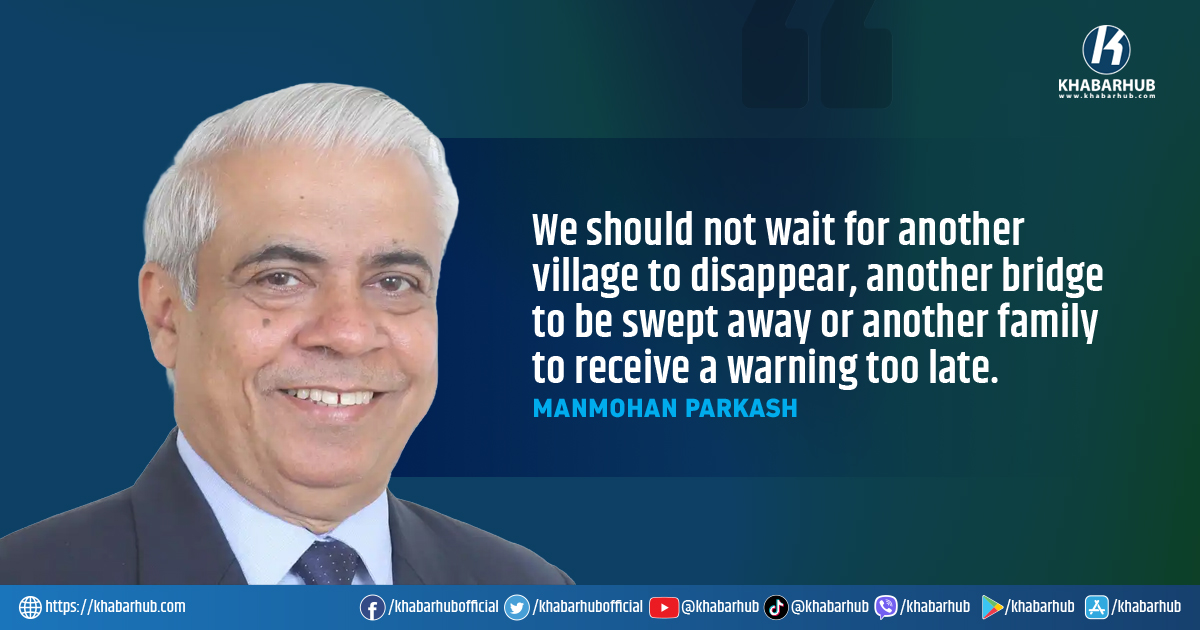
We should not wait for another village to disappear, another bridge to be swept away or another family to receive a warning too late. The science is warning us. The mountains are warning us. And now tragedy has warned us again. The question is whether we will act before the next disaster proves it again.
(Manmohan Parkash is a former Senior Advisor in the Office of the President and former Deputy Director General for South Asia at the Asian Development Bank (ADB). Views expressed are personal.)






Comment