




Development was once understood as a simple matter of applying the models developed economies created. But, as my research has shown, there is a catch-up paradox: a country cannot conclusively catch up with, let alone overtake, its forerunners merely by imitating them. Instead, latecomers should take advantage of emerging technologies to “leapfrog” those ahead of them.
Fundamentally, leapfrogging means doing something new before those who were once ahead of you. The rise of wireless communications technologies enabled a number of developing economies to bypass fixed-line telephony altogether.
But true leapfrogging is what happened next: some of these countries (perhaps most famously Kenya) developed innovative mobile payment systems, without ever having built traditional banking systems or using services like credit cards.
The point is not just to bypass outdated technologies, but to lead in new markets. South Korea’s leap into digital technology, for example, enabled it to surpass its forerunner Japan. While South Korean champion Samsung built global dominance in digital televisions, Japan’s Sony remained stuck in its ways, continuing to invest in and produce analog TVs.
A key motivation to develop this approach is undoubtedly US sanctions, which restrict the Dutch company ASML from exporting its extreme ultraviolet lithography machines to China.
This incumbent trap also ensnared the American firm Motorola, which remained committed to analog mobile phones, instead of developing digital phone alternatives that it considered less stable. The choice was not irrational: Motorola, like other firms that fall into the incumbent trap, had invested massively in achieving superiority in an existing technology, and did not want to throw that away. In the end, however, it was left behind.
For latecomers, the key to successful catch-up cycles, which bring changes in industrial leadership, is to recognize the window of opportunity created by emerging technologies to forge a new path.
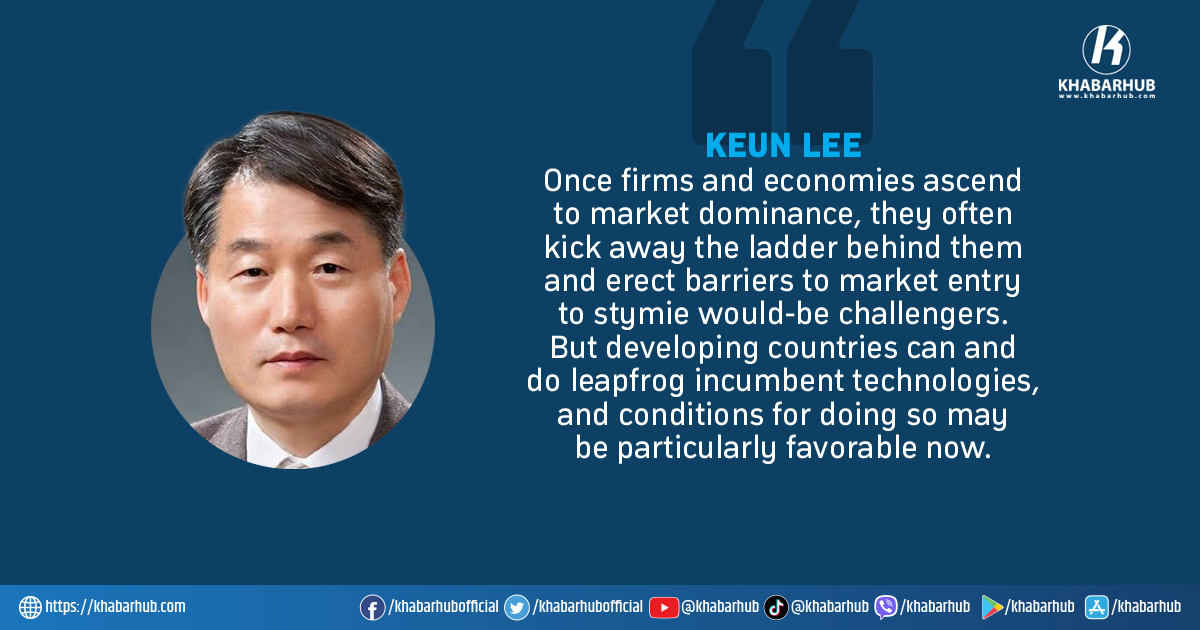
As Ha-Joon Chang of the University of Cambridge pointed out in 2002, once firms and economies ascend to market dominance, they often kick away the ladder behind them and use patents, trademarks, and other intellectual-property protections to erect entry barriers in established markets. Other advantages, such as existing economic complexity, scale, and capacity, strengthen their position further.
Leapfrogging effectively amounts to using a hot-air balloon to ascend where there is no ladder. Of course, this requires the latecomer to have certain resources and capabilities. But once those are in place, it is largely a matter of identifying the right weather conditions: a balloon is likely to find a clearer path and far more lift amid a shift in technological paradigms, or during exogenous moments of disruption or “creative destruction.”
Even under the most favorable of conditions, no flight is risk-free. Countries must choose the right technologies to focus on, and confront the costs of building new markets. This is as true in advanced economies as it is in developing ones. First movers like Tesla initially faced huge losses, and survived only because of generous public-sector support (in Tesla’s case, from the US Department of Energy and California’s state government), as well as venture capitalists and financial markets.
But such support is no guarantee of success. The US firm Solyndra arrived on the scene in 2005 offering more efficient solar-panel technologies based on thin films instead of silicon, and four years later, it secured a $535 million loan guarantee from the Department of Energy. But losses accumulated, and in 2011, the firm filed for bankruptcy.
Simply put, becoming a first mover is a high-risk, high-reward strategy. For those unwilling to undertake it—or unable to bear big losses on the way to success—a parallel-mover strategy offers an alternative. In this scenario, a company simultaneously develops multiple types of products alongside industry leaders.
In automobiles, Germany’s Volkswagen is an incumbent; China’s BYD is a leapfrogger; and Korea’s Hyundai is a parallel mover, balancing the development of combustion-engine and electric vehicles.
Advanced economies have something to learn, too. No matter how dominant a firm was yesterday, or remains today, the incumbent trap can be a death sentence.
China’s leapfrogging has partly been a matter of geopolitical necessity. Last month, Huawei unveiled a new chip-design principle it calls the Tau Scaling Law. Instead of continuing to make transistors smaller, as Moore’s Law would dictate, Huawei is seeking to accelerate communication across electronic systems.
A key motivation to develop this approach is undoubtedly US sanctions, which restrict the Dutch company ASML from exporting its extreme ultraviolet lithography machines to China.
The new chip design reflects China’s broader approach to development, which has never followed the Western model. China’s leaders have always understood that attempting to overtake the US without changing lanes virtually guarantees a collision.
Even as the two countries compete in cutting-edge technologies like AI, their strategies are fundamentally different, with China focusing more on building open-source models that can be implemented broadly and the US emphasizing proprietary frontier models.
Leapfrogging has played a powerful role in making successful catch-up cycles possible, and will continue to do so. Given the economic transformation that is currently underway, emerging and developing economies should be working to identify where opportunities match their capabilities and resources. Managing first-mover risks effectively—or adopting a more cautious parallel-mover approach—will be vital to success.
Advanced economies have something to learn, too. No matter how dominant a firm was yesterday, or remains today, the incumbent trap can be a death sentence.
(Keun Lee, a former vice chair of the National Economic Advisory Council for the President of South Korea, is Professor of Economics at Seoul National University)
Copyright: Project Syndicate






Comment