




It may not be a fascinating proposition, but getting politics right is the most important task. Without it, pioneering efforts to build modern political institutions, embrace pluralism, strengthen constitutional government, and develop a thriving economy cannot be sustained. The consolidation of modern politics and the emergence of democratic forces pressing for change can foster a desire for good governance and make broader progress possible.
Above all, protecting individual rights and creating an environment capable of overcoming new forms of social and political division can help contain violence and establish the conditions for genuine political progress. This is the point Stephen Marche (2022) emphasizes.
Here again, political nihilism may seem increasingly old-fashioned, even backward, as decentralized forms of political organization and governance gain ground. Yet the rise of the corporate state carries profound political consequences. It can concentrate power in ways that leave citizens with diminishing control over the forces shaping their lives.
More fundamentally, the emergence of the corporate state can produce a profit-driven political system whose driving force is the concentration, expansion, and preservation of state power and control, with potentially grave consequences.
Some people may understandably feel uncomfortable with this political transformation and respond with resentment, suspicion, or negativity.
The road ahead is grim. Mass political culture tells us that despite material progress and prosperity, a spirit of unhappiness and depression increasingly haunts market democracies around the world. This challenges the idea that markets necessarily maximize human well-being, as well as the eighteenth-century promise of the right to pursue happiness under governments chosen by the people themselves.
While Nepal cannot fully escape the gravitational pull of neoliberalism, it is equally clear that the country will not be redeemed by a solitary, independent-minded figure who rises above party labels and dissolves partisan boundaries. Such a unifying presence is not waiting in the wings.
What remains uncertain is whether the RSP government can cultivate the deeper political maturity needed to move beyond the kakistocratic habits that, in my view, have shaped Nepal’s governance since 2008. The question is not merely institutional but existential: Can a political culture accustomed to decay learn to imagine itself anew?
Nepal today increasingly resembles two estranged Nepali publics—communities that distrust, resent, and even despise one another. The political middle ground, once a space for negotiation and shared purpose, has all but vanished. In this fractured landscape, the RSP itself risks appearing less like a reformist force and more like a consortium of plutocrats. Vasily Grossman, the Russian novelist, as quoted by Chris Hedges in Empire of Illusion (2008), reminds us that the struggle between good and evil is never abstract; it is lived daily in the choices societies make. His warning—that evil triumphs when people fail to resist it—feels acutely relevant to Nepal’s present moment.
The deeper challenge, then, is to move beyond anger, retaliation, and the short-term calculations that dominate political life. Nepal must cultivate a practical wisdom capable of strengthening collective dignity, social cohesion, and the quality of everyday life. Such transformation is slow, often imperceptible, but without it, neither political change nor economic progress can produce a society that feels stable, hopeful, or whole. Renewal requires not only new policies but a new sensibility—a shift in how citizens and leaders understand their shared fate.
Comparative political research reminds us that institutions unable to adapt to shifting realities often drift toward stagnation and lose the moral authority that sustains them. The RSP government’s challenge, therefore, is not simply administrative; it must demonstrate change that is felt, seen, and trusted. Only then can this political transition become a genuine renewal rather than another repetition of familiar disappointments. The deeper test is whether Nepal’s institutions can rediscover the vitality that once animated democratic aspiration.
Scholars increasingly observe that what once seemed unimaginable has begun to seep into everyday life. No society, however stable it appears, is immune to internal fractures. The descent from relative prosperity into unrest rarely follows a single thread; it emerges from a dense weave of insecurity, polarization, distrust, corruption, and the slow erosion of faith in public institutions.
These pressures accumulate quietly until a society finds itself struggling to restore coherence. In his book The Next Civil War, Stephen Marche describes the possibility of the United States—the world’s most enduring democracy and largest economy—descending into a profound internal crisis. The prospect is deeply unsettling, for the consequences would be devastating.
Conceptually, alternatives always exist; human societies are never locked into a single path. Yet when hatred saturates public discourse, when discouragement replaces hope, when corporate scandals become routine, and when governments appear beholden to powerful interests, democratic institutions begin to lose their moral grounding. In such an atmosphere, opposition becomes reactive rather than constructive, and political actors respond to fear rather than wisdom. The erosion is subtle but profound: a society forgets how to imagine a future beyond its grievances.
The March 2026 parliamentary elections marked a profound rupture with Nepal’s so-called established political forces. The RSP won 182 of the 275 seats, while the Nepali Congress won 38 and the UML 25. The result represented not merely a change in political fortunes but a powerful rejection of an established political elite whose long record had become associated, in the public imagination, with corruption, patronage, political privilege, and failure of governance.
For decades, politics too often became a mechanism for accumulating money, power, and personal privilege rather than advancing the common good. The result was an erosion of democratic culture and public trust. The country paid the price while political actors and their networks benefited from the system. Nepal cannot rebuild a healthier political order using the same assumptions, habits, and incentives that produced the old one. The familiar slogans, self-delusions, and self-serving political packages designed to manipulate the masses have lost much of their credibility, as demonstrated by the ballot box.
In particular, the long dominance of figures such as Oli, Dahal, Deuba, Bhattarai, and Madhab has left a political legacy that deserves rigorous scrutiny. Their periods in power were accompanied by persistent concerns over corruption, institutional weakness, political patronage, and the deterioration of public services. Political spectacle and partisan confrontation increasingly displaced constructive democratic discourse, while powerful interests were often perceived as receiving preferential treatment over broader public interests.
Yet elections exposed the limits of this political formula. The old slogans and political narratives could no longer conceal the accumulated grievances of citizens. The electorate produced a dramatic change in the composition of Parliament and opened space for a new political generation.
For the first time in decades, the NC and UML have found themselves confronted with the consequences of their long-consolidated party rule and personality-driven leadership. Rather than attempting to preserve the old political order, they should allow space for a new political elite to emerge and do what is necessary and appropriate for Nepal and its people.
For the RSP government, however, the challenge extends beyond political transformation. It must also lead Nepal’s reconstruction following the devastating flash floods—an enormous and perhaps almost incalculable task.
Some people may understandably feel uncomfortable with this political transformation and respond with resentment, suspicion, or negativity. That is part of democratic life. Some politicians, civil society actors, media figures, and analysts have questioned aspects of the political transition or advanced competing interpretations of the events surrounding it. Such disagreement is legitimate in a democracy. The important question is whether these competing perspectives can develop sufficient public support to shape the country’s political direction.
That, too, is democracy.
Nepal has paid enough for political failure. The question now is simple but profound: Do we break the cycle, or repeat it?
Nepal’s democratic institutions still struggle to regulate market forces while protecting social equality and public welfare. Political elites continue to coexist with a crude form of capitalism that can privilege market interests under different forms of governance. If this remains unchanged, economic and social inequality could deepen in ways that are difficult to reconcile with a democracy founded on equal rights, opportunities, and duties.
The September 2025 Gen Z uprising and the March 2026 elections should be understood as intertwined expressions of a deeper transformation. The protests revealed a generation unwilling to accept corruption, inequality, and political stagnation as inevitable. The election that followed translated this dissatisfaction into a dramatic reshaping of Parliament.
Together, these events opened a path for Nepal to imagine a political order not bound by the habits of previous decades. This emerging consciousness echoes Einstein’s insight: problems cannot be solved from the same level of awareness that created them. Nepal now stands at a threshold where a shift in political sensibility may matter as much as institutional reform.
The challenge now is to understand how Nepal can move toward a democratic political order in which institutions rise above partisan struggle and restore legitimacy to a system weakened by years of decay. At a moment of profound turbulence and institutional challenge, there is no immediate formula for safeguarding the national interest.
The real test, therefore, is whether the RSP can rise above the political consciousness that brought down the old order—and build something fundamentally different: a democratic system that protects citizens, serves the public interest, strengthens institutions, and advances the national interest. Nepal has already paid a heavy price for political failure. What matters now is whether this new chapter can prevent the country from slipping back into the same cycle of disappointment, instability, and lost opportunity.
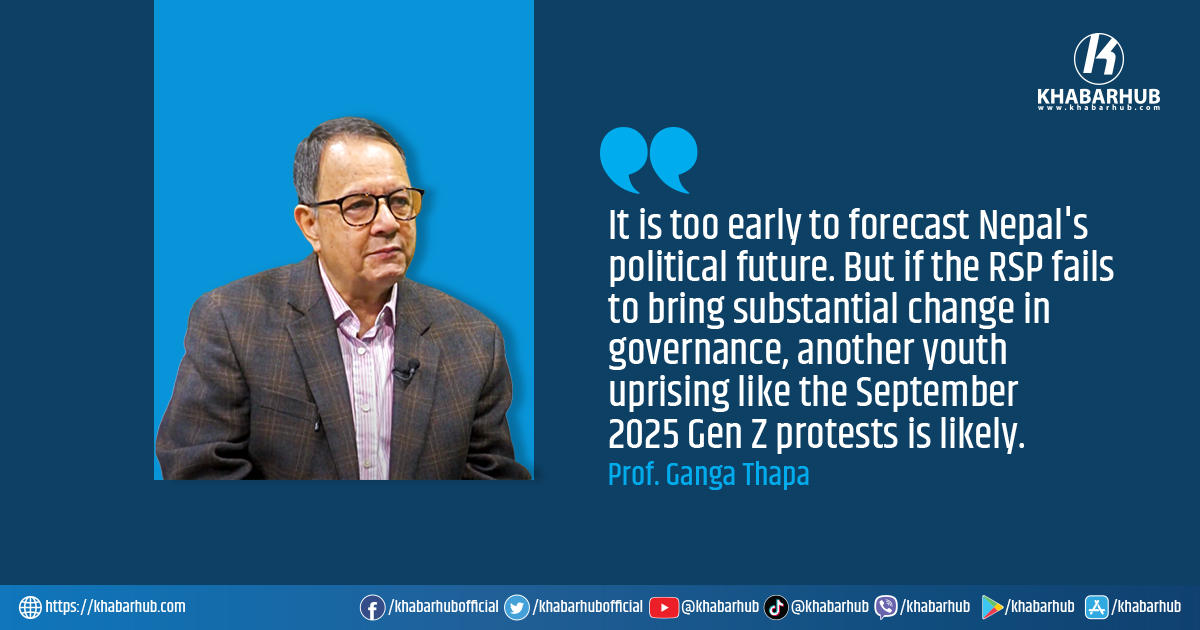
It is too early to forecast Nepal’s political future. But if the RSP fails to bring substantial change in governance, another youth uprising like the September 2025 Gen Z protests is likely.
For the RSP government, however, the challenge extends beyond political transformation. It must also lead Nepal’s reconstruction following the devastating flash floods—an enormous and perhaps almost incalculable task. The government must rebuild damaged infrastructure while preparing Nepal for an unpredictable future. Its real test, therefore, will not simply be whether it can govern, but whether it can transform this crisis into an opportunity to rebuild the country with greater resilience, institutional competence, and strategic foresight.
Indeed, the recent Bhotekoshi flash floods—an event that claimed thousands of lives and swept away entire settlements—confront us with a rare and devastating reminder of a truth most of us seldom witness: that suffering is woven into the human condition, often without warning or explanation. Catastrophes like this seem to undergo a kind of mysterious metamorphosis; they begin as natural events but quickly reveal the fragile architecture of our political and moral worlds. We know such disasters cannot always be prevented, yet survival—both physical and institutional—often hinges on the choices and conduct of those in power.
In this moment, I find myself unexpectedly moved by the Balen government’s response. Their actions do not erase the tragedy, but they gesture toward a form of governance that acknowledges vulnerability without surrendering to despair. It is a small but meaningful source of hope.
Disasters of this scale may never be fully predictable, but that does not mean we should retreat into willful ignorance or live under perpetual anxiety. Nepal must learn to inhabit a world where danger is a constant companion, not an aberration. Real life rarely unfolds along a neat, linear trajectory; more often, the path to survival resembles a looping, disorienting roller coaster. Accepting this truth is not fatalism—it is the beginning of resilience.
It is too early to forecast Nepal’s political future. But if the RSP fails to bring substantial change in governance, another youth uprising like the September 2025 Gen Z protests is likely. In that scenario, all variants of communist gangs would be washed away in the plural landscape; the RSP would survive but be squeezed to a few dozen seats; the Nepali Congress would gain; and the next election would be hijacked by new political forces with a comfortable new majority.
The central thesis is that Nepal’s 2025–26 political rupture is meaningful only if it produces a genuine change in political consciousness, not merely a change in political personnel—as some critics characterize the present regime, using terms such as “hooligans,” “thuggocrats,” or, in Nepali, “लफङ्गा तन्त्र.”





Comment