



Although Nepal’s Constitution formally commits to inclusive democracy, its implementation reflects a system of managed representation. Articles 42 and 38(4) guarantee proportional participation of marginalized groups and women in state bodies, while Articles 84(2) and 84(8) establish a mixed electoral system ensuring representation of women, Dalits, indigenous groups, Khas Arya, Madhesis, Tharus, Muslims, and other marginalized communities, with a minimum of 33 percent female representation.
These provisions, shaped by the 2006 People’s Movement and institutionalized through the Interim Constitution of 2007 and the Constitution of Nepal (2015), were intended to correct historical exclusion. However, the House of Representatives Election Act (2017) permits closed party lists, granting party elites effective control over PR nominations.
As a result, despite Election Commission directives, elections in 2017, 2022, and 2026 reveal that representation has remained largely numerical rather than influential. Although 110 of the 275 parliamentary seats are allocated under proportional representation to promote inclusion and balance, these seats are filled through party lists rather than direct public mandates.
PR therefore remains essential in a diverse society like Nepal, but its credibility depends on reform. The problem lies not in the principle of proportional representation, but in how it has been captured by elite incentives. Cosmetic fixes will not work.
This has raised a fundamental question: do PR seats genuinely empower marginalized communities, or do they merely facilitate symbolic inclusion for party interests? The unrest of 2025 exposed this unresolved tension and the widening gap between constitutional promises and political reality, where inclusion exists on paper, participation is guaranteed, but meaningful power remains concentrated.
Structural Accountability Failure, Elite Capture, and Cluster Misclassification
The persistent invisibility of many proportional representation (PR) Members of Parliament in Nepal is not an individual failing but a structural flaw embedded in the system itself. PR MPs are selected through centralized and opaque party processes in which voters and communities play no role, with list placement driven more by loyalty to party leadership, factional bargaining, and internal power dynamics than by grassroots engagement.
As a result, many PR MPs lack organic ties to the social groups they are formally said to represent, turning representation into a symbolic exercise rather than a lived political relationship. Accountability therefore flows upward to party elites rather than outward to citizens, unlike first-past-the-post MPs, who face direct electoral pressure from defined constituencies. Without territorial accountability or electoral sanction, PR MPs have weak incentives for visibility, responsiveness, or performance, making invisibility a systemically produced outcome.
This accountability gap has enabled elite capture and cluster misclassification to become routine features of the PR system. Increasingly, PR has functioned as a pathway for political elites to re-enter Parliament after electoral defeat or to secure seats without facing voters at all.
Figures such as Arzu Rana Deuba and Prakash Sharan Mahat entered Parliament through PR despite losing direct contests, while wealthy individuals like Binod Chaudhary and controversial actors such as Eknath Dhakal have used party lists to protect political or business interests.
Party lists also frequently include spouses and close relatives of senior leaders, including Menuka Kumari Pokharel, Manju Khand, Nain Kala Thapa, and Julie Kumari Mahato, effectively converting space intended for marginalized communities into an extension of party leadership.
This distortion is further entrenched through cluster misclassification, where elite candidates are strategically placed under Dalit, Janajati, or Madhesi quotas by exploiting overlapping identities. Weak enforcement by the Election Commission and minimal penalties have normalized these practices, allowing PR lists to function as tools of internal party bargaining rather than social justice.
The result is inclusion reduced to headcount, overrepresentation of socially dominant groups under the guise of diversity, and a steady erosion of public trust in the democratic purpose of proportional representation.
Gen Z Mobilization and the Crisis of PR Legitimacy
By 2025, Nepal’s proportional representation system had lost much of its public credibility, a shift made visible by the scale and intensity of Gen Z–led mobilization. The unrest, including attacks on parliamentary property, reflected not a rejection of inclusion or diversity, but growing frustration with a system perceived as insulated from accountability and detached from its constitutional purpose.
Three years later, Parliament lay in ashes both figuratively and, quite literally, following the unrest of 2025. The incineration of the building served as a grim metaphor for the collapse of a political promise that expanded representation in numbers but failed to translate it into genuine political influence.
Developments surrounding the preparation of the March 5, 2026 election lists further reinforced this perception, suggesting institutional continuity rather than reform. Without clear constitutional limits on repeat PR nominations and enforceable eligibility standards, PR risks remaining a mechanism of symbolic inclusion—visible in form but hollow in substance.
Why Proportional Representation Still Matters
Any honest assessment of Nepal’s proportional representation system must recognize its early achievements. Before 2008, women held less than 6 percent of parliamentary seats; following PR, their representation rose to around one-third and has remained broadly stable, with more than 60 percent of women MPs entering through PR in 2017.
Dalits, Adivasi Janajatis, Madhesis, and Muslims—groups historically excluded from state power—also gained parliamentary presence that constituency elections alone would not have delivered. PR further demonstrated that meaningful contribution is possible when representatives exercise agency, as seen in figures such as Manushi Yami Bhattarai, Pampha Bhusal, Ram Kumari Jhakri, and Binda Pandey, who used PR platforms for sustained advocacy, policy engagement, and political growth. These cases do not erase PR’s flaws, but they show that the system itself is not inherently defective.
PR therefore remains essential in a diverse society like Nepal, but its credibility depends on reform. The problem lies not in the principle of proportional representation, but in how it has been captured by elite incentives. Cosmetic fixes will not work.
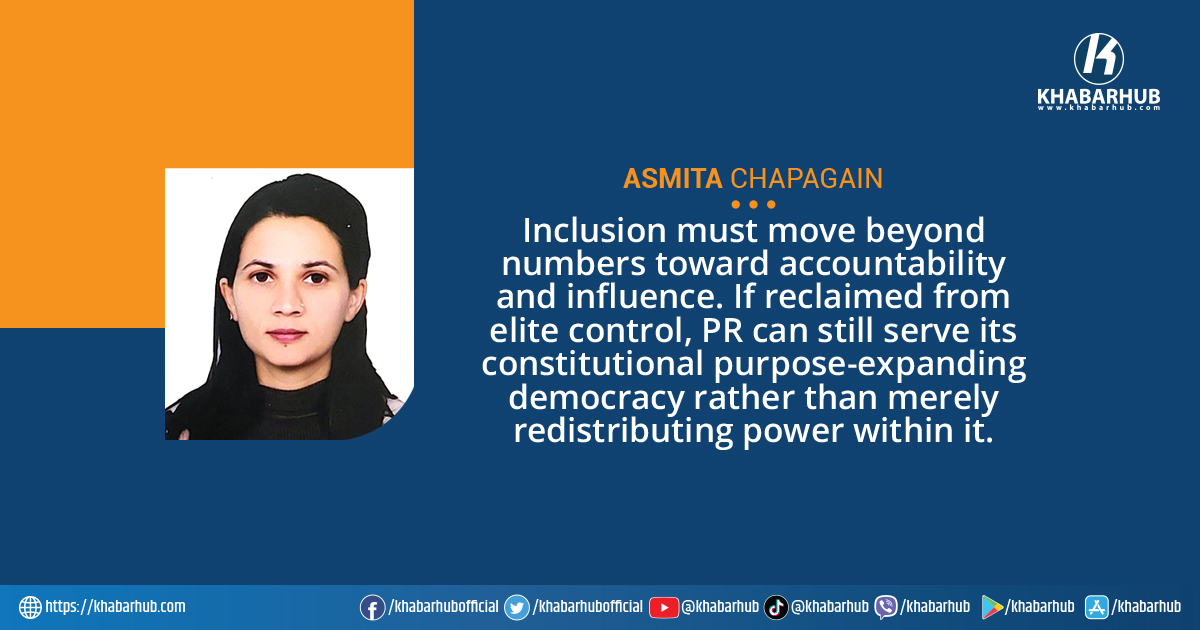
What is required are enforceable safeguards: limits on repeated PR tenure, restrictions on re-entry through PR after FPTP defeat, independent candidate vetting, and clear expectations of public engagement and performance. Inclusion must move beyond numbers toward accountability and influence. If reclaimed from elite control, PR can still serve its constitutional purpose—expanding democracy rather than merely redistributing power within it.
(Data Sources: This article draws on a synthesis of publicly available legal texts, electoral data, parliamentary records, media reports, and relevant academic and policy literature)




Comment