




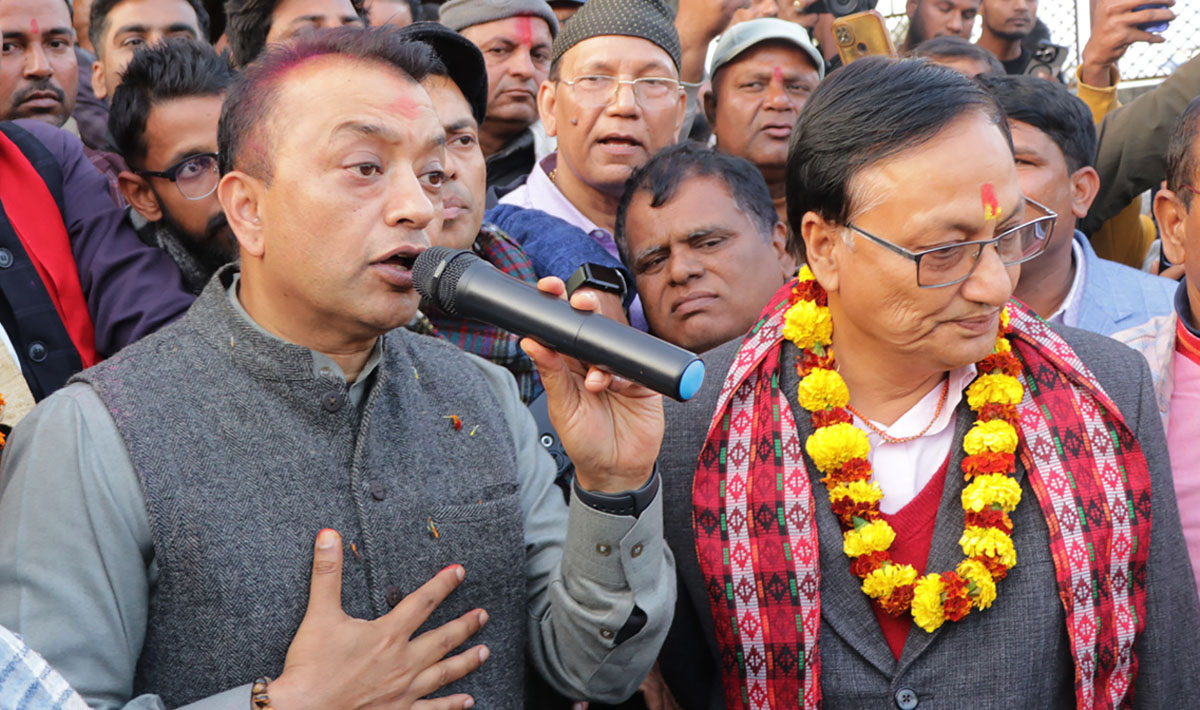
KATHMANDU: Nepali Congress President Gagan Kumar Thapa has said he is fully aware of the contribution Madhesh has made to Nepal, democracy, and the Nepali Congress.
Thapa, who registered his candidacy from Sarlahi–4 for the March 5 election, visited his new constituency for the first time on Monday. Speaking at a program in Sarlahi, he said he has repeatedly raised the question of why Madhesh has not received the dignity, respect, and equal status it deserves. This time, however, he said he has come not just to raise questions, but to seek answers by representing Madhesh.
“I have not come here merely to ask questions, but to find their answers,” Thapa said. “I am a Nepali Congress worker. I clearly understand the debt that Madhesh has given to the Congress, to democracy, and to the entire country. I know this through B.P. Koirala, and through the history of martyrs that Madhesh has produced.”
Thapa said the late leader Pradip Giri was the person he was closest to in recent years, describing him as a ‘walking embodiment of Madhesh.’ He added that his association with Giri inspired him to understand Madhesh more deeply.
“I understood the hills and life in Kathmandu,” he said, “but I realized that one cannot become fully Nepali without committing oneself to Madhesh and embracing it within oneself.”
Recalling his journey along the Postal Highway, Thapa said he became even more drawn to Madhesh and came to understand why, despite immense potential, young people are still forced to seek employment abroad.
Referring to education, he highlighted the contribution of teachers from Madhesh. “There was a time when mathematics and science classes in the hills and Kathmandu could not run without teachers from Madhesh,” he said. “In the next 10 to 15 years, information technology will become a major source of income for Nepal. For that, a strong foundation in mathematics and science is essential, and this is a crucial contribution Madhesh has made to the country.”
Thapa reaffirmed his commitment to translating issues of Madhesh’s development, dignity, and equality into practice.





Comment