




Nepal’s legal architecture on disability rights is progressive by different legal instruments. The constitution of Nepal (2015), the Rights of Persons with Disabilities Act, the Local Government Operation Act,2017, ratification of United Nations Convention on the Rights of Persons with Disabilities, Sustainable Development Goal’s roadmap, 16th Periodic Plan and other key policies and strategies collectively represent a robust normative foundation in Nepal.
But the lived reality is different. As per 2021 census, only 2.2 % population is recorded against the WHO global benchmark of 15% which indicates that persistent exclusion, tokenistic programming and budgeting. This indicates that governance system continues to treat disability inclusion as a welfare concern rather than a human rights perspective.
This article argues that Nepal requires not merely better implementation of existing policies but a fundamental shift in governance logic from charity and compliance toward outcome based, rights driven and intersectional disability inclusion.
Reframing the Problem: From Impairment to Barrier
The dominant misunderstanding in Nepal’s policy discourse is that disability inclusion is primarily a medical condition requiring remediation, which must be changed. Nepal is legally committed on social or human rights model via committed on UNCRPD which clearly says that it is not impairment alone but societal barriers that produce disability.
For example, a person using a wheelchair is not disabled by their mobility limitation rather they are disabled by a public transport system that excludes them, a public place without ramps or handrails or accessible toilets or lights.
Nepal’s SDG commitments are directly implicated. SDG 4.5 on eliminating education disparities, SDG 8.5 on productive employment, SDG 10.2 on political and social inclusion, SDG 11.2 on accessible transport, and SDG 16.7 on inclusive decision-making all have explicit disability dimensions.
As Rights of Persons with Disabilities act recognizes different categories of disabilities which are physical, visual, hearing, deaf-blind, speech & language, intellectual, psychosocial, autism spectrum, multiple, chronic health-related, and a four-tier severity classification system (profound/red, severe/blue, moderate/yellow, mild/white).
This functional or inclusive framework is conceptually sound, but the challenge is not in its design but in its systematic application where accurate screening or identification, timely ID card issuance with referral services, right level of programming and budgeting for systemic transformation, disability-disaggregated data with Washington group disability statistics, and context-sensitive service delivery at the local level remain deeply inadequate.
Equally, it seems underreporting crisis due to stigma, limited awareness among parents, weak early screening, gaps on data collection tools mean that only 2.2% of the population is reported as disability against a global benchmark of 15% which again shows that invisible population is underreported.
Every policy, program, and budget are based on this undercounted baseline is structurally insufficient. Targeted interventions to promote accurate reporting, integrate Washington Group Questions (WGQ) into all national and local data systems, and train enumerators in culturally sensitive disability screening and identification are therefore not administrative details but they are prerequisites for human rights and justice.
The Implementation Gap: Where Commitments Dissolve
As per the constitutional mandates, at least 5 % representation of persons with disabilities must be across all state mechanisms but looking at the recent 2026 election, there are five or 2% members of parliaments with disabilities at the federal level. Similar cases can be seen at provincial and local level too.
This is not a technical failure but a political one. Proportional representation list is the primary pathway of political inclusion as well as direct election candidacy, leadership roles within parties, etc. remains largely inaccessible.
The motto “Nothing About Us Without Us” comes often in Nepal’s development or policy discourse. It is rarely operationalized in practice.
Meaningful inclusion of ‘Organizations of Persons with Disabilities (OPDs)’ in government program design, budget consultations, and policy review processes could produce more effective interventions. State mechanisms should create structured, funded, and accountable spaces for this engagement rather than treating it as optional consultation.
The same logic applies across sectors. Healthcare facilities often lack sign language interpreters and personnel trained in deaf communication. Most schools lack adapted curricula designed for children with disabilities, trained teachers, assistive learning materials, and accessible infrastructure as needed.
Vocational training programs are often fragmented and rarely designed around the interests and competencies of persons with disabilities. Financial services and entrepreneurship pathways are functionally inaccessible in many cases. Disability inclusion related intervention are not isolated service gaps, but they are systemic failures of coordination, financing, and accountability from government side.
Intersectionality: Why One-Size-Fits-All Fails
Disability does not exist in isolation. For example, a woman from Dalit community with a psychosocial disability in a remote hill district faces compounding vulnerabilities, for example, poverty, geographic exclusion, gender discrimination, caste-based stigma that single-sector interventions cannot address.
A child with autism in a Madhesh community faces not only learning barriers but also acute family-level stigma and near-absent specialist services. An elderly person with acquired physical disability faces both ageism and exclusion from active rehabilitation services.
GEDSI-responsive (Gender Equality, Disability, and Social Inclusion) planning and budgeting must move beyond token inclusion of these categories and translate into concrete intersectional analysis before any program and budget design.
The risk of ignoring this is not only moral but it is economic. Misallocated resources, duplicated efforts across parallel systems with CSOs, and interventions that reach the already-visible rather than the most marginalized represent a waste of scarce public finance.
Data disaggregated by disability, gender, ethnicity, geography, and poverty level needs to be collected consistently and systematically by all three tiers of government which will be the foundation of efficient and equitable planning.
A Twin-Track Strategy: The Viable Framework
Twin track approach to disability inclusion where mainstreaming disability inclusion across all sectoral policies and programs as well as specific or targeted interventions address the needs of persons with disabilities.
For example, in education, several measures are essential to ensure disability inclusion. These include budgeting for accessible school infrastructure based on universal design principles, as well as incorporating disability-inclusive content in both pre-service and in-service teacher training. It is also important to maintain disability-disaggregated data in IEMIS and run community awareness programs to address harmful practices and stigma.
Additional priorities include providing resource classes with trained teachers and ensuring the availability of need-based assistive devices according to different types of disabilities. Schools should also promote the participation and leadership of children with disabilities in clubs and activities, along with initiatives to support their enrollment, retention, and life skills development.
Furthermore, systems for monitoring progress, tracking outcomes, and offering incentives for disability inclusion should be strengthened. Linking ECED centers with early screening, identification, referral services, and timely interventions is also crucial to support inclusive education.
In health and rehabilitation, budgeting for early screening integrated into maternal and child health services, immunization visits can prevent secondary complications and enable timely interventions. Nepal specific screening tools, trained enumerators or volunteers, home visit-based screening, functional referral pathways connecting to community-based rehabilitation, assistive technologies are necessary.
Likewise, Community-based rehabilitation as well as integrated health, education, livelihood, and social support are better to expand and adequately finance. Assistive devices, from hearing aids and wheelchairs to braille materials and other learning resources must shift from tokenistic provision to need-responsive, subsidized and freely available services at community level.
Likewise, budgeting for skills development or vocational training aligned with individual competencies and market demand, accessible financial services, and affirmative hiring policies with workplace accommodation requirements should be institutionalized from disability perspectives.
The social protection system, including disability allowances, requires both expansion of coverage to moderate and mild disability categories and a significant increase in allowance amounts to reflect the real cost of living with disability is necessary.
In governance, the 5% constitutional mandate must be enforced, tracked, and reported against at federal, provincial, and local levels. All state institutions including I/NGOs/CSOs should undergo disability inclusion audits before launching programs. Procurement and infrastructure standards must embed universal design. Official communication, government websites, and public service delivery must meet accessibility standards across disability types.
Financing Inclusion: From Aspiration to Allocation
Having progressive policies without adequate financing are just aspirations. Currently, disability inclusion agendas are characterized by this disconnection. Disability responsive dedicated budgeting or traceable resources across sectoral ministries and 3 tiers of government is not only a technical exercise but it is a political commitment too.
Disability inclusion is not a standalone sector or a welfare obligation. It is a cross-cutting governance priority, a human rights commitment, and a precondition for Nepal’s vision of Happy Nepal: Prosperous Nepal. The question is no longer whether Nepal has the frameworks. The question is whether it has the political will to fund them.
Nepal’s SDG commitments are directly implicated. SDG 4.5 on eliminating education disparities, SDG 8.5 on productive employment, SDG 10.2 on political and social inclusion, SDG 11.2 on accessible transport, and SDG 16.7 on inclusive decision-making all have explicit disability dimensions.
Nepal’s SDG status and roadmap provides baselines or endlines, and disability indicators that should anchor all planning and budgeting cycles. Development partners, CSOs, and OPDs can complement public financing but must do so in alignment with national systems not through parallel structures that weaken government accountability and create duplication.
Language, Attitude, and the Normative Foundation of Inclusion
Transformation requires removing attitudinal-physical-communication-digital barriers. The language in public and private spheres, documents, media should be right based or disability inclusive. Pity-based language, references to persons with disabilities as “suffering from” conditions or narratives that treat basic achievement as inspirational, are not merely poor style choices.
They are normatively damaging which they shape institutional culture, influence policy interpretation, and sustain the welfare model that progressive law has sought to replace.
All levels of government should develop and adopt disability-inclusive language guidelines, maintain these in accessible formats, including braille, sign language, and easy-read and model rights-based, person-first language across all official communications and service delivery. Rights-based language is normative and transformative, not cosmetic.
Conclusion
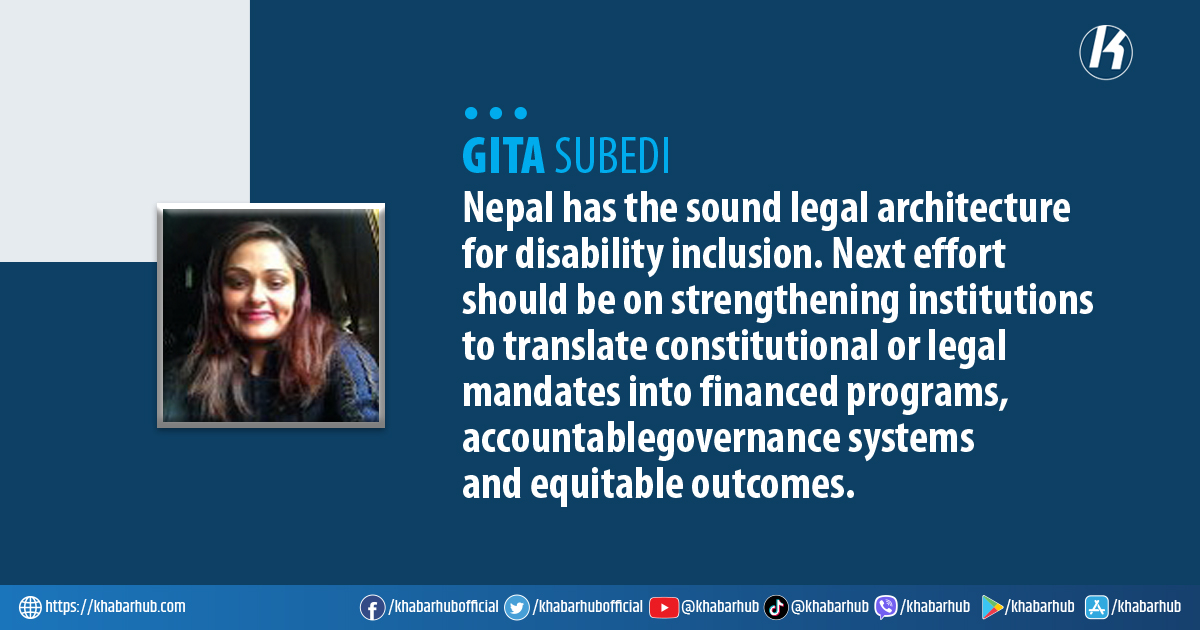
Nepal has the sound legal architecture for disability inclusion. Next effort should be on strengthening institutions to translate constitutional or legal mandates into financed programs, accountable governance systems and equitable outcomes.
Disability disaggregated data-based planning and budgeting from 3 tiers of governments, meaningful participation of persons with disabilities in designing-implementation-evaluating the systems that govern their lives, coordinated service delivery across different thematic ministries, resource leveraging from different development partners/CSOs and private sectors, empowerment and leadership of PWDS, positive narratives and modeling of PWDs leadership are necessary.
Disability inclusion is not a standalone sector or a welfare obligation. It is a cross-cutting governance priority, a human rights commitment, and a precondition for Nepal’s vision of Happy Nepal: Prosperous Nepal. The question is no longer whether Nepal has the frameworks. The question is whether it has the political will to fund them.
(The author writes on inclusive education, GESI, and disability rights in Nepal)



Comment