




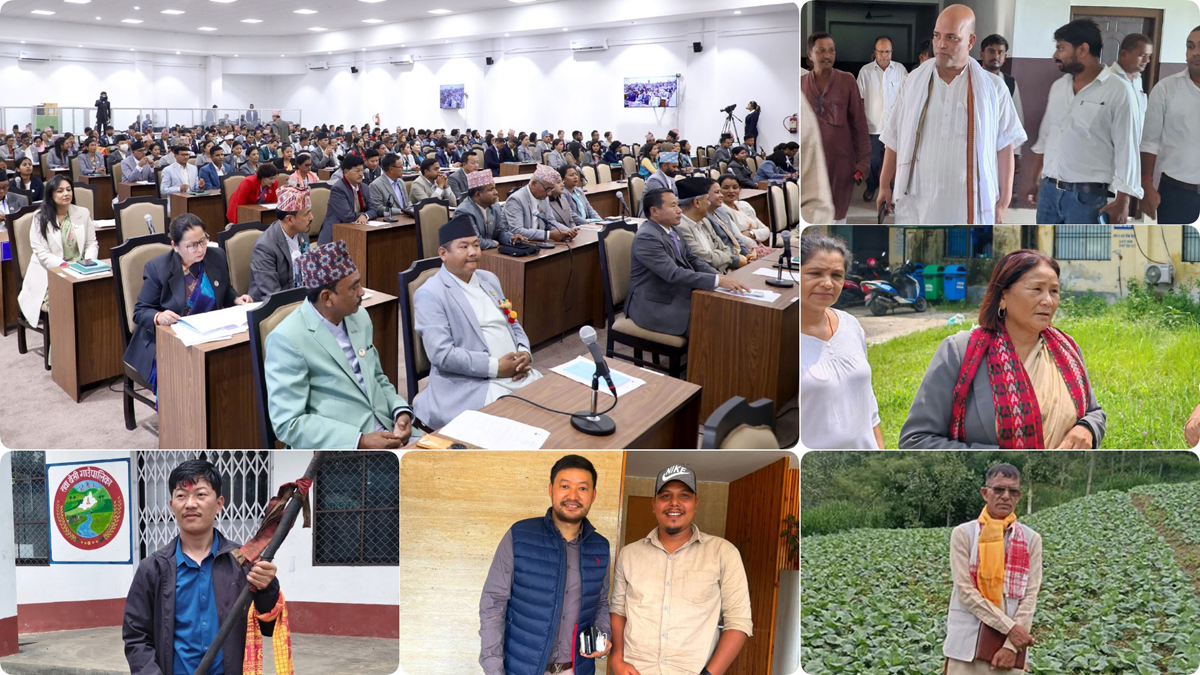
KATHMANDU: As Parliament remains on a two-week recess, Members of Parliament (MPs) have fanned out across the country to gather public grievances. But the timing of the visits has drawn criticism from the opposition, which argues that the monsoon planting season leaves little opportunity for meaningful public consultations.
On July 15, Speaker of the House of Representatives (HoR) Dol Prasad Aryal (DP) adjourned the House until July 30, urging lawmakers to visit their constituencies to understand the people’s grievances and local problems.
The House was adjourned due to the lack of parliamentary business, giving MPs time to engage directly with their constituents.
MP Shambhu Suskera, elected from Jhapa-4, said he had reached his constituency in line with the Speaker’s directive to hear the concerns of local residents.
Similarly, Rubina Acharya, MP from Morang-4, is currently visiting villages in her constituency. “The country continues to face floods and landslides, and this is also the peak season for paddy plantation,” Acharya said. “As promised to the people, we have gone to the villages to discuss their problems and bring those issues to the House.”
According to Acharya, voters have responded enthusiastically to the visits. “People are eager to share their concerns when we arrive,” she said. “We are documenting their complaints in writing and will continue putting pressure on the government to address them.”
Thapa said farmers continue to face shortages of fertilizer and seeds. “When I visited the constituency, most people were working in their fields. They are struggling with a lack of fertilizer and seeds. We did not even have enough time to speak with many of them,” she said.
MP Indira Rana Magar, elected from Jhapa-2, said she is also monitoring public offices and institutions across her constituency.
“We believe the government should prioritize good governance and effective public service delivery,” she said. “We are closely monitoring issues related to development, education, healthcare, food security, and other public concerns. These issues will be raised in Parliament and through meetings with government officials.”
Rana added that she is working to maintain direct contact with constituents in accordance with Speaker Aryal’s appeal, her party’s decisions, and her own commitments.
“Although it is not possible to visit every household, we are reaching as many villages as possible to discuss local problems, the commitments we made during the election, and the government’s priorities,” she said. “Because it is the monsoon season, some areas remain difficult to access. Many people have also submitted their concerns in writing.”
Following the adjournment of the House, Speaker Aryal encouraged MPs to spend the break in their constituencies, saying that listening to the people’s voices is one of the most important aspects of representative democracy.
“The voices collected by MPs will reach Parliament and become the basis for holding the government accountable,” Aryal said. “The strength of representative democracy lies in ensuring that people’s problems reach Parliament and that Parliament, in turn, demands solutions from the government.”
However, the opposition has questioned the practicality of sending MPs to their constituencies during the monsoon, arguing that many people are occupied with paddy plantation and other agricultural work, making meaningful public consultations difficult.
Meanwhile, Sulabh Kharel, MP from Rupandehi, said people in his constituency have high expectations of the government.
“People are very hopeful,” Kharel said. “Especially after the formation of the National Independent Party-led government, there is growing confidence that good governance and transparency will be strengthened. People believe our government has no room for failure and expect us to deliver results.”
According to Kharel, people are not only expressing their expectations from the government but also offering constructive feedback. “They have shared many local concerns,” he said. “They have suggested ways for the government to move forward and have also pointed out where they believe it is going wrong.”
Dr. Amaresh Kumar Singh, MP from Sarlahi-4, said people continue to have hope in the Balen-led government. He added that he has been regularly visiting his constituency even before Speaker Dol Prasad Aryal urged lawmakers to do so.
“I have always raised the issues of my constituency and the entire Madhesh in Parliament. We do not need the Speaker to allocate time for us to visit our constituencies,” Singh said. “Others should also learn from this. It is far better to spend time in the constituency listening to the people’s problems than wasting time elsewhere.”
Rastriya Swatantra Party (RSP) MPs KP Khanal, Ganesh Parajuli, Ranju Darshana, Jagadish Kharel, Madhusudan Chamlagain and Rahbar Ansari, among others, are also actively visiting their constituencies during the parliamentary recess.
Most ruling coalition MPs say they have been welcomed enthusiastically by constituents, who have expressed optimism about the government’s performance. Opposition lawmakers, however, paint a different picture, saying they have not witnessed the same level of public enthusiasm.
Opposition parties have also criticized the government’s decision to adjourn Parliament, arguing that both the government and the Prime Minister have failed to remain accountable to the House. They say there was no justification for suspending parliamentary proceedings and have consistently opposed the decision.
Opposition questions timing of constituency visits
While ruling MPs say their constituency visits have been productive, opposition lawmakers argue that the monsoon season is the worst time for public outreach. They contend that MPs routinely visit their constituencies even while Parliament is in session, making the adjournment unnecessary.
According to the opposition, meaningful consultations are difficult during the rainy season, when floods and landslides disrupt travel and most farmers are occupied with paddy plantation, leaving few people at home.
Nepali Congress Chief Whip Basana Thapa, elected from Dailekh, said that although she has reached her constituency, most voters remain busy in the fields.
“As a result, I have not been able to meet as many people as I had hoped,” Thapa said. “Those I have met have had little time to discuss their concerns because they are occupied with farming and dealing with the impacts of the monsoon.”
Some CPN-UML lawmakers have yet to visit their constituencies. While some have already returned after completing their visits, others are still preparing to leave.
“I have already visited my constituency and will return again. I am in Kathmandu now for party work. But this is not the right time to conduct constituency visits,” she said. “Parliament should have been in session to raise the people’s issues. There are floods and landslides, and farmers are busy with paddy plantation. Many urgent needs remain unmet. Those issues should have been raised in the House. Instead, the government used the parliamentary recess as an excuse.”
Thapa said farmers continue to face shortages of fertilizer and seeds. “When I visited the constituency, most people were working in their fields. They are struggling with a lack of fertilizer and seeds. We did not even have enough time to speak with many of them,” she said.
“The House should have been in session by now, but the Speaker adjourned it. This is the season of floods and landslides, and the government does not appear to be adequately preparing for disasters. This is precisely the time when we should be raising the people’s concerns in Parliament.”
Some CPN-UML lawmakers have yet to visit their constituencies. While some have already returned after completing their visits, others are still preparing to leave.
Kshitij Thebe, MP from Taplejung, said his visit had been delayed due to recent changes in the provincial government. Although he plans to travel to Taplejung in the coming days, he also believes Parliament should be in session.
“We regularly visit our constituencies, but this is not the right time to listen to people’s concerns,” Thebe said. “People are rarely at home because they are working in the fields. In the hills, constituents tell us not to disturb them during the planting season. The government has simply made an excuse. The Speaker also made it appear as though sending MPs to the constituencies was a substitute for Parliament by telling us to ‘go to the villages and bring back the people’s problems.'”
Thebe added that road conditions in his constituency have worsened during the monsoon.
“Many roads connecting the eastern region have deteriorated, and some areas are facing food shortages. This is exactly the time when Parliament should have been functioning instead of being adjourned,” he said.
“Parliament was adjourned because key bills were stalled in committees, and the Speaker used constituency visits as a justification.”
According to Thebe, one of the biggest concerns in Taplejung is the increasing threat posed by wild animals.
“Because Taplejung is a hilly district, attacks by monkeys and other wild animals have become a serious problem,” he said. “People repeatedly tell us that although they manage to grow crops, monkeys often destroy or consume them before harvest. They complain that the government has failed to address the issue.”
Meanwhile, Nepal Communist Party MP Balawati Sharma said the current period is unsuitable for constituency outreach. Sharma, who recently returned from Baglung-1, claimed that people there are not particularly enthusiastic about the current government.
“Despite having a two-thirds majority, the government has delivered little progress,” Sharma said. “It promised good governance, but people say farmers continue to face the same old problems. This is not the right time to visit villages because of floods, landslides and the paddy planting season. Parliament was adjourned because key bills were stalled in committees, and the Speaker used constituency visits as a justification.”
Sharma argued that both the Speaker and the government were making excuses.
“It is simply an excuse,” she said. “People are in their fields during the planting season while floods and landslides continue to affect many areas. How can MPs hold meaningful discussions under such circumstances? Lawmakers from the hill districts are also hearing repeated complaints about the growing threat of wild animals.”
Meanwhile, Shram Sanskriti Party leader Aren Rai said people in Khotang are disappointed with the government’s performance. He said farmers are increasingly unable to protect their crops from wild animals, particularly monkeys and badgers.
“The problem of wild animals, especially monkeys and badgers, has become severe. Farmers are unable to harvest their crops,” Rai said. “People complain that the government has failed to take effective measures to control the problem. There are also issues related to roads, education and healthcare, but the biggest concern in our district is the menace of monkeys. People want this issue to be raised in Parliament and a lasting solution found.”
Rai said he visited three rural municipalities despite the ongoing floods and landslides.
“Everywhere I went, the biggest complaint was the monkey problem,” he said. “People kept asking, ‘Is there a government at all?'”
Although Prime Minister Balendra Shah has said the government is preparing a legal framework to address the growing monkey menace, Rai noted that no progress on the initiative has been made public.
Lawmakers say farmers in several districts, including Darchula, Baitadi, Achham, parts of Karnali Province and the hilly districts of Gandaki Province, are facing similar problems caused by wild animals, particularly monkeys. MPs from those areas have urged the government to introduce a scientific and long-term strategy to manage the growing human-wildlife conflict.





Comment