




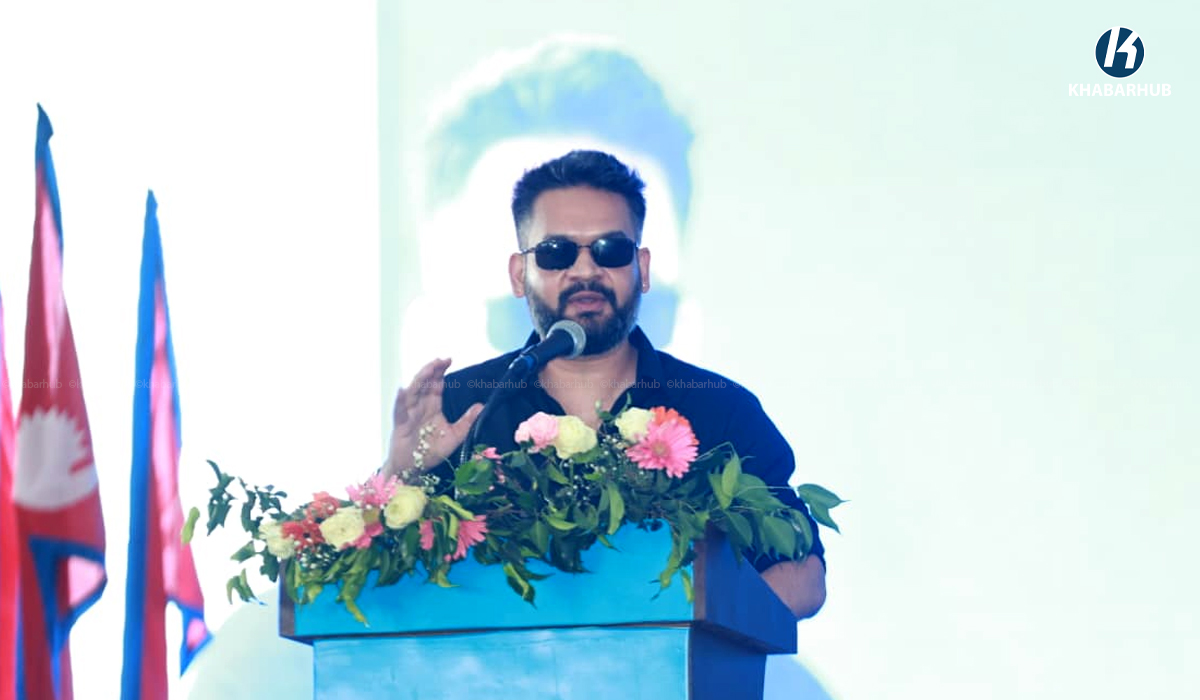
KATHMANDU: Four months after securing a sweeping electoral mandate, Prime Minister Balendra Shah (Balen) stepped onto the national stage with a message that was equal parts warning, promise, and political manifesto.
In his first major public address since taking office following the March 5 elections and the Gen-Z protests, Prime Minister Balen used the Rastriya Swatantra Party’s (RSP) inaugural general convention in Chitwan on Sunday to lay out his government’s priorities, defend its direction, and signal how it intends to reshape Nepal’s political landscape.
The speech marked Balen’s first major public address since forming a government after securing a strong majority.
As political rivals continue to question the RSP’s ideological identity, Balen described his party as a “development-oriented” force. He also reiterated Nepal’s claim over Lipulekh and Kalapani, sending a clear message to both India and China regarding Nepal’s territorial position.
He stressed that his government would continue advancing toward its goals without unnecessary interruptions. “The government is like a vehicle. It has both an accelerator and a brake,” he said. “But our vehicle is not travelling on local roads—it is moving on an expressway. It will apply the brakes only when it reaches its destination.”
His remarks conveyed confidence that the government is moving in the right direction and will not be deterred by political obstacles or external pressure.
Likewise, PM Balen argued that the political transformation that brought the RSP to power is not temporary.
“The people and their votes are like the wind—it may blow in different directions,” he said. “But we did not ride the wind; we changed the course of the river.”
He suggested that public support for the RSP represents a deeper shift in Nepali politics rather than a short-term electoral trend. According to him, once a river returns to its natural course, it continues to flow in the same direction.
Balen also said the party would not rely on the same campaign promises in future elections.
“We entered politics with an agenda of good governance. We promised to address issues such as squatters and cooperative fraud, and we will resolve them during this term,” he said. “We will not go to the next election with the same agenda. We will present a new one.”
Similarly, Prime Minister Balen stated that his government would not engage in political retaliation but would take action against those involved in wrongdoing.
“Our party is focused on moving forward. We are not interested in settling old political scores,” he said. “However, if public property has been misused or government funds have been abused, those matters must be investigated.”
His comments signalled that corruption and financial misconduct would face scrutiny regardless of when they occurred.
Since its formation, the RSP has faced questions about its political ideology and whether it belongs to the left, right, or centre of the political spectrum.
Addressing the issue, Balen downplayed ideological debates. “You do not need to worry too much about whether our party is left, right, or centre,” he said. “We are a development-oriented party. We are a party of action and progress.”
His remarks reflected the party’s effort to position itself as pragmatic and results-driven rather than defined by traditional ideological categories.
Likewise, Prime Minister Shah reiterated that his government would take a firm stance against corruption while operating within legal and institutional frameworks.
He said the government would engage with constitutional bodies and regulatory agencies according to established procedures but would not hesitate to investigate irregularities.
While rejecting the politics of revenge, he indicated that past cases involving financial misconduct, misuse of public resources, or abuse of authority would be examined, signalling a willingness to reopen unresolved corruption files.
Prime Minister Balen also addressed the possibility of factionalism within the RSP, warning party members against forming internal groups.
He argued that successful politicians should earn the trust and support of the public rather than build power bases within the party.
“Do not plant the seeds of factionalism today,” he warned. “Tomorrow those seeds will grow into trees that will be difficult to uproot.”
His message underscored the importance of party unity as the RSP transitions from an opposition force to a governing party.
Meanwhile, speaking on Nepal’s border dispute, Prime Minister Balen reaffirmed Nepal’s claim over Lipulekh and Kalapani, stating that historical evidence supports Nepal’s position.
He argued that documentary evidence related to the border exists in British records and should be examined.
At the same time, he emphasized that Nepal does not seek third-party mediation. Instead, he said the government would engage directly with neighbouring countries and pursue a resolution through bilateral dialogue.
Balen stressed that the government would handle the issue through legal and diplomatic channels, ensuring that all actions remain consistent with national and international law.





Comment