




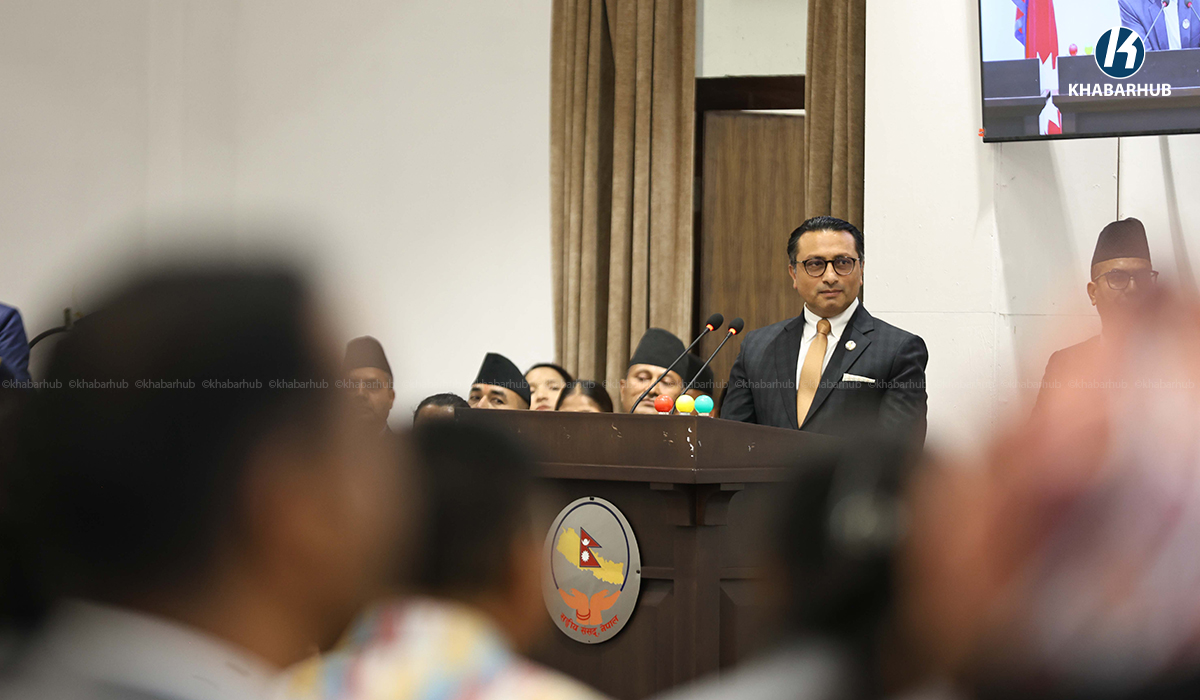
KATHMANDU: As the government prepares the upcoming fiscal year’s budget, the private sector has urged authorities to introduce a transformative budget aimed at structural reforms of the national economy.
Business leaders say the country needs not just incremental changes but a fundamental shift in its current economic model, and have expressed readiness to support the government in implementing such reforms.
The private sector has also noted that both the government and the private sector are entering a phase of renewed leadership and policy thinking, raising expectations for a more reform-oriented economic direction.
The federal parliament has already endorsed the principles and priorities of the Appropriation Bill, and the government is scheduled to present the national budget for fiscal year 2026/27 on May 29 in a joint sitting of both houses of parliament, as required by the Constitution.
During consultations, the Nepal Chamber of Commerce and Industry submitted a set of policy suggestions to Finance Minister Swarnim Wagle, emphasizing that the upcoming budget should go beyond being a routine annual document and instead mark a turning point in Nepal’s economic history.
The Chamber said the budget should focus on reshaping the country’s economic structure rather than maintaining the existing import- and remittance-dependent model.
Finance Minister Wagle has said citizens now expect results rather than speeches, adding that the government is prioritizing legal reforms, institutional accountability, time-bound implementation, digital tracking, real-time monitoring, and performance measurement.
He has also stated that the government is attempting to move forward through a “mission-based” approach to economic management.
Private sector representatives have called for measures to revive declining business morale, stimulate market demand, attract stalled investment, and create employment opportunities through policy reforms.
According to newly elected Chamber of Commerce President Anjan Shrestha, the recently announced “6 pillars, 60 initiatives” national framework complements the government’s policy direction.
Business leaders say Nepal’s economy remains heavily dependent on remittances and imports, limiting long-term structural growth.
Data shows that remittance inflows reached around Rs 1.659 trillion during the first nine months of the current fiscal year, with most of it being used for consumption rather than productive investment.
The Chamber noted that despite excess liquidity in the banking sector, credit expansion and investment growth remain weak, while industrial expansion has stalled.
It also criticized frequent changes in tax policy, arguing that instability has weakened investor confidence. The private sector has called for a unified revenue code and the establishment of a more empowered revenue board.
The Chamber warned that Nepal’s industrial production capacity remains limited to around 40 percent, while the construction sector is in one of its most difficult phases in recent years.
It also noted a sharp decline in private sector contribution to gross capital formation, which has dropped from 28 percent to 16 percent over the past four years.
Business leaders further warned that recent geopolitical tensions in the Middle East could negatively impact Nepal’s remittance inflows and overall economy by around 1.8 percent.
They also cautioned that Nepal’s graduation from the least developed country (LDC) category could result in the loss of preferential market access, increasing costs for exports.
To address these challenges, the Chamber has called for a long-term integrated policy for export-oriented industries such as garments, carpets, woolen products, felt, and pashmina.
It has also urged legal provisions allowing Nepali companies to invest abroad using earnings from exports, along with stricter control over cross-border smuggling and unfair import practices under regional trade arrangements.
The private sector has also demanded special programs to revive sick industries and promote investment through public-private partnership (PPP) and build-operate-transfer (BOT) models, especially in energy, transmission, hydropower storage, and industrial infrastructure.
Focus areas proposed for budget priorities include agriculture, tourism, herbs, tea, coffee, information technology, and services exports, with the goal of shifting Nepal from a consumption-based economy to a production and export-driven model.
The Confederation of Nepalese Industry (CNI) has also submitted consolidated budget suggestions covering sectors such as investment, taxation, customs, tourism, agriculture, energy, ICT, banking, insurance, capital markets, infrastructure, education, and anti-money laundering measures.
CNI President Birendra Raj Pandey said the private sector has recommended policies that promote income generation and wealth creation.
He added that improved investment conditions and policy stability would significantly contribute to employment generation and overall economic growth.
CNI has also urged the government to allow flexibility in land use for approved industrial projects and to ensure at least 10 years of policy stability for key industries.
It further recommended prioritizing domestic production, import substitution, and employment creation as central pillars of the upcoming budget.





Comment