




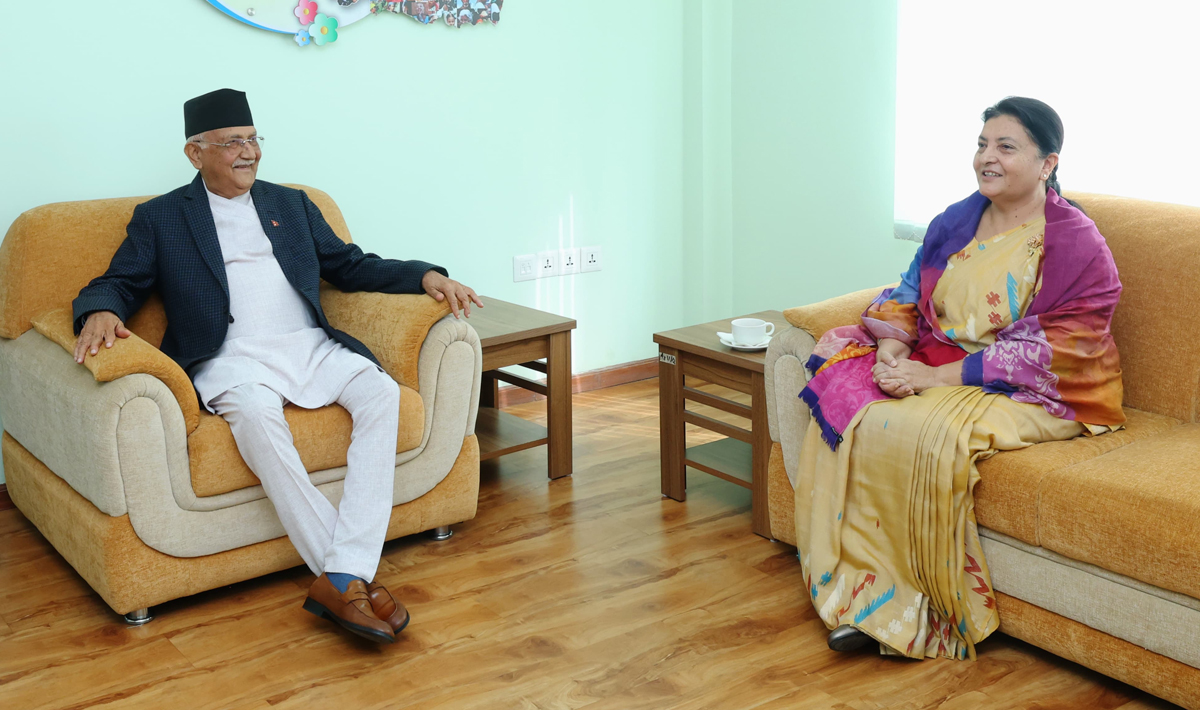
KATHMANDU: The renewal of former President Bidya Devi Bhandari’s membership in the CPN-UML after nearly two years has reignited debate over the party’s future leadership and internal power balance.
The decision, announced during Monday’s Secretariat meeting by party Chairman KP Sharma Oli himself, has fueled speculation that Bhandari may be preparing for a more active and influential role within the party.
As discussions intensify over whether she could eventually challenge Oli’s dominance or even lead the UML, the development has exposed shifting alliances and growing tensions within the party’s top leadership.
Following the decision, discussions have intensified within UML circles about the possibility of Bhandari assuming party leadership in the future. Some leaders have argued that her leadership could help unify the communist movement and strengthen the party’s organizational direction.
Supporters also claim that Bhandari is more consensus-oriented than Oli and possesses the ability to guide the party according to its ideological principles.
However, leaders close to Oli maintain that Bhandari’s rise could deepen internal divisions within the party. They also reject claims that the renewal of her membership automatically signals a path to the party leadership. So far, neither side has disclosed the details of any understanding reached between Oli and Bhandari that led to the membership renewal.
UML central committee member and former law minister Padam Giri said the party now needs organizational restructuring through generational transformation and political renewal.
Leaders from Oli’s secretariat have downplayed speculation surrounding the development. “Her membership has been renewed, but there is no need for unnecessary speculation,” a source said. “The question of a former president taking over party leadership does not arise immediately. The party will move forward by utilizing her experience, knowledge, and capabilities.”
Bhandari completed her second term as president on Falgun 28, 2079 BS, ending a nine-year tenure. After leaving office, she spent nearly a year traveling across the country to assess her political standing and public support before deciding to return to active politics.
Oli himself had previously proposed Bhandari, then the party’s vice-chairperson, for the presidency. However, after her presidential term ended and she sought to re-enter active politics, Oli reportedly became reluctant to renew her party membership, fearing she could emerge as a stronger political figure within the UML.
Critics within the party questioned Oli’s decision to delay the renewal, arguing that it reflected concerns over Bhandari’s growing influence. Oli, often viewed as resistant to internal challenges, reportedly attempted to keep Bhandari sidelined for nearly two years. However, after the UML suffered a disappointing defeat in the Falgun 21 election, relations between the two leaders appeared to improve.
Last week, Oli and Bhandari met at Tribhuvan University Teaching Hospital in Maharajgunj, where they reportedly held discussions for more than two hours. According to sources close to Bhandari, the issue of renewing her party membership was one of the key topics discussed during the meeting.
“Naturally, the issue of membership renewal came up during the discussion,” a source close to Bhandari said. “No conclusion was reached immediately, but afterward the chairman became more positive. Beyond the membership issue, no other agreements have been made public.”
Who holds greater influence?
Vice Chairman Bishnu Prasad Poudel and UML General Secretary Shankar Pokharel, both of whom had earlier supported Oli’s position against renewing Bhandari’s membership, are now increasingly seen as closer to Bhandari.
The two leaders reportedly played a key role in inviting Bhandari as the chief guest at a memorial program held in Madannagar on Sunday in honor of Madan Bhandari and Jivraj Ashrit.
Bhandari attended the event as chief guest, while Oli was absent due to health reasons. Sources indicate that efforts are now underway within the UML Secretariat to rally more leaders behind Bhandari and gradually bring her to the forefront of party politics.
Despite the growing political speculation, neither Oli’s nor Bhandari’s secretariat has clarified the exact terms or political understanding that led to the renewal of her party membership.
Oli’s recent signals suggest that he is not immediately willing to hand over the party leadership to Bhandari. However, with growing calls from the UML’s second- and third-generation leaders for leadership change and party unity, Oli’s room to maneuver appears increasingly limited.
Following the renewal of Bhandari’s party membership, discussions have intensified within political circles that she could eventually lead not only the UML but also efforts toward broader communist unity. Yet, many younger leaders within the party insist that serious internal discussion is still needed before deciding whether Bhandari represents the party’s future direction.
“A serious discussion has yet to take place on whether the former president is the right option at this stage. Her membership has only just been renewed,” said a member of the party Secretariat.
“There is no need to become overly emotional. There are also strong voices advocating for third-generation leadership. The party will review the election results and make decisions accordingly. If the national political environment ultimately demands that Bhandari lead the UML and the wider communist movement, we know she is prepared.”
Will Bhandari’s return benefit or weaken Oli?
Some critics argue that the renewal of Bidya Bhandari’s membership and her return to active politics could weaken Chairman KP Sharma Oli’s authority within the UML. However, political analysts say it is still too early to draw firm conclusions.
Political analyst Shyam Shrestha said Bhandari’s return should not be viewed in simplistic terms, adding that the real implications will only become clear once details of the agreement behind the membership renewal emerge publicly.
Meanwhile, leaders close to Oli claim that Bhandari’s return could actually strengthen the UML politically if leadership transition is handled through a special general convention. “Her membership has been renewed. If party leaders elect her through a special convention, not only UML but the broader communist movement could also move toward unity,” said a leader close to Oli.
While leaders close to Oli argue that introducing arrangements outside the existing constitutional framework would be inappropriate, the UML constitution itself contains provisions for convening a special general convention under certain conditions.
“The UML will eventually select new leadership through a special general convention. That leader could be Bidya Bhandari or someone she endorses.”
Oli fears an internal power shift
As discussions surrounding the possibility of a special general convention gain momentum within the UML, leaders close to Bhandari say no final decision has been made about whether she herself will seek leadership or support another candidate. At the same time, some leaders aligned with Oli have started arguing that the party should now move according to the aspirations of younger generations, especially if Oli eventually steps aside from leadership.
“Leadership must reflect the aspirations of the people”
UML central committee member and former law minister Padam Giri said the party now needs organizational restructuring through generational transformation and political renewal.
“In the current context, the party should move forward according to the aspirations of ordinary party workers and the public,” Giri said. “People now want generational transfer and a revival of the party.
Senior leaders, including the former president, should remain as guiding figures. Media speculation alone should not dominate internal party debates. There must be serious discussions about the party’s future direction.”
Former UML central committee member and youth leader Usha Kiran Timilsina also stressed the importance of generational change, arguing that the UML cannot regain momentum without leadership transformation.
“There is no need for excessive debate about whether the former president should lead the UML,” she said. “The UML already understands the risks of failing to prioritize generational transition. Since the party has only recently exited government power, I do not think Bhandari’s membership renewal should automatically be interpreted as preparation for her leadership.”
She added that even if Bhandari becomes involved in future leadership discussions, the UML must first assess the expectations of the public, party members, and changing political realities.
“Even if she returns, the party should hold a special general convention and seriously examine the current public mood, social psychology, and pressures both inside and outside the party,” Timilsina said.
“Bhandari may play a role in encouraging debate on leadership transition, generational change, and party transformation. But it is still too early to say whether she herself will lead the party. Even if she does, I do not think it would necessarily generate widespread public enthusiasm.”
At the same time, a growing section of younger leaders within the UML continues to push for an entirely new generation of leadership rather than the return of established senior figures.
Former lawmaker and former president of the All Nepal National Independent Students Union (ANNISU), Nabina Lama, has also argued that it is premature to speculate about Bidya Bhandari taking over the party leadership. According to Lama, the UML currently needs leadership that can genuinely understand the aspirations of ordinary party workers and the broader public.
While leaders close to Oli argue that introducing arrangements outside the existing constitutional framework would be inappropriate, the UML constitution itself contains provisions for convening a special general convention under certain conditions.
Article 63 of the UML Constitution 2079 states that a special general convention must be organized within six months if at least two-thirds of district committees or a majority of national general convention representatives submit a written demand.
According to a senior UML source, some leaders are preparing to move forward using this constitutional provision as the basis for possible leadership restructuring. However, party leaders remain reluctant to clearly answer whether Bidya Bhandari could ultimately assume leadership through such a convention.
At the same time, a growing section of younger leaders within the UML continues to push for an entirely new generation of leadership rather than the return of established senior figures.





Comment