




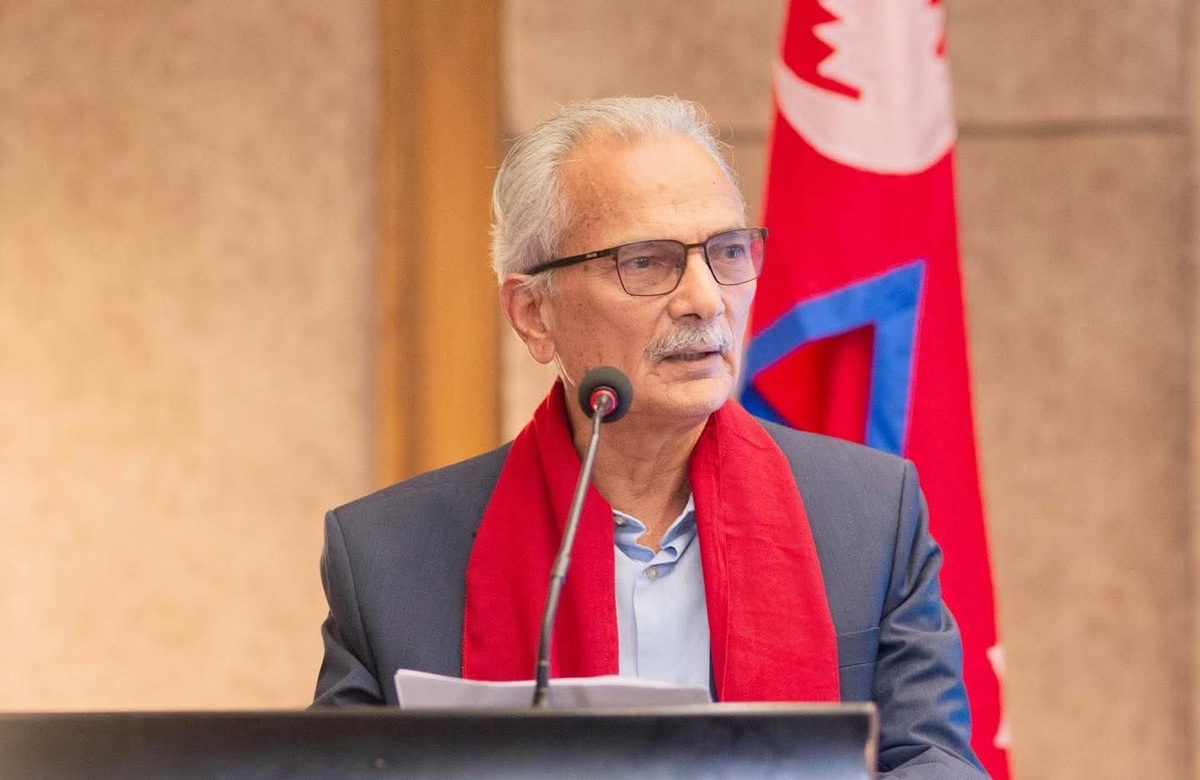
KATHMANDU: Former Prime Minister and President of the then Constitutional Assembly (CA) Constitutional Committee, Dr Baburam Bhattarai, has said the promulgation of the Constitution by the CA on September 19, 2015 is a significant accomplishment of Nepal’s democratic history.
Talking to RSS on the occasion of the Constitution Day today, the former Prime Minister said the Constitution was promulgated following a long political struggle, the people’s movements and other various movements. The Constitution has institutionalised federal democratic republic, secularism, federalism and inclusive democracy.
However, the leader admitted that despite the completion of one decade since the Constitution was promulgated, many expected achievements have remained unmet as of date. ” This is the not the fault of the Constitution, but weaknesses in its implementation including a delay in enactment of laws, limited capacity of political leadership, weak governance and the obstacles in socio-economic transformation.
He pressed the need to prioritise economic development, employment, production and prosperity as the major agenda of the nation.
According to Dr Bhattarai, republic, federalism, secularism and inclusive democracy are the foundations of the Constitution, any attempts capable of weakening these features are unexpected.
Differing views in regard with the consensus are obvious when the society characterised by diverse opinions and ideologies, he said, adding that amidst such differences, the major accomplishment of the Constitution be protected.
In view of Dr Bhattarai who represented the Gorkha-1 in the 2013 Constituent Assembly (CA) that had promulgated the 2015 Constitution, he said the provision of inclusion in the Constitution has yield positive change improving the representation of women including those from the Dalit community in the leadership. “It has contributed to further strengthening of the practice of inclusion,” he concluded.
He believes that proper allocations of rights and management of resources among the three-tier governments and an increased participation of the people is necessary to further enable the federalism.
Acknowledging some incompleteness in the Constitution, Dr Bhattarai highlighted the need for reforms in provisions concerning a mixed electoral system, demarcation and naming of federal units, restructuring of judiciary and appointments in constitutional bodies.
The mixed electoral system is likely to cause political instability, he said, arguing that it would be better to switch to a directly elected Presidential system and a fully proportional parliamentary system to avoid such potential instability.
He called for making the judiciary and constitutional bodies more independent, participatory, and powerful.
Regarding constitutional amendment, he stressed the need to prioritise national consensus, conscience and the protection of democratic accomplishments while proceeding with constitutional amendments.
He said that amending the Constitution does not mean demolishing the foundation of a house; rather it means strengthening and beautifying the houses thorough additional works and necessary improvements. “An amendment that weakens the foundation of the Constitution will threaten its major achievements. Therefore, it should not be undertaken haphazardly”, he stressed.
At the end, he said that the promulgation of the Constitution by the Constituent Assembly is an epoch-making event in Nepal’s history. He urged the younger generations to contribute to promoting good governance, economic prosperity, social justice and democratic values by safeguarding the Constitution.
He also said that Asoj 3 (the third day of Asoj in the Nepali calendar) should continue to be observed as a National festival, commemorating the promulgation of the historic constitution given by the Constituent Assembly.






Comment