




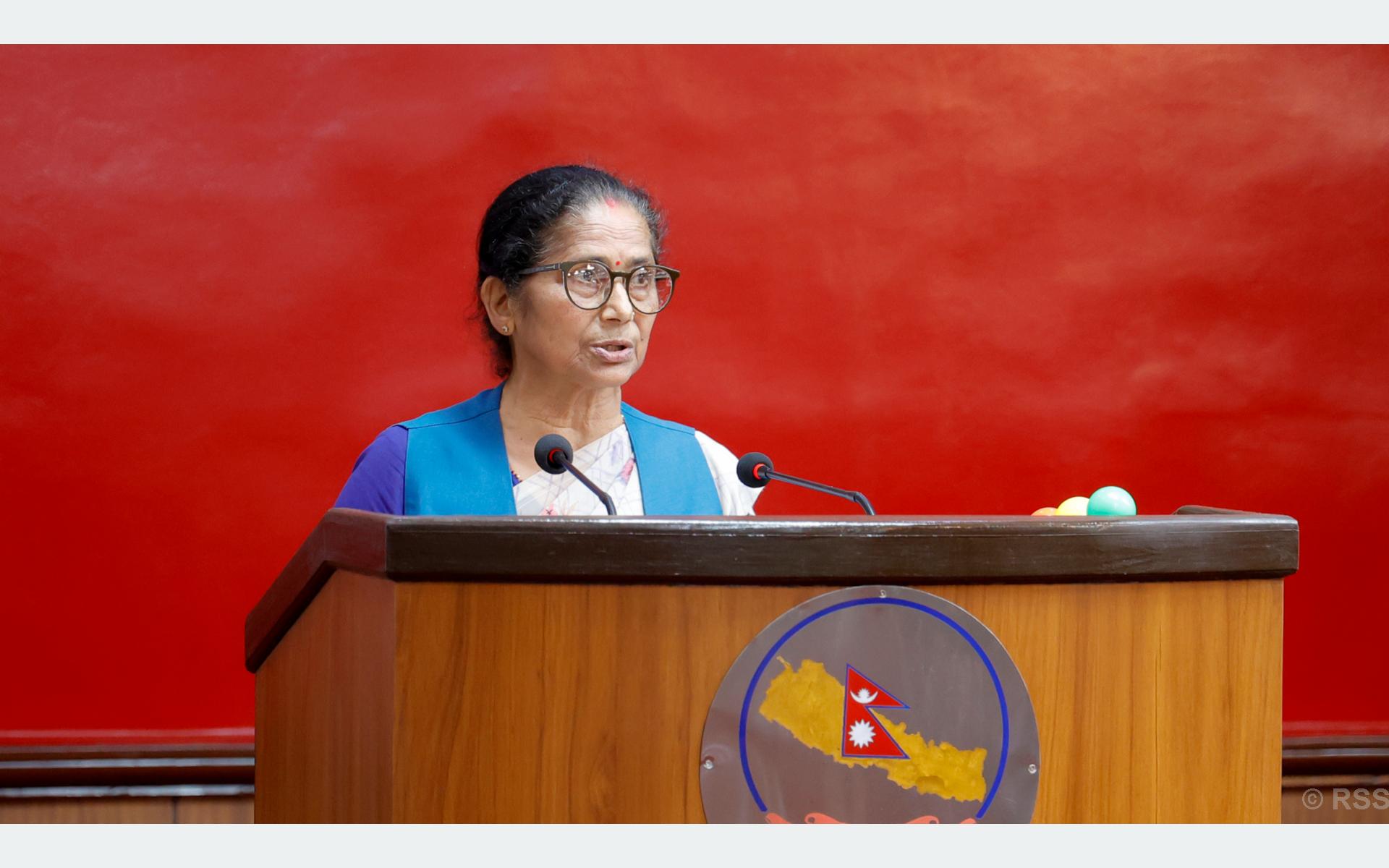
KATHMANDU: Nepali Congress (NC) lawmaker Kamala Panta has stressed the need to strengthen disaster preparedness and early warning systems to reduce the growing risks posed by climate change to mountains, glaciers, glacial lakes, river systems and human settlements.
Speaking at today’s meeting of the National Assembly, she said the mountains are not only a source of Nepal’s natural beauty but also a major source of water. She warned that changes in glaciers and glacial lakes could directly affect agriculture, drinking water, hydropower, biodiversity and the lives of people living downstream.
“When glaciers and glacial lakes change, the risks of floods and landslides also change. The risks to hydropower projects, roads and bridges increase. Agriculture and drinking water systems are affected, and ultimately the impact reaches human settlements,” she said.
Panta said climate change should not be viewed solely as a matter for the Ministry of Environment, but should be addressed through coordination among the finance, energy, agriculture, tourism, infrastructure and local government sectors.
She also stressed that women, children, senior citizens and persons with disabilities are particularly vulnerable during disasters and that their safety should be prioritized.
She emphasized the need to develop a culture of identifying potential risks and preparing for disasters in advance rather than relying primarily on rescue and relief efforts after disasters occur.
“Nepal should not wait to rescue people after disasters occur; it should prepare beforehand. The state should implement the recommendations provided by experts,” she said.
Noting that the Department of Hydrology and Meteorology works in the areas of rivers, meteorology, hydrology and early warning systems, Panta said the department’s capacity should be strengthened and early warning information should be delivered to at-risk communities through local governments.
She also called for the effective use of local media, including radio, to reach people who do not have access to mobile phones or smartphones. The government, she said, should pay particular attention to how far in advance at-risk communities can receive warnings in the event of a glacial lake outburst or a sudden rise in river levels.
Panta stressed the need to map the risks faced by schools, health institutions and settlements located along potential flood paths and to establish clear criteria for settlement in vulnerable areas. She also called for climate risk assessments and adaptation measures to be incorporated into the planning and construction of roads, bridges and hydropower projects.
“If there is loss of human life, it cannot be reversed. Therefore, the first priority of preparedness must be to prevent loss of life,” she said.
Panta urged the government to establish a research and monitoring centre on Himalayan climate and glaciers in the Gandaki region. She said an integrated assessment of climate and disaster risks should be carried out across the Himalayan districts and that information should not remain confined to Singha Durbar or provincial capitals, but should reach at-risk communities through district headquarters and local governments.
She also suggested preparing an integrated risk map extending from the Himalayas to downstream river areas and using it as a basis for development planning. Climate and disaster risks, she said, should be assessed when constructing roads, bridges, hydropower projects and tourism infrastructure.
“We need to ask whether it is development to build structures that could be washed away by floods within a few years,” she said.
Panta said local communities possess valuable traditional knowledge about their geography, rivers, landslide-prone areas and safe locations. She stressed that scientific knowledge should therefore be integrated with local experience in disaster risk reduction and climate adaptation.
She further emphasized that Nepal’s geographical, cultural and natural diversity should be treated as an economic asset rather than pursuing a uniform development model across all districts.
Panta said the biodiversity of the Himalayas, trekking routes, Tibetan-Thakali culture, Himalayan civilization, distinctive landscapes, and the apples and medicinal herbs of Mustang and Manang could be developed as sources of economic opportunity.
Similarly, she highlighted the historical, religious and cultural heritage of Gorkha and Lamjung, Gurung-Ghale culture, rural tourism and hydropower potential; tourism opportunities in Kaski and Tanahun; the lakes and wetlands of the region, Bandipur and Devghat; religious and cultural tourism and agriculture; and the potential of oranges, coffee, hill-based enterprises and agricultural technology in Syangja and Parbat.
She also pointed to the religious, cultural and tourism potential of Baglung and Myagdi, saying these resources should be systematically utilized.
Panta said economic opportunities could be created by conserving local resources, knowledge and diversity while simultaneously addressing climate and disaster risks.





Comment