




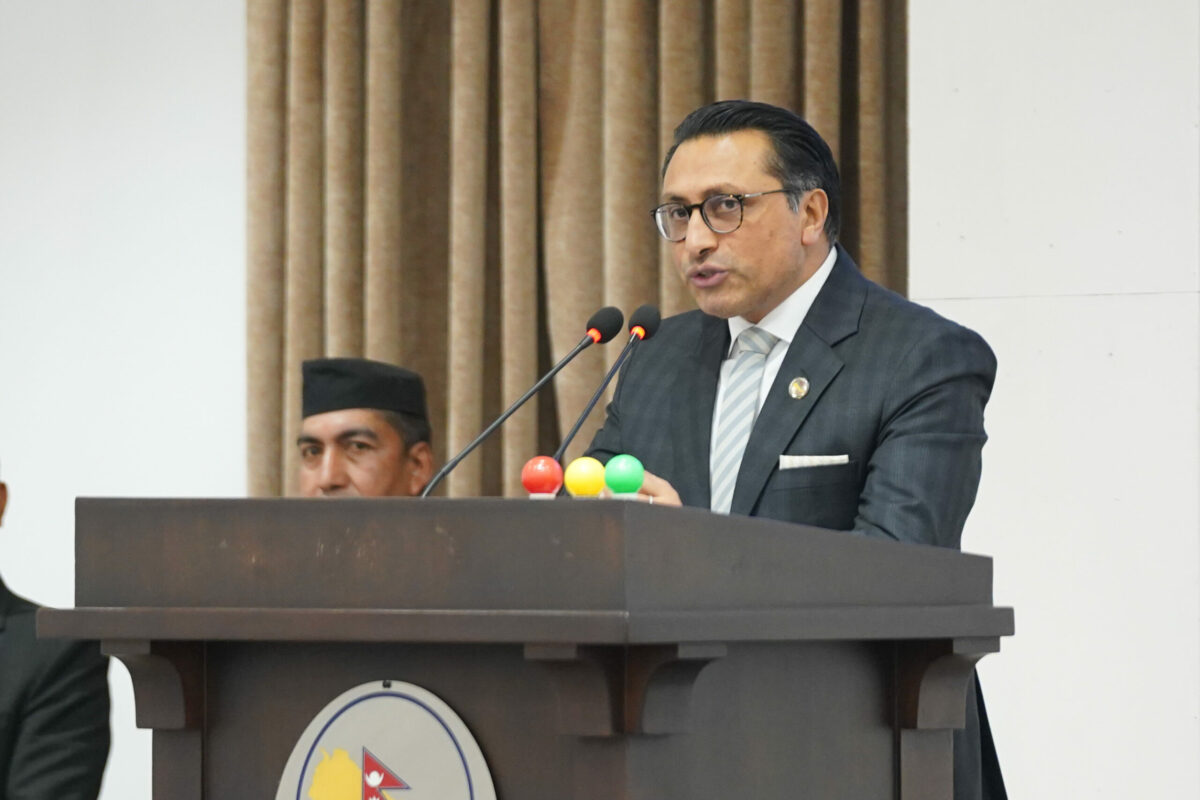
KATHMANDU: Finance Minister Swarnim Wagle has said that the government has given high priority to completing national pride projects within the stipulated timeframe.
Responding to questions during the House of Representatives’ discussion on the Appropriation Bill, 2083 on behalf of Prime Minister Balen Shah, Wagle addressed allocations related to the Office of the President, Vice President, Office of the Prime Minister and Council of Ministers and its subordinate agencies, the Ministry of Defence, and the National Planning Commission.
He clarified that national pride projects will now be approved and budgeted only after key preparatory works such as land acquisition, feasibility studies, and other groundwork are completed. He expressed confidence that this approach would ensure projects are initiated and completed within the stipulated timeframe.
Wagle also clarified that there has been no change in the total budget allocation of the Office of the Prime Minister and Council of Ministers and its agencies. However, he noted that capital expenditure data for the Department of Information Technology and the National Cyber Security Centre did not appear in the published development program book because it was listed in an Excel sheet within the LMBS system.
He said that under Nepal’s Constitution, a functional classification report was prepared in 2016 to clarify responsibilities across federal, provincial, and local governments. He added that the Office of the Prime Minister has initiated work to revise this report to address complexities in federal implementation, based on consultations with stakeholders across all levels of government and experts.
Regarding digital infrastructure, he said major data centers are already in operation, including the integrated data management center in Singha Durbar and a disaster recovery center in Hetauda. He added that the Kohalpur data center has been completed and preparatory work has begun for a new facility in Khumaltar. Future data centers, including those for artificial intelligence, will take into account environmental, geographical, and social impacts before selection.
He further said digital education is being integrated into school-level curricula and that the government is prioritizing the use of information technology to make governance more efficient, transparent, and citizen-friendly. Plans have also been included for establishing the country’s first sovereign AI computing center in Syuchatar, Kathmandu.
On national security, Wagle said it is the government’s responsibility to collect timely and accurate information regarding threats to peace and constitutional order. He noted that agencies such as the National Investigation Department are actively engaged in this work and that the use of information technology and AI is being expanded to make intelligence more modern and reliable.
He also said cybersecurity institutions such as the National Cyber Security Centre and Cyber Bureau are operational and that the government is expanding infrastructure and institutional capacity to reduce cyber risks and combat cybercrime.
Wagle added that the Nepal Army continues to carry out responsibilities under the National Security Policy, 2075, including modernization, border security, and disaster management. He said efforts are ongoing to further strengthen its infrastructure, technology, and operational capabilities.






Comment