




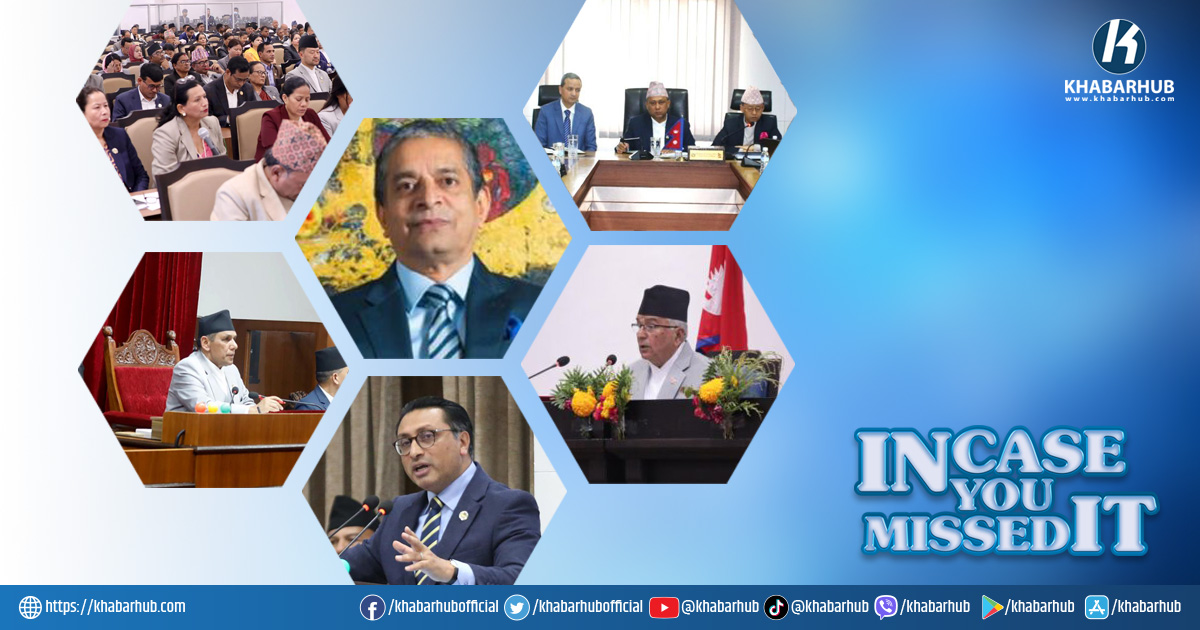
KATHMANDU: Last week’s political and institutional developments in Nepal revealed a government attempting to project itself as reformist, decisive, and transformational, while simultaneously exposing the tensions, contradictions, and resistance that accompany rapid political change.
At the center of these events was the approval of the government’s policy and programme for fiscal year 2026/27 by the House of Representatives despite persistent obstruction from opposition parties. The episode was more than a routine parliamentary process. It became a symbolic contest over legitimacy, governance style, democratic culture, and the future direction of Nepal’s federal republic under Prime Minister Balendra Shah and the Rastriya Swatantra Party (RSP)-led government.
The approval of the policy and programme despite opposition protests demonstrated the numerical and procedural strength of the ruling side, but it also highlighted the widening trust deficit between the government and opposition forces.
The opposition’s demand that Prime Minister Shah personally appear in Parliament to answer lawmakers’ concerns reflected a broader criticism that the government has increasingly centralized authority while maintaining a confrontational relationship with institutional checks and parliamentary conventions.
This conflict between disruptive politics and institutional continuity is likely to become one of the defining tensions of Nepal’s evolving political culture.
By allowing Finance Minister Dr. Swarnim Wagle to respond on behalf of the prime minister, the government technically fulfilled parliamentary procedure, yet politically it deepened the opposition narrative that the prime minister avoids accountability in institutional settings.
The opposition’s obstruction was therefore not merely about the content of the policy document. It reflected concerns about governance culture. Speaker Dol Prasad Aryal’s decision to proceed with voting despite continued protests demonstrated the ruling coalition’s determination to avoid legislative paralysis, but it also reinforced criticism that Parliament is becoming increasingly majoritarian rather than consensus-driven.
Nepal’s post-2006 democratic culture has largely relied on negotiation, compromise, and informal accommodation among political forces. Last week’s developments suggested a shift toward a more assertive style of governance where parliamentary majority is being used more aggressively to advance executive priorities.
At the same time, the government’s policy and programme itself represented one of the most ambitious governance blueprints presented in recent years. The 100-point framework attempted to position the government as a transformative force seeking to modernize the state, reform institutions, digitize governance, restructure the economy, and rebuild public trust.
Politically, the document was carefully framed around the aftermath of the 2025 Gen Z protests, which the government portrayed as a moral and political turning point demanding accountability, anti-corruption reforms, and civic-centered governance.
This framing is politically significant. Unlike traditional Nepali governments that often relied on party ideology or coalition bargaining narratives, the current administration is attempting to derive legitimacy from public frustration with the old political order.
The repeated references to governance reform, corruption control, digital efficiency, and service delivery indicate that the government understands public anger not merely as economic dissatisfaction, but as disillusionment with the state itself.
The policy document therefore functions not only as an administrative roadmap but also as a political manifesto designed to institutionalize the anti-establishment energy that brought the RSP to power. In that sense, last week’s parliamentary approval symbolized the formal transition of protest politics into state policy. However, translating protest rhetoric into durable governance systems remains far more difficult than drafting ambitious commitments.
Economically, the policy and programme attempted to signal a break from Nepal’s traditional remittance-dependent and consumption-driven economic model. The government’s emphasis on a “Borderless Economy,” digital exports, hydropower expansion, remote work recognition, startup incentives, and green industrialization reflects an effort to reposition Nepal within emerging global economic trends.
Particularly notable was the recognition of information technology as a strategic national industry and the attempt to legally integrate remote work and international digital services into the formal economy.
These ideas suggest a government trying to think beyond conventional development frameworks centered solely on foreign labor migration and donor dependency. The proposal for one-day business registration, digital tax systems, investment visas, and interoperable state databases also indicates an awareness that Nepal’s biggest development obstacle may not simply be lack of resources, but institutional inefficiency and bureaucratic friction.
However, the opposition’s criticism that the programme lacks implementation clarity cannot be dismissed easily. Nepal has historically suffered from a chronic gap between policy ambition and administrative execution.
Successive governments have produced highly aspirational plans that ultimately failed due to weak institutions, political instability, bureaucratic inertia, corruption, and poor coordination among federal, provincial, and local governments.
This tension between ambition and implementation remains the central question surrounding the current government. Many proposals within the policy document — including AI-enabled governance, universal digital public services, carbon trading systems, hydrogen infrastructure, fully integrated transport networks, and large-scale public sector restructuring — require administrative capacity and political continuity that Nepal has historically struggled to sustain.
The government’s target of sustaining 7 percent annual growth for a decade and generating 10,000 megawatts of electricity similarly reflects enormous ambition but faces structural constraints including investment shortages, land disputes, environmental clearances, and governance bottlenecks.
The opposition parties exploited these weaknesses in their criticism. UML leaders portrayed the programme as authoritarian and overly centralized, while the Nepali Congress argued that it merely repackaged old policies using new terminology. Prachanda’s criticism was particularly revealing because it reflected anxiety among older political forces that the new government is attempting to monopolize the language of reform and accountability while marginalizing traditional parties.
Interestingly, despite harsh criticism, opposition responses were not entirely dismissive. Even critics acknowledged the importance of IT reforms, governance modernization, and economic restructuring. This indicates that Nepal’s political debate is gradually shifting from ideological conflict toward competition over administrative competence and reform credibility. The main disagreement now lies less in what Nepal needs and more in who can realistically deliver it.
Another major theme of last week was the growing debate over institutional culture and executive behavior, particularly surrounding Prime Minister Balen Shah’s controversial conduct during the President’s presentation of the policy and programme. What may have initially appeared as a matter of protocol quickly escalated into a national discussion about constitutional dignity, political symbolism, and democratic norms.
Criticism of the prime minister for leaving Parliament during the President’s speech reflected deeper anxieties about anti-establishment populism entering formal governance structures. Balen Shah’s political identity has long been built around disruption, informality, and rejection of traditional political culture.
Those traits helped him gain popularity among younger voters frustrated with elite politics. However, governing a constitutional republic requires balancing reformist energy with institutional discipline.
The backlash from politicians, journalists, commentators, and even former supporters suggested that sections of society now fear that excessive personalization of politics could undermine institutional stability. Critics were essentially asking whether Nepal’s democratic institutions are strong enough to absorb highly individualized political styles without weakening procedural legitimacy.
This debate is especially important because Nepal’s democratic system remains relatively young and fragile. Institutions often rely heavily on symbolic respect and political restraint to maintain authority. The concern expressed by critics was not simply about dress codes or parliamentary etiquette, but about whether informal populism risks normalizing disregard for constitutional conventions.
At the same time, the criticism also exposed generational and cultural tensions within Nepalese politics. Many younger supporters of Balen Shah see traditional political rituals as outdated symbols of elite hypocrisy, while defenders of institutional protocol argue that democratic systems depend on respect for formal procedures regardless of personal style.
Nepal’s political history is filled with grand promises undermined by implementation failure, elite conflict, and bureaucratic weakness.
This conflict between disruptive politics and institutional continuity is likely to become one of the defining tensions of Nepal’s evolving political culture.
The government’s broader restructuring initiatives last week also indicated a clear attempt to centralize coordination and streamline administration. The reduction of ministries from 25 to 18 was presented as an efficiency reform aimed at reducing bureaucratic duplication.
Similarly, bringing the National Investigation Department back under the Prime Minister’s Office suggested a drive toward tighter executive control over intelligence and governance mechanisms.
Supporters may interpret these moves as necessary administrative modernization. However, critics see potential risks of excessive concentration of power. Nepal’s political history makes such concerns politically sensitive because previous attempts to centralize authority have often generated fears of democratic backsliding. The challenge for the government will be proving that centralization is being pursued for efficiency rather than political control.
Meanwhile, judicial interventions last week highlighted another important institutional reality: Nepal’s democratic system still retains functioning checks and balances.
The Supreme Court’s interim orders against the government’s decisions on customs duties and union restrictions demonstrated that the judiciary remains willing to challenge executive actions. These rulings also reflected broader tensions between reform-oriented executive activism and constitutional safeguards.
Similarly, the formation of a probe committee to investigate former Home Minister Sudan Gurung revealed the government’s attempt to maintain an anti-corruption image while managing internal political pressures.
Yet skepticism remains strong because many observers suspect the investigation could become politically negotiated rather than fully independent. The possibility of Gurung’s reappointment if cleared demonstrates the delicate balancing act between political loyalty and accountability narratives.
Beyond high politics, last week’s developments also reflected important social governance themes. The government’s commitments on free secondary education, digital schooling, universal healthcare standards, telemedicine, employment promotion, and mental health reform indicate an attempt to expand the social role of the state. These policies align with growing public expectations that governance should deliver not only political stability but tangible improvements in daily life.
The approval of the policy and programme may have secured a parliamentary victory for the government, but the deeper political contest over legitimacy, accountability, and governance effectiveness has only begun.
The publication of SEE results also served as a reminder of Nepal’s continuing demographic and educational pressures. With over half a million students participating in secondary examinations, the state faces enormous pressure to create employment opportunities for an increasingly educated population. This partly explains the government’s emphasis on startups, remote work, IT industries, and employment-linked education reforms.
Ultimately, last week’s events revealed a Nepal in political transition. The government is attempting to move from anti-establishment rhetoric to institutional governance while maintaining its outsider identity. The opposition, meanwhile, is struggling to adapt to a political environment where traditional ideological battles matter less than public perceptions of efficiency, accountability, and reform capacity.
The central question is whether the current administration can convert ambitious policy narratives into measurable institutional outcomes. Nepal’s political history is filled with grand promises undermined by implementation failure, elite conflict, and bureaucratic weakness.
The Balen Shah government appears aware of this history and is trying to distinguish itself through digitization, managerial governance, and performance-driven politics.
However, reformist momentum alone will not guarantee success. Sustained implementation requires political inclusiveness, institutional cooperation, legal stability, bureaucratic professionalism, and public trust. The confrontational atmosphere in Parliament, growing concerns over executive style, judicial pushback, and opposition resistance all indicate that Nepal’s democratic system is entering a more competitive and uncertain phase.
What emerged most clearly last week was that Nepal is no longer debating whether change is necessary. Across the political spectrum, there is broad recognition that governance reform, economic modernization, and institutional accountability are urgently needed. The real struggle now concerns who controls the reform process, how far executive power should extend, and whether transformation can occur without weakening democratic culture itself.
The coming months will therefore test not only the government’s policy ambitions but also the resilience of Nepal’s democratic institutions. The approval of the policy and programme may have secured a parliamentary victory for the government, but the deeper political contest over legitimacy, accountability, and governance effectiveness has only begun.





Comment