





KATHMANDU: Economic Digest presents a brief yet comprehensive roundup of major business developments in Nepal, delivered in clear and accessible summaries.
Nepal’s current economic landscape presents a mixed picture of improving corporate performance, persistent liquidity problems, and structural challenges requiring policy intervention. Commercial banks recorded a strong 35.73 percent rise in combined profits, while Nepal Telecom’s profit increased by nearly 48 percent, indicating improved earnings and loan recovery despite weak credit demand. However, declining deposit rates amid excess liquidity suggest that financial institutions continue to struggle to convert available funds into productive investment.
The LPG shortage highlights weaknesses in distribution and regulatory coordination. Long queues, demands to restore local retail distribution and concerns raised by the Nepal Chamber of Commerce point to a supply system under strain, with potential implications for businesses and consumers.
At the same time, the government is seeking to rebuild private-sector confidence through stronger industrial security, policy reforms and improved investment protection. Business representatives, however, continue to cite regulatory uncertainty, blacklisting and weak investment confidence as major constraints.
Beyond the immediate economic pressures, the reports indicate opportunities for diversification through electricity exports, postal modernization, tourism and commercial agriculture. Initiatives involving cardamom, livestock, forest plantations and adventure tourism demonstrate growing efforts to strengthen local economies. Overall, Nepal’s challenge is to translate these emerging opportunities into sustained investment, productivity and broad-based economic growth.
Commercial banks lower deposit rates amid excess liquidity
Commercial banks have reduced their deposit interest rates for the period from mid-August to mid-September 2026 as excess liquidity continues to persist and demand for credit remains weak. The average maximum interest rate on individual deposits has fallen to 4.136 percent from 4.1675 percent, while the average rate for institutional deposits has declined to 3.081 percent from 3.116 percent. Five banks have cut their deposit rates, with Siddhartha Bank making the largest reduction by lowering its individual deposit rate by 0.29 percentage points to 3.76 percent. Nepal Bank, Citizens Bank, Kumari Bank and Standard Chartered Bank have also reduced their rates. The other 15 commercial banks have left their rates unchanged. Nabil Bank and Prabhu Bank continue to offer the highest individual deposit rate at 4.55 percent.
Commercial banks post 36% growth in combined profit
Nepal’s 20 commercial banks earned a combined net profit of Rs 71.61 billion in fiscal year 2025/26, representing a 35.73 percent increase from Rs 52.76 billion in the previous year. The rise came largely after banks stepped up efforts to recover loans. Nabil Bank brought its non-performing loan ratio down to 4.2 percent and posted a profit of Rs 7.90 billion, while Nepal Bank reduced its bad-loan ratio to 4.18 percent and earned Rs 4.50 billion. The average non-performing loan ratio across the banking sector declined marginally to 7.96 percent from 7.97 percent. However, five commercial banks experienced declines in profitability, with Prabhu Bank recording a net loss.
Gold price climbs Rs 3,600 per tola, silver rises Rs 50
The price of gold increased by Rs 3,600 per tola in the domestic market on Sunday, while silver became Rs 50 more expensive. According to the Federation of Nepal Gold and Silver Dealers’ Association, fine gold was traded at Rs 305,200 per tola today, compared with Rs 301,600 per tola on Friday. The price of silver was set at Rs 4,710 per tola, up from Rs 4,660 on Friday. International media reports said gold was traded at around USD 4,377 per ounce in the international market, while silver was traded at USD 64 per ounce.
Nepal Telecom posts 48% rise in net profit to Rs 8.86 billion
Nepal Telecom’s net profit increased by 47.58 percent to Rs 8.86 billion in fiscal year 2025/26, compared with Rs 6 billion recorded in the previous fiscal year. According to the company’s unaudited financial statement, profit before tax climbed 34.66 percent to Rs 13.26 billion, while earnings before interest, taxes, depreciation and amortization (EBITDA) rose to Rs 20.48 billion from Rs 18.49 billion. Operating revenue also increased by 3.12 percent to Rs 34.95 billion, taking total income to Rs 39.19 billion from Rs 38.18 billion a year earlier. The company reported annualized earnings per share of Rs 49.25.
Chamber questions remarks over Radisson’s LPG stock
The Nepal Chamber of Commerce has raised concerns over comments made during a monitoring inspection of the five-star Radisson Hotel by the Ministry of Industry, Commerce and Supplies and Nepal Oil Corporation (NOC) concerning its LPG stock. The Chamber said a hotel of that size, consuming approximately 50 to 60 LPG cylinders each day, could reasonably maintain a stock of around 200 cylinders. It said treating such operational stock as an indication of illegal activity was inappropriate. While stressing that artificial shortages and unlawful LPG trading should be prevented, the Chamber cautioned that excessive publicity surrounding such cases could harm legitimate businesses and undermine the investment environment. It called on the authorities to resolve supply and regulatory issues through dialogue and coordination with hotel operators, business owners and private-sector representatives.
LPG sellers seek restoration of local distribution system
The Gas Sellers Federation Nepal has called on the government to restart LPG distribution through local retailers as consumers continue to face a cooking gas shortage. Federation President Gyaneshwar Aryal said in a statement that the current practice of supplying gas directly from factories and through widely dispersed designated sales points has created difficulties for consumers and contributed to distribution problems. The federation urged the authorities to address the bottlenecks by allowing retailers located close to consumers to resume household LPG deliveries. It said reviving and strengthening the established local distribution network would make it easier for consumers to obtain cooking gas and provide immediate relief from the ongoing shortage.
Private investment vital to broadening Nepal’s electricity market
Energy experts have emphasized the need for increased private-sector involvement to broaden Nepal’s electricity market, arguing that power trading licenses can be granted under the existing Electricity Act, 1992. During an interaction organized by the Independent Power Producers’ Association, Nepal (IPPAN), participants said large-scale electricity trading cannot be managed effectively by a single entity and called for a competitive trading environment. Energy Minister Biraj Bhakta Shrestha said electricity exports generated Rs 29.32 billion in revenue during the last fiscal year, resulting in more than Rs 18 billion in net profit. Officials stressed that stable policies, strong regulation, energy diplomacy and greater private-sector participation are necessary for Nepal to establish itself as a dependable year-round electricity exporter.
Special LPG sales draw long queues across Kathmandu Valley
Long lines of consumers were seen at designated LPG distribution centres across the Kathmandu Valley on Sunday after Nepal Oil Corporation (NOC) launched special sales to address the ongoing cooking gas shortage. Consumers began gathering at the NOC premises in Teku and six other designated locations early in the morning under an arrangement involving the District Administration Office and gas industrialists. The initiative is intended to assist consumers who have been unable to obtain cylinders through regular dealers. The special sales will run from 11am to 5pm, and buyers are required to present either a citizenship certificate or a National Identity Card. Cylinders from several LPG brands, including Nepal, HP, Everest/Sugam, Shreeram and Sagar, are being distributed through the designated outlets.
Govt proposes industrial security force to safeguard private investment
The government has drafted a Private Investment Protection and Promotion Strategy that includes a proposal to establish an Industrial Security Force and designate industrial areas, corridors and special economic zones as peace zones. The initiative comes after widespread damage was inflicted on private businesses during the September 2025 Gen Z protests. The National Planning Commission has estimated the total physical losses at Rs 84 billion. The proposed strategy includes risk-based security arrangements, rapid response teams, round-the-clock industrial security hotlines and highway patrols. Businesses that suffered losses from vandalism and arson could be offered tax and regulatory concessions, subsidized loans and other forms of support. The government says the measures are intended to rebuild investor confidence, protect private investment and support economic growth.
Government has five-year mandate, says FNCCI senior vice president
Federation of Nepalese Chambers of Commerce and Industry (FNCCI) Senior Vice President Sur Krishna Vaidya has said the current government has a clear five-year mandate and should not be evaluated solely on the basis of its first 100 days in office. He urged the government to update outdated policies, improve customs enforcement and establish a more trustworthy environment for businesses and investors. Vaidya said 268 entrepreneurs had recently been arrested and that around 60,000 entrepreneurs are on blacklists, while between Rs 1.5 trillion and Rs 1.6 trillion remains deposited in banks amid low investor confidence. He also called for the introduction of a credit transaction law, arguing that inconsistent policies and enforcement practices are making it increasingly difficult for entrepreneurs to conduct business.
Postal service expands role as government courier network
The government’s effort to transform the postal system into a more citizen-oriented courier service is gaining momentum, with official documents, health-related materials and other goods increasingly being delivered through the postal network. The system has already transported more than 1.05 million driving licenses and 247,043 passports, while more than 10,000 citizens have received services at their doorsteps. The expanded service could lower delivery expenses, improve access to government services and open new commercial opportunities for the postal sector. The postal network has also been used to transport medical samples and health supplies. Meanwhile, the government is pursuing agreements with airlines to improve both domestic and international postal connectivity.
NRNA NCC Cambodia to represent Nepal at Asia-Pacific conference in China
The Non-Resident Nepali Association National Coordination Council (NRNA NCC) Cambodia is set to represent Nepal at the 11th NRNA Asia Pacific Conference 2026, titled AROHAN, in Guangzhou, China. The event will bring together NRNA leaders and representatives from the Asia-Pacific region and other countries to discuss shared priorities and enhance cooperation among Nepali communities living abroad. NRNA NCC Cambodia said its participation reflects its commitment to strengthening unity, cooperation and empowerment within the Nepali diaspora. The conference will also offer an opportunity for participants to exchange ideas, reinforce institutional partnerships and advance initiatives aimed at building a more connected Nepali community around the world.
Red Panda Marathon to showcase Solukhumbu’s adventure tourism potential
The third Red Panda Marathon is scheduled to take place in Salleri, Solukhumbu, on September 5, combining red panda conservation with efforts to promote the lower Everest region as an adventure tourism destination. The 48-kilometer race will start at Thekchen Pema Choling Monastery, pass through Pike Peak at an elevation of 4,054 meters and finish back in Salleri. Organizers said the marathon is intended to increase awareness about protecting red panda habitats while drawing both Nepali and foreign trail runners to the region. A new 5-kilometer fun run has also been introduced to encourage participation from local residents. Earlier editions held in Taplejung and Ilam saw participation from runners from Nepal, India and Japan.
Phaktanglung distributes 445,000 cardamom saplings to farmers
Phaktanglung Rural Municipality in Taplejung has distributed around 444,900 cardamom saplings to farmers in six wards under its “One Ward, One Product” program. The saplings brought from Ilam include 317,600 Bharlang, 86,600 Ramsai and 40,700 Dambarsai varieties. Rural Municipality Chairman Rajan Limbu said the initiative is intended to boost cardamom production and improve the livelihoods of farmers in Taplejung, one of Nepal’s major cardamom-producing districts. As the high-altitude climate of Ward 7 is not suitable for cardamom cultivation, farmers there were instead supported in yak and chauri rearing and chhurpi production. The programs were financed through provincial and local government resources.
Jhulanotsav brings devotional songs to Mithila temples
The Jhulanotsav festival is being celebrated across Mithila, with devotional swing songs resonating through temples and monasteries in Mahottari and other parts of Madhesh. As part of the celebration, idols of Ram-Sita and Radha-Krishna are placed on elaborately decorated swings and rocked as devotees sing traditional Jhula, Malar and Kajari songs. The festival is observed from Shravan Shukla Tritiya through Shravan Purnima and is particularly prominent at the Lakshmi Narayan Monastery in Matihani and the Janaki Temple in Janakpur. According to Maithil tradition, the festival was introduced based on traditions associated with Ayodhya and Vrindavan and has since developed into a distinctive cultural and devotional celebration in Mithila.
Cycling campaign promotes Goraksha Lake as a tourism destination
The Himalayan Riders Society Hetauda has organized a cycling campaign to highlight the tourism and economic potential of Goraksha Lake in Hetauda Sub-Metropolitan City-18. Located around 20 kilometers east of Hetauda, the lake was formed after a dam was constructed in 2003 for irrigation purposes. Society President Raju Thapa Magar said greater promotion of the lake could attract more visitors, generate business opportunities and increase local earnings. The society, which uses cycling campaigns to promote tourism destinations, said the event was also aimed at drawing attention to the area’s natural attractions and encouraging the development of the lake as a tourism centre.
Dumre-Besishahar-Chame road remains risky after more than three decades
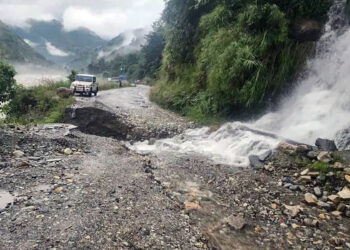
More than three decades after the Dumre-Besishahar-Chame road track was opened, the Lamjung section continues to pose serious risks, particularly during the monsoon season. Landslides, flooding and swollen streams regularly interrupt traffic, creating difficulties for local residents and tourists traveling toward Manang. Flooding at Raitu Stream in Marsyangdi Rural Municipality-4 recently stopped traffic for nearly eight hours until the road project installed hume pipes to reopen the route. Heavy rainfall also triggered a landslide at Srichaur, blocking the road. Officials have warned that travel risks remain and advised travelers to check road conditions before setting out.
Commercial farming expands in Gulmi’s Thulolumpek
Commercial agriculture and livestock farming are gaining momentum in Thulolumpek of Satyawati Rural Municipality-3, Gulmi, as farmers increasingly shift away from subsistence-based production. Farmers are earning income from vegetable cultivation, pig farming and poultry, with some agricultural enterprises generating annual returns of up to Rs 1.7 million. Around 500 plastic tunnels are currently being used to grow tomatoes and other vegetables commercially in the area. Farmers, however, continue to face challenges including poor road access, inadequate irrigation, fluctuating market prices, hailstorms, strong winds and crop diseases. The ward office is encouraging cardamom, tea and coffee cultivation while also promoting improved buffalo and goat farming to further expand commercial agriculture and increase farmers’ earnings.
Kailali provides Rs 55 million in livestock subsidies to farmers
The Veterinary Hospital and Livestock Service Expert Center in Kailali distributed Rs 55 million in subsidies to 373 farmers across all 13 local levels during the last fiscal year under the “One Local Level, Two Products” campaign. The assistance focused on goat, buffalo, pig and fish farming with the aim of encouraging local enterprises, boosting production and increasing farmers’ income. The center also provided subsidies to 21 groups comprising single women, former Kamaiyas, marginalized communities, people with disabilities and economically disadvantaged households. It allocated Rs 950,000 for the management of three cattle shelters and distributed Rs 1.487 million in incentives to 551 farmers involved in raising oxen and male buffaloes for plowing.
Tree plantation turns underused forest land into productive areas in Kailali
Community forests in Kailali are converting vacant and underused land into productive areas through the plantation of timber, fruit, medicinal, fodder and multipurpose tree species. Jarahi Community Forest has planted various species across more than 67,637 square meters after clearing unwanted bushes and vegetation. Since fiscal year 2023/24, the forest has planted teak, eucalyptus, sandalwood, rudraksha, moringa, cinnamon, amla, bamboo and other species. Similarly, 100,000 saplings have been planted across 18 forest areas under the Udasipur Sub-Division Forest Office, while another 7,000 cane and bamboo saplings have been planted across approximately 250,000 square meters in other community forests. Officials said the plantation drive could contribute to forest conservation, support local livelihoods and create opportunities for future income generation.
Subsidies encourage women to take up commercial pig farming in Pouwadungma
Women in Pouwadungma Rural Municipality have increasingly entered commercial pig farming after receiving subsidies covering half the cost of piglets and shed construction under the Vice Chairperson Self-Reliance Program. The rural municipality set aside Rs 3 million last fiscal year and implemented programs worth Rs 6 million, with farmers contributing the remaining 50 percent of the costs. Financial support was provided to 20 pig farms and one goat farm. Local women said the subsidies eased the financial burden of starting livestock businesses and encouraged them to move toward commercial farming. The municipality said it would continue agricultural and livestock initiatives designed to raise farm earnings and promote women’s economic self-reliance.





Comment