




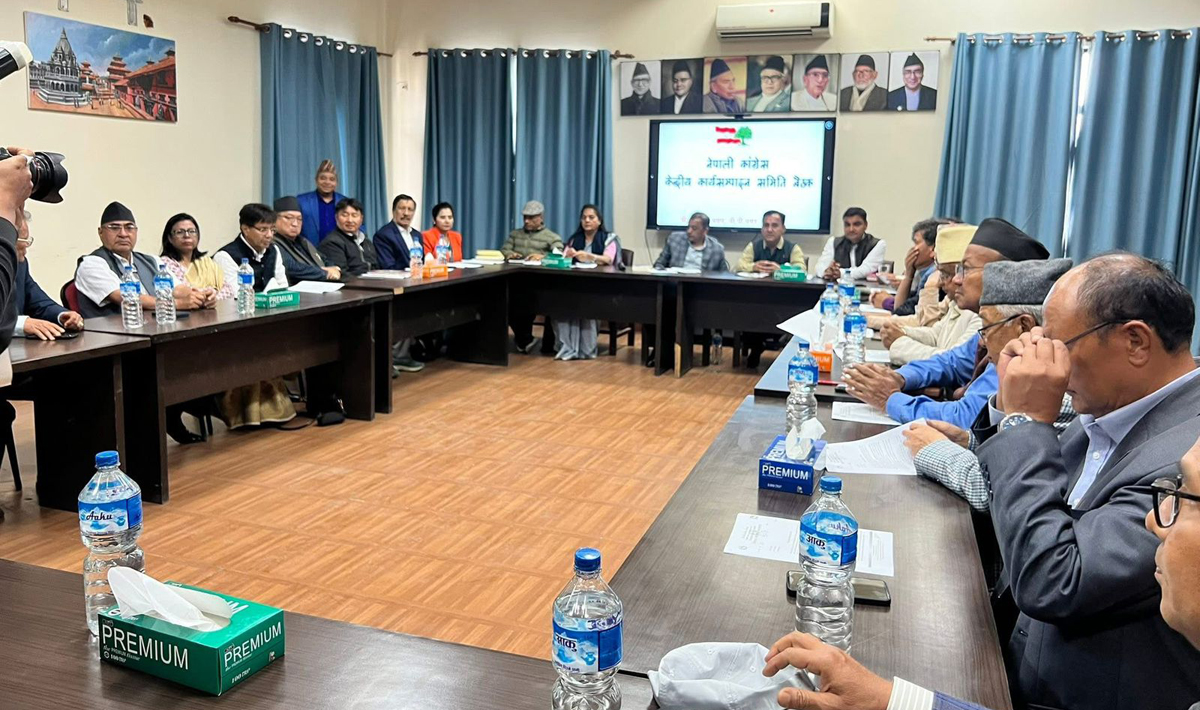
KATHMANDU: Nepali Congress (NC) President Gagan Thapa on May 11 nominated 19 additional members to the party’s Central Working Committee (CWC).
All the newly nominated leaders were affiliated with factions that had not participated in the special general convention held last Poush. Among them, 11 are considered close to former President Sher Bahadur Deuba, seven are linked to leader Dr. Shekhar Koirala, and one is close to leader Shashank Koirala. Leaders close to Thapa say the move was aimed at strengthening party unity ahead of the party’s 15th General Convention.
Nepali Congress leader Nain Singh Mahar said the president had attempted to bring all sides together to strengthen the party. “The Congress believes in pluralism and multiparty democracy,” Mahar said. “The president has tried to accommodate everyone through these nominations to make the party stronger. Such efforts are necessary to ensure a successful general convention.”
Referring to past ideological differences between founding leaders BP Koirala and Subarna Shumsher, he said differing views within the party were natural.
However, not all senior leaders are satisfied with the nominations. Leaders from other factions, including Purna Bahadur Khadka and Dr. Shekhar Koirala, publicly expressed dissatisfaction with Thapa’s decision, accusing him of acting unilaterally without proper consultation. They warned that such a move could weaken broader party unity.
Referring to past political developments, he added, “The earlier movements emerged because of the way they handled power while in government. Now their influence has weakened, and there is little point in continuing these internal conflicts.”
“I was neither informed nor consulted regarding the nomination to the Central Working Committee,” Khadka wrote in a social media post published on May 12. “The decision taken on the 28th has undermined the party’s goal of achieving broad and complete unity.”
Likewise, Dr. Koirala issued a five-point statement after discussions with leaders close to him at the Baluwatar liaison office on the same day.
Thapa, who became party president during the special general convention with a pledge to end factional politics within the party, now finds himself appointing leaders from various factions as central members. Yet, his decision has not received unanimous support.
Speaking to Khabarhub, newly appointed central member Sushila Mishra Bhatta said her inclusion was natural given the current political circumstances within the party.
“The party has not split, so I do not see this as ‘unity’ in that sense,” she said. “There were factions and differing opinions in the party before, and they still exist. The leaders should now move forward through dialogue and focus on national interests.”
Bhatta added that she would remain committed to the party until the 15th General Convention. “The Nepali Congress must become stronger to strengthen democracy in the country, and I will continue to stand firmly with the party until the general convention,” she said.
Bhatta, who also served as a central member after the 14th General Convention, is considered close to Deuba’s camp. She said she was informed about her nomination only at the last moment.
“There had been discussions with President Thapa’s side about further refining the party, but I was not aware that I would be appointed,” she said, adding that she later spoke with leader Dila Sangraula after the announcement.
Similarly, Laxmi Pariyar, another leader considered close to Deuba and newly appointed to the Central Working Committee, said she would prioritize party unity under the current leadership.
“The dissatisfaction among senior leaders currently outside the party leadership structure should be addressed,” Pariyar said.
Another newly appointed central member, Jeevan Pariyar, said the nomination of 19 leaders alone was not enough to ensure complete internal unity within the party. Pariyar, who is considered close to Dr. Shekhar Koirala, was elected joint general secretary during the 14th General Convention.
“The president has brought 19 leaders who did not participate in the special general convention into the working committee. But this alone is not sufficient,” he said. “Internal unity has still not been fully achieved.” He suggested that party president Gagan Thapa should adopt a more flexible approach and take further initiatives to build consensus.
“I was the first person to demand a leadership change through a special general convention after the Gen-Z protest of September 8 and 9, 2025,” Pariyar said. “At that time, the leadership did not accept the proposal for a 54 percent majority.”
He added that he had deliberately chosen not to participate in the convention held last year because he feared it could lead to a split in the party.
“I did not attend the convention because I saw a risk of the party breaking apart if I participated,” he said.
Pariyar argued that there was little point in continuing disputes after multiple constitutional and legal bodies had already recognized the legitimacy of the current leadership.
“I had already said that Gagan should be accepted as president after the Election Commission recognized the March 5 election. But the leadership did not agree at the time,” he said. “Now that even the Supreme Court has settled the issue of legitimacy, there is no alternative to broader unity.”
Similarly, another leader close to Dr. Shekhar Koirala, Chandra Bhandari, presented a somewhat different perspective. He said senior leaders expressing dissatisfaction within the party no longer had the time or political space to continue internal disputes ahead of future elections.
“Leaders like Purna Bahadur Khadka, Prakash Man Shrestha and Shekhar Koirala will be around 80 years old in the next five years. Will they still continue fighting alongside their sons and grandsons?” Bhandari said. “If they plan to pass leadership to the next generation, they should prepare and guide them accordingly.”
Bhandari argued there was little reason to oppose the recent nominations since most of those appointed were already close to rival factions.
“Those who attended Sher Bahadur Deuba’s and Shekhar Koirala’s meetings have now been brought into the committee,” he said. “If this had not been done, who would have included them later? What else would have satisfied them?”
Referring to past political developments, he added, “The earlier movements emerged because of the way they handled power while in government. Now their influence has weakened, and there is little point in continuing these internal conflicts.”





Comment