




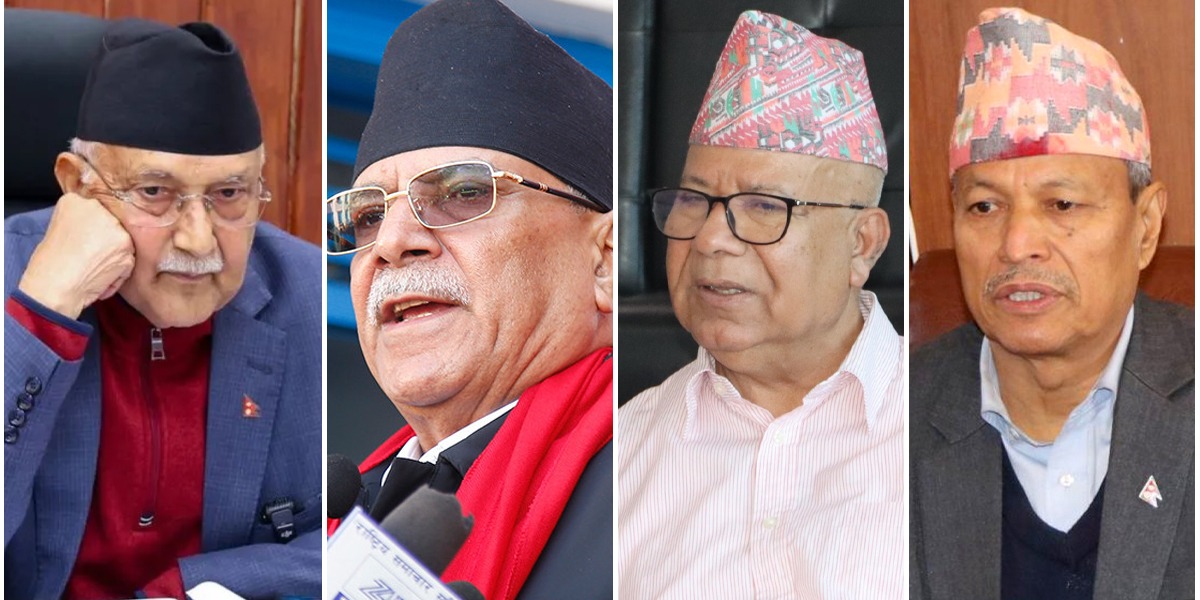
KATHMANDU: The results of the March 5 House of Representatives election have revived debate over a possible reunification between the CPN-UML and the Nepali Communist Party (NCP), both of which now appear to be operating on the margins of Nepali politics.
The UML and the then Maoist Centre had formed a left alliance during the House of Representatives election held in 2022 and went on to establish a majority government after unification. However, the alliance soon fractured into multiple factions. Now, discussions on possible reunification have resurfaced.
UML Chair KP Sharma Oli, who was arrested on charges related to the use of force and the killing of students during the Gen-Z protest, has since been released and is undergoing treatment at Maharajgunj-based Tribhuvan University Teaching Hospital in Kathmandu. In his absence, party vice-chairs Bishnu Paudel and Shankar Pokharel have advanced dialogue on potential unity with the NCP, party insiders have said.
Unity debate amid a multifaceted crisis
The renewed discussion comes amid growing speculation that both UML and NCP are facing an existential crisis in national politics. The latest election held in March weakened the once-dominant communist vote base, while the rise of the Rastriya Swatantra Party (RSP) has disrupted the traditional balance of power within the democratic system.
At the same time, the government led by Balendra Shah, popularly known as Balen, has signaled a strong stance against past corruption and misuse of power. Acting on its reform agenda, the government has already formed a commission to investigate the assets of high-level officials who have held office since 2062/63 BS. This move is expected to directly affect leaders across major parties, including communist factions and the Nepali Congress.
Ultimately, the biggest uncertainty lies with the second- and third-generation leaders and cadres in both parties. They may resist a unity perceived as a strategy to prolong the dominance of an older leadership rather than a genuine ideological or structural renewal.
If governance reforms are aggressively implemented, both UML and NCP risk further electoral setbacks in upcoming provincial and local elections, particularly if they remain divided. Such a scenario could also create space for the rise of right-wing forces, reflecting broader global political trends.
Following the recent parliamentary elections, the government took a decisive step against UML leadership by arresting Oli based on the recommendation of a commission led by Gauri Bahadur Karki. Once seen as a dominant political figure, Oli now faces mounting political challenges.
Attempts to mobilize support for his release failed to unify the party or generate significant public backing, highlighting a decline in UML’s popular support. This has also reignited internal debates over leadership change.
During his detention, Oli had positioned Vice Chair Ram Bahadur Thapa as acting leader and parliamentary party head, further deepening factional divides. Meanwhile, Bishnu Paudel, who opposed Oli’s arrest, grew dissatisfied after being sidelined, intensifying internal power struggles.
On the NCP side, Cordinator Pushpa Kamal Dahal Prachanda has acknowledged the weakening of communist influence. Senior leader Narayan Kaji Shrestha also recently emphasized the need for transformation and reorganization within the communist movement.
As these pressures mount, the idea of reunification appears to be gaining traction—not as a purely ideological move, but as a strategic response to political decline. Rather than focusing solely on leadership restructuring within UML, the conversation is increasingly shifting toward broader unity with the NCP as a possible path forward.
Is unity possible?
In politics, few things are truly impossible—but a renewed unity between UML and NCP appears far more difficult now than in the past. The current push for unification is not rooted in ideology or a shared long-term vision; rather, it is largely driven by political survival amid declining influence.
Instead of addressing national priorities or revitalizing the broader communist movement, the momentum for unity seems tied to preserving the relevance of an aging leadership facing mounting pressure.
The experience of past unification efforts reinforces this skepticism. Ahead of the 2022 House of Representatives election, the two parties aligned quickly based on short-term interests rather than principles.
That arrangement soon unraveled as competing ambitions triggered internal conflict and eventual fragmentation. Such precedent suggests that any unity built again on convenience rather than clarity of purpose is likely to be fragile and contested, particularly among party cadres who remain ideologically committed.
Internal dissent further complicates the picture. Senior leaders like Surendra Pandey have openly opposed the idea, arguing that previous unity efforts were driven by the pursuit of power, while current attempts are aimed at salvaging declining political relevance.
Within UML itself, cohesion has weakened significantly, with factional divides becoming more visible since its 11th General Convention. Leaders such as Gokarna Bista and Yogesh Bhattarai rising despite resistance from the establishment signal a shift in internal power dynamics, while broader dissatisfaction has surfaced even among long-time loyalists of KP Sharma Oli.
A similar pattern is evident in the NCP under Pushpa Kamal Dahal, where electoral setbacks and self-admitted leadership shortcomings have weakened its standing. As the party’s influence declines, questions are emerging about whether it can be reorganized effectively under the same leadership.
Ultimately, the biggest uncertainty lies with the second- and third-generation leaders and cadres in both parties. They may resist a unity perceived as a strategy to prolong the dominance of an older leadership rather than a genuine ideological or structural renewal.
If that younger cohort seeks a different political direction, it could either block reunification altogether or reshape it into a fundamentally new form—one that departs from traditional power-sharing arrangements. In that sense, unity is possible, but only under conditions that go beyond crisis management and address deeper questions of leadership, legitimacy, and purpose.



Comment