




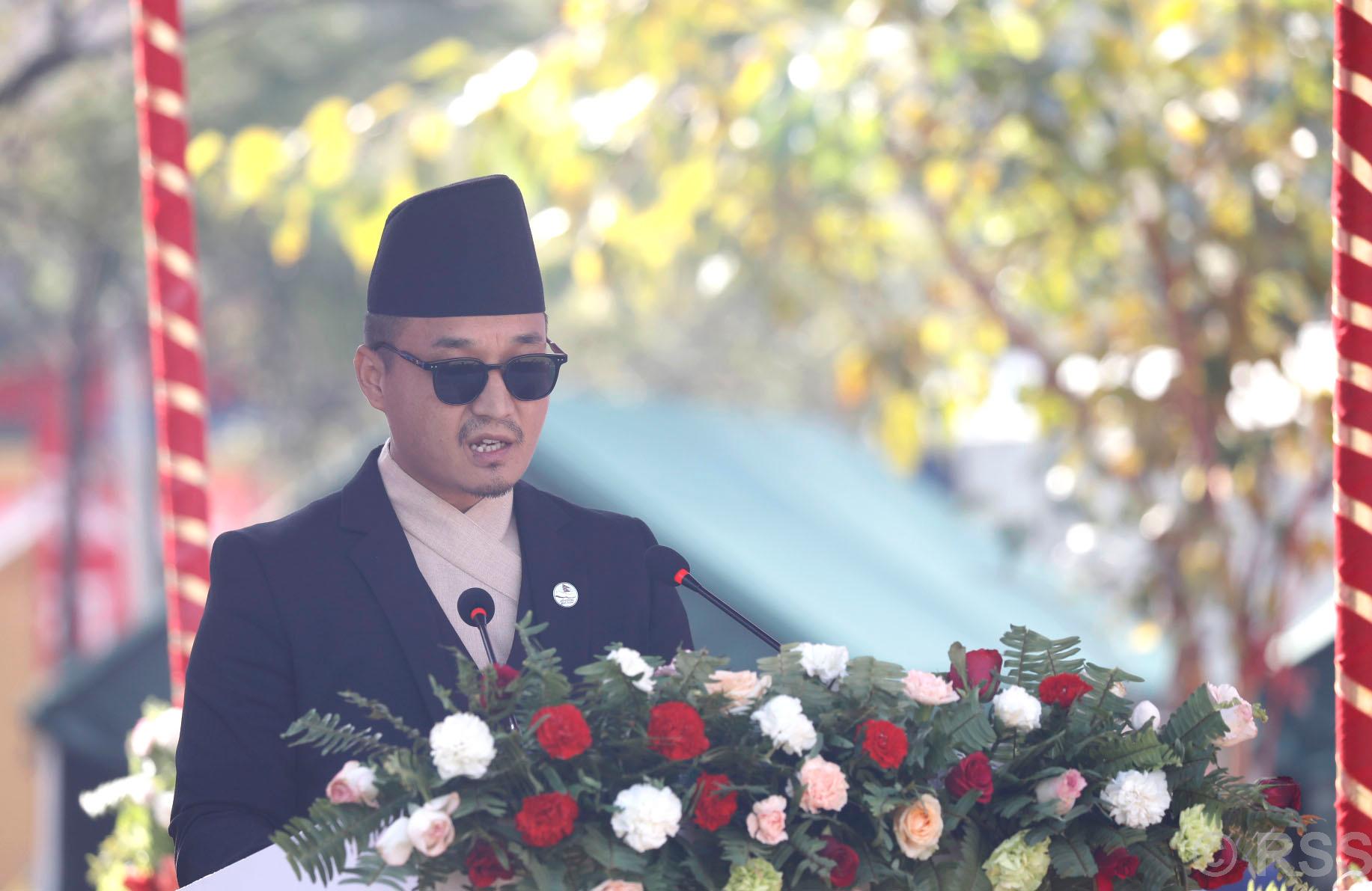
KATHMANDU: Home Minister Sudan Gurung has said the government is preparing legal reforms to make the Nepal Police more capable, professional and modern.
Speaking at a programme organised in Kathmandu on Friday to mark the 71st Police Day, Gurung said work was underway on a new police bill aimed at reforming the organisation.
“The government is taking initiatives to improve service facilities through legal provisions to motivate police personnel. Facilities related to housing, healthcare and transfers will be managed,” he said, adding that efforts were underway to digitise all police offices.
Gurung said the government would also promote the use of retired security personnel’s knowledge and skills while working to enhance their self-esteem.
Stressing that crime knows no borders, he said the Nepal Police must be strengthened to effectively control and investigate transnational crimes.
“At the first meeting of the home ministers of BIMSTEC member states held recently in New Delhi, India, and during discussions with my Indian counterpart, I emphasised greater cooperation in information sharing and the use of technology to combat cross-border crime,” Gurung said. “We must make effective use of regional mechanisms to strengthen Nepal’s internal security.”
He also warned that those who leak sensitive state information would not be granted immunity and stressed the need for police personnel to protect confidential information responsibly.
The Home Minister directed the police to strengthen their capabilities in emerging fields, including artificial intelligence (AI), digital forensics, cybercrime and financial crime investigations, DNA forensics and DNA profiling.
He said the police uniform should represent hope, trust and cooperation between citizens and law enforcement rather than fear or intimidation.
“The younger generation is asking whether the state will work for them and whether they will have a bright future in their own country,” Gurung said. “The answers will be reflected in police conduct, impartial investigations and rescue operations during disasters.”
He said arrangements had been made to provide risk allowances and meal expenses to security personnel deployed in disaster response operations. A proposal had also been put forward to increase the number of police positions based on the findings of a recent organisational and management survey of the Nepal Police.
Gurung said investing in the infrastructure and technology needed by the Nepal Police was his top priority. He added that the new government was committed to serving the public with renewed enthusiasm, energy and a fresh outlook.
“To meet citizens’ expectations of the state, you must adapt your conduct and professional practices to the pace and spirit of the government,” he said. “From registering complaints and first information reports (FIRs) to conducting investigations, citizens must remain at the centre of your work.”
He urged police personnel to adopt citizen-friendly behaviour and working methods and maintain zero tolerance towards crime. On the occasion, Gurung paid tribute to police personnel who had lost their lives in the line of duty.
He also commended police officers for their courage and commitment to rescue operations despite the loss of their colleagues in the Bhotekoshi area of Rasuwa on Bhadra 10 and during subsequent floods in Manang, Mustang and the Budhigandaki area.




Comment