




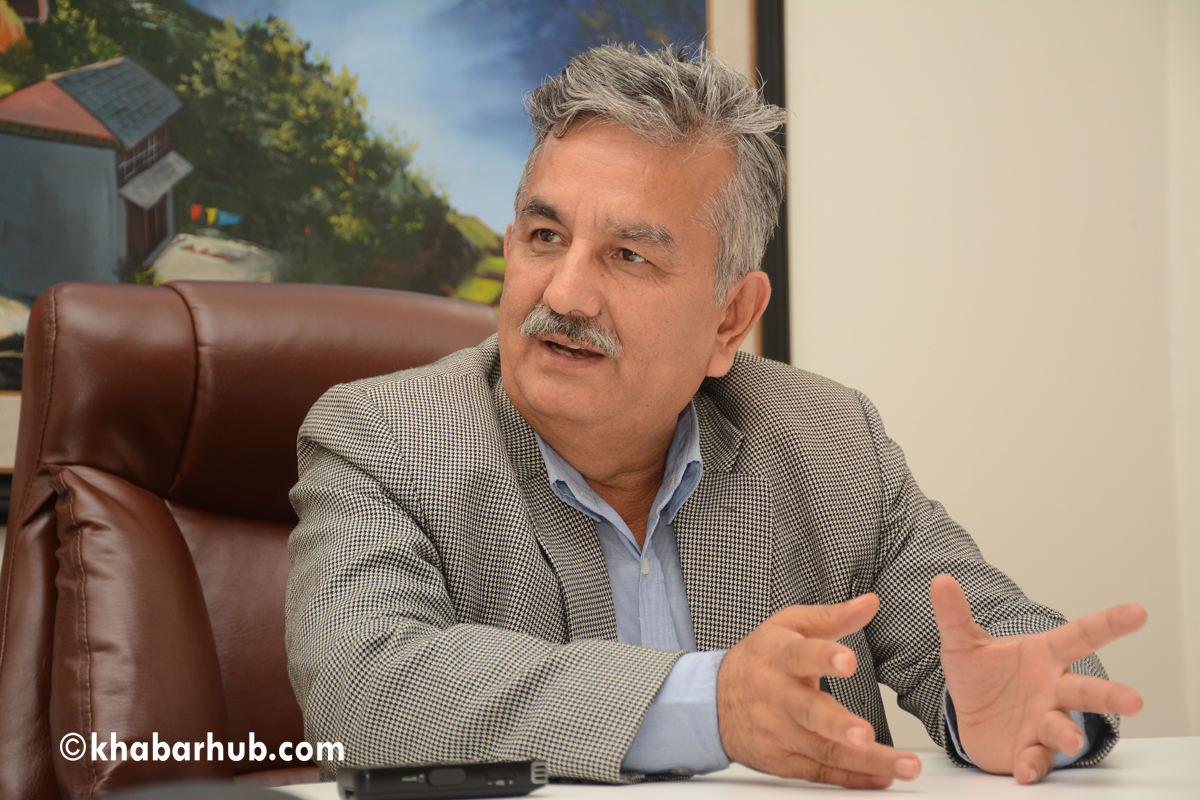
KATHMANDU: Leader of CPN-UML, Surendra Pandey, is widely regarded as an intellectual and experienced leader within the party. Despite continuing his studies, Pandey was denied a parliamentary ticket by party Chairman KP Sharma Oli this election, reportedly due to political differences.
Although he did not receive a ticket for Chitwan Constituency-1, Pandey, former UML Vice Chairman actively supported UML candidate Kamal Pathak during the nomination process and continues to participate in the party’s election campaign.
Pandey says he is helping Pathak to the best of his ability. He also claims that no party, including UML, is likely to secure a majority in the upcoming elections and argues that it is misleading to promise one. He added that the interim government, led by Sushila Karki, should advise political parties on constitutional amendments and electoral reforms.
He pointed out that even if there were a wave for the Rastriya Swatantra Party (RSP) similar to the Maoist surge in 2064 BS, a majority would still be impossible. Unlike the Maoists of that era, which had a clear agenda, Pandey says the RSP has little substantive policy beyond being “new.”
He predicts that the next House of Representatives will once again result in a hung parliament and cautions that until the electoral system is reformed, parties will remain focused solely on forming and toppling governments.
Pandey expressed concern about the public being “tested” by political parties, saying: “People are good at testing everything. But there is a concern about whether people’s lives will be affected while leaders are being tested.” He also noted that both the Congress and UML have made little progress on constitutional amendments, despite having raised the issue.
The following is an edited excerpt of an interview with Pandey by Khabarhub, discussing the post-March 5 parliamentary situation, constitutional amendment and electoral system reform, the reasons behind Oli not granting tickets, and the possible future of the UML.
UML Chairman Oli did not give you a ticket this time. Are you upset?
Tickets are given to maximize the party’s chances of winning. Whether everyone who gets a ticket wins is a different matter. There will be a review after the election to assess who could have won and who did not. Only Chairman Oli knows why I was not given a ticket. I am not upset, but I haven’t found a definitive answer either.
Some say leaders who did not get tickets are not supporting the candidates. Is that true?
Everyone contributes in their own way. Responsibility is assigned differently in different areas, but even without formal responsibilities, leaders who weren’t given tickets are working voluntarily. That’s my approach.
Have you been formally given any responsibilities in the campaign?
No, I have not been assigned any formal duties, but I am supporting the campaign in my own capacity.
With these internal issues, can UML still win respectable seats this time?
Let’s wait and see. UML is currently the second-largest party. Our hope is to be the first, but the final outcome depends on the people. I don’t feel the need to speculate further.
Is it possible for UML, or any party, to secure a majority under the current electoral system?
No. Has any party achieved a majority since this mixed system of direct and proportional elections was introduced? Even when UML and the NCP merged in 2074 BS, the two parties together approached a near two-thirds majority, but UML alone never got a majority. Claims of securing a majority are unrealistic and misleading.
Why do parties keep promising a majority when it’s clearly impossible?
Promoting lies is one matter, but the reality is that the current system makes a single-party majority virtually impossible. Parties should not mislead the people. Citizens should also question how a majority could even be achieved under this system.
What about past elections? Were majorities easier to achieve under a direct election system?
Yes. In the fully direct elections of 2048 BS and 2056 BS, parties could secure a majority. But after the proportional system was introduced, it became practically impossible. Even large waves, like the Maoist surge in 2064 BS, would not guarantee a majority if a party does not have a clear agenda.
What does this mean for the upcoming HoR?
The next House of Representatives is likely to be another hung parliament. Unless electoral reforms are implemented, parties will continue to focus primarily on forming and toppling governments rather than long-term governance.
Any concerns about the people amid this political scenario?
People are capable of testing leaders, but we must consider whether their lives will be affected while parties are testing each other. Political parties must focus on reforms, not just on power struggles.
Do the claims of new political parties hold any weight?
Not really. Those who claim to be “new” only offer slogans. I haven’t seen any clear agenda explaining how they plan to build the country. There’s no analysis of what was done wrong in the past or what concrete steps they will take now. They just say “new,” but after one election, that newness will fade.
So you don’t see a future for these “new” parties?
Even the Maoists started with this narrative, calling themselves revolutionary and “new.” After one election, they too became old.
Can we compare the Rastriya Swatantra Party now with the Maoist wave in 2064 BS?
Not really. Back then, the Maoists reached people with a specific agenda and demands. Popularity alone does not guarantee results. For example, in Kathmandu, a candidate once got 65,000 votes but lost the next election deposit. The Maoists had a similar surge in 2064 BS, but by 2070 BS, their direct seats fell from 120 to just 26. After that, they never recovered. People are good at testing leaders, but while they do so, there’s a concern about the real-life impact on citizens.
What should voters focus on in this election?
People need to vote consciously, understanding what a representative can realistically do. They shouldn’t expect the impossible. Candidates can promise a lot, but if it’s not feasible, it won’t happen. Both the voters and the candidates share responsibility. Expenses, false assurances, and misunderstanding of the three levels of government —local, state, and federal—often confuse people.
Are promises like “we will overcome all disappointments” credible?
No. Parties can’t claim they will deliver what they cannot. Overcoming disappointments is not about slogans, it’s about concrete actions that are actually possible.
What will the next parliament look like?
It’s likely that more than two parties will have to form a coalition government, similar to the situation after the 2079 BS election. The cycle of forming and toppling governments will continue. The September 8 and 9, 2025 protests showed that people were demanding a Prime Minister’s resignation outside constitutional procedures. The elections are happening under the same constitution. Claims that a single party will secure a majority and govern for five years are misleading.
The Nepali Congress-UML government had promised constitutional amendments in the past. Was anything done?
Nothing concrete happened. Even though I wasn’t in the House at the time, it was clear from party discussions that amending the constitution didn’t progress. Sporadic discussions occurred, but no real process began.
Was a team ever formed to draft the constitutional amendments?
Nothing of that sort happened. It didn’t even start. If it had, people would have known, these days, is anything secret? You cannot amend a constitution without following legal processes and established practice. A committee formally endorsed by parliament is required; a private meeting of party leaders in two rooms cannot serve as a basis for amendment.
Even if someone claims that something happened, it has no formal meaning. The situation remains the same today because the so-called agenda of amending the constitution was more about being able to say, “This constitution has given everything.” If it hasn’t been given, then parties simply went into the election standing on this claim. Personally, I don’t see how it was possible under those circumstances. If the interim government had handled it properly, it could have been done.
What exactly should have been done?
The constitution needed proper amendment. For that, a proposal should have been developed with the participation of all parties, outlining clear steps and commitments. That proposal could have become the election agenda, and then parliament could approve it and amend the constitution accordingly. This would have given people hope.
Even if such efforts didn’t guarantee a majority, at least voters would see a commitment to action. Instead, parties went to the election with no concrete agenda. Each party focused on its own priorities, and no one presented a formal manifesto.
Most announcements are limited to saying who will be the prime minister. Beyond that, there is no clarity on what the prime minister or the government will do, and no solutions have been proposed. The result is that parties remain focused only on forming and dismantling governments, rather than offering meaningful governance.



Comment