




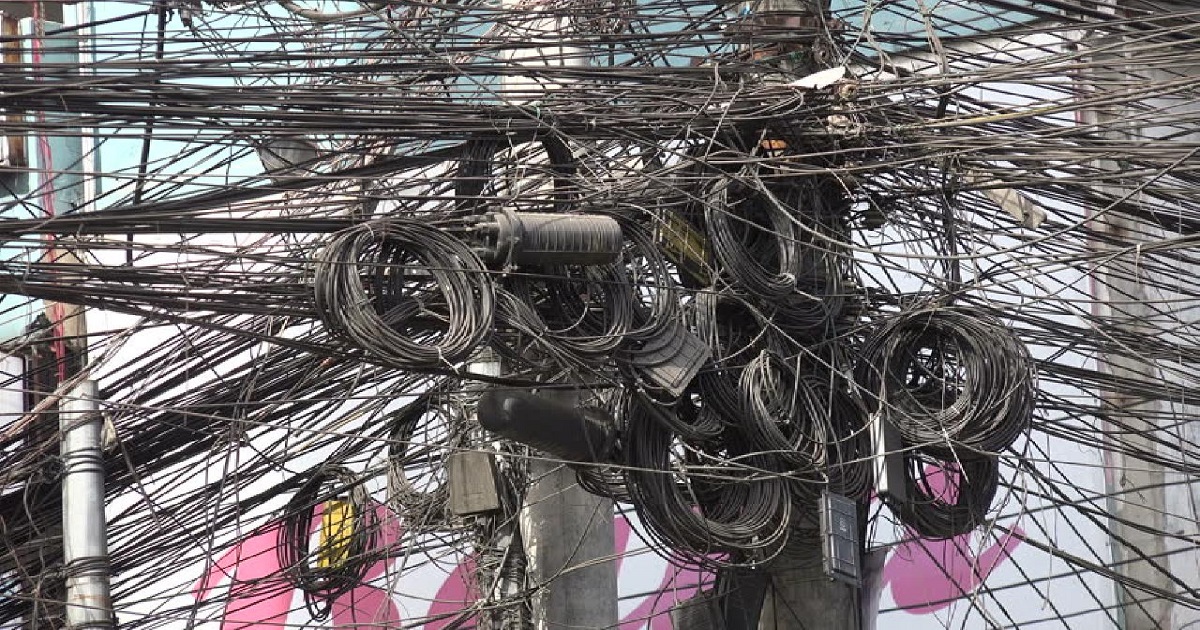
KATHMANDU: The government has directed concerned authorities to prepare a time-bound action plan to remove tangled and unused internet, telephone, and television cables hanging from utility poles and pavements across the Kathmandu Valley.
A high-level inter-agency meeting held at the Ministry of Energy in the presence of Minister for Communication and Information Technology Dr Bikram Timilsina and Minister for Energy, Water Resources and Irrigation Biraj Bhakta Shrestha instructed Nepal Telecommunications Authority (NTA), Nepal Electricity Authority (NEA), Nepal Telecom, Ncell, and the Internet Service Providers’ Association of Nepal (ISPAN) to prepare an integrated plan and remove unused cables from six locations in the first phase by the second week of Shrawan.
The meeting decided that NTA would lead the cable management initiative, while all service providers would be required to place clear identification tags on their cables. It also decided to maintain regular coordination among concerned agencies and review progress regularly to ensure visible results for the public.
The first phase of cable management will cover six major areas: Tripureshwor–Kalimati–Kalanki, Jadibuti–Pepsicola, Tripureshwor–Lazimpat, Samakhusi–Town Planning–Gongabu, Kirtipur area, and Old Baneshwor–Gaushala–Chabahil.
Authorities said unmanaged cables have created public safety risks and affected the aesthetic appearance of urban areas.
The meeting also reviewed the lack of progress despite the NTA issuing a public notice on Jestha 28, giving service providers 15 days to manage the cables.
Communication Minister Timilsina said the problem of unmanaged cables was created due to weaknesses among multiple agencies and stressed the need to focus on solutions.
“This is a problem created by ourselves. Somewhere or another, all agencies have weaknesses. A notice was issued to manage the cables within 15 days, but the expected progress was not achieved. Now, we need to start with what can be done immediately,” he said.
Timilsina instructed authorities to remove unused cables immediately and inform the ministry if any support or coordination was required. He said service providers responsible for installing cables must also take responsibility for removing them.
“The public wants immediate results. No one has the excuse to delay solving this problem,” he said.
He directed NTA to strengthen regulation, coordinate among stakeholders, and prepare a detailed action plan with clear timelines for different areas.
Energy Minister Shrestha said effective coordination among all concerned bodies was necessary for long-term cable management. He said the government’s initiative was not intended to create difficulties for anyone but to find a sustainable solution.
“We are all facing the same problem and challenge. We must solve it together. Both regulators and service providers need to cooperate,” he said.
Shrestha said the government would begin work in selected areas as pilot projects and expand the initiative based on lessons learned. He also said necessary legal reforms related to infrastructure management were being pursued.
The minister added that the government would soon take a decision regarding outstanding pole rental payments owed by internet service providers to the Nepal Electricity Authority. He also said the government was positive about establishing an infrastructure company for telecommunications and electricity cable management.
During the meeting, ISPAN said cable removal work was already underway in the Old Baneshwor–Gaushala–Chabahil area and other priority areas identified by Kathmandu Metropolitan City. The organisation said monsoon conditions and restrictions on daytime road work had affected progress.
The Nepal Electricity Authority said it had already managed electricity cables in many areas, but cables belonging to different service providers remained on poles. The authority said identifying cable ownership has become difficult, while many service providers have failed to regularly pay pole rental fees and often leave old cables behind after installing new ones.
ISPAN Chair Sudhir Parajuli said proper identification of cable ownership was necessary, as many cables currently hanging from poles have unclear ownership. He also pointed out that telecommunications infrastructure was not considered during the construction of underground electricity systems, worsening the issue.
Nepal Telecom said it is currently working actively on two routes and plans to double its workforce within a month to complete tagging of all its cables. Ncell also said it is gradually managing its cable network.
The meeting concluded that instead of each service provider carrying out separate tagging, a joint team following a common standard would make the process more effective.
According to NTA, cable management work is currently being carried out in the six designated areas, and all telecommunications and internet service providers operating there have been instructed to place identification tags on their cables.




Comment