




KATHMANDU: Expectations of economic transformation following the Gen-Z movement and the new government’s formation are beginning to fade, as experts raise concerns over declining business confidence, slow reforms, and a widening gap between promises and performance.
Speaking at a discussion on restoring business confidence in Nepal organized by the Institute for Strategic and Socio-Economic Research (ISSR) in Kathmandu on Tuesday, participants said expectations for meaningful reforms have faded despite a favorable political environment.
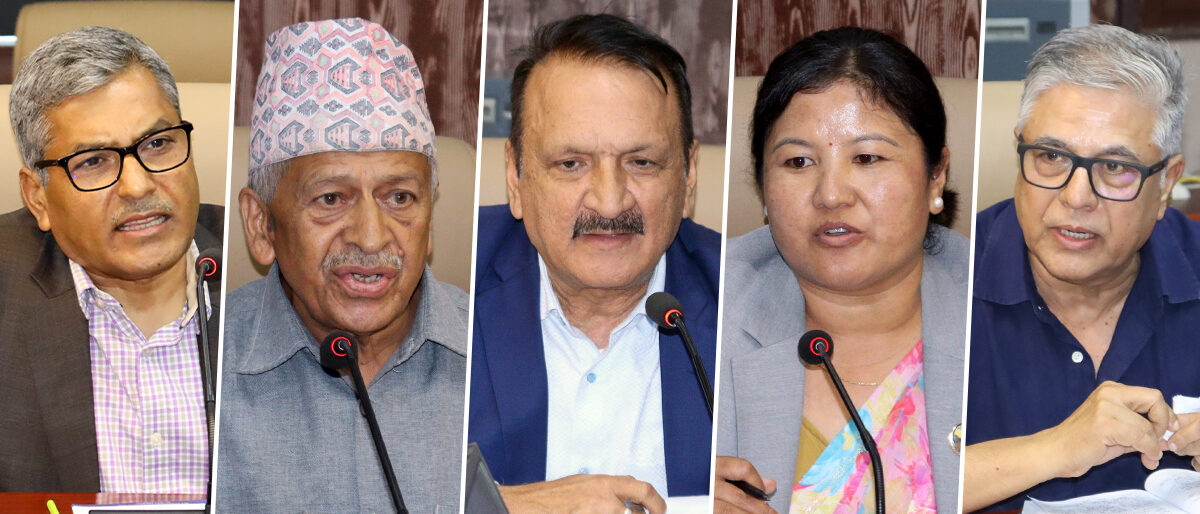
Former CPN-UML vice-chairman Surendra Pandey said public optimism is diminishing and urged the government to respond before confidence erodes further.
“Nepal is a country with limited resources but high expectations. Much of that hope is now fading,” Pandey said. “The government must take the situation seriously and act before public confidence is lost.”
He also expressed concern that fertilizer shortages and changing weather patterns could hurt agricultural production, potentially driving up food prices in the coming months.
Nepali Congress leader and former finance minister Dr. Prakash Sharan Mahat said Nepal’s economy has gradually recovered since the COVID-19 pandemic and that the current government initially raised expectations for stronger economic management and improved business confidence. However, he said those expectations weakened within four months of the government’s formation.
Mahat argued that actions taken in the name of good governance have at times undermined the rule of law, creating uncertainty in the market. He also questioned whether the government could achieve its ambitious target of 7 percent economic growth.
He stressed the need for targeted industrial policies, saying Nepal should selectively support sectors with the potential to become self-sufficient while encouraging investment in industries that generate employment and income.
Mahat also criticized what he described as a policy approach similar to that of US President Donald Trump, arguing that reducing taxes for the wealthy on the assumption that investment will automatically increase is not appropriate for Nepal’s economic context.
Former secretary Kewal Bhandari said the majority government had been expected to introduce transformative reforms but had instead continued with conventional policies. He added that neither the national budget nor the new monetary policy has inspired confidence among the private sector or demonstrated a clear strategy for reviving business sentiment.
Former Nepal Rastra Bank Governor Dipendra Bahadur Chhetri said the government has considerable room to improve the economy but warned that measures introduced under the banner of good governance have made the private sector increasingly cautious. He said the government’s 7 percent growth target could be achievable if the monetary policy’s target of 11 percent credit expansion is met.
Former Governor Maha Prasad Adhikari echoed that assessment, saying sustained credit growth would support the government’s economic objectives. However, he noted that while the financial sector has moved ahead relatively quickly, progress in physical infrastructure development remains slow, underscoring the need for greater public investment.
Speaking at the event, former Nepal Rastra Bank Governor Dr. Chiranjivi Nepal said the Gen-Z movement had raised expectations for meaningful change, but those hopes have yet to materialize. He argued that while monetary policy has played a critical role in supporting economies around the world in recent years, Nepal’s latest monetary policy has failed to address several key challenges.
Dr. Nepal also observed that government budgets, which previously focused on marginalized communities, now appear to be increasingly geared toward the middle class. He further argued that Nepal Rastra Bank had introduced the new monetary policy without fully assuming responsibility for addressing broader economic concerns.
The discussion featured a presentation by economist Dr. Sudhan Oli, who reviewed the latest trends across key sectors of the economy. The event was moderated by ISSR Director Naresh Shrestha and chaired by Pem Kandel.





Comment