




The recent discussions during the official visit of Nepal’s Foreign Minister to India regarding the possible establishment of a campus of the Indian Institute of Technology (IIT) in Nepal have generated considerable public interest.
As an engineering educator who has devoted more than five decades to teaching, research, academic leadership, and institutional development, I warmly welcome every initiative that strengthens educational cooperation between Nepal and India.
The IIT system is internationally recognized for its excellence in engineering education, research, innovation, and technological leadership. Nepal has much to gain from closer collaboration with these distinguished institutions.
However, I respectfully submit that there is a more strategic and sustainable path.
Before investing billions of rupees in establishing a new IIT campus, Nepal should first invest in strengthening its own engineering institutions—particularly the Institute of Engineering (IOE) at Tribhuvan University, which has served as the nation’s premier engineering institution for more than half a century.
For over 50 years, the IOE has educated generations of engineers who have built Nepal’s roads, bridges, hydropower projects, telecommunications systems, industries, and urban infrastructure. Equally important, it possesses assets that cannot be created overnight: institutional memory, experienced faculty, established academic traditions, a strong alumni network, public trust, and a deep understanding of Nepal’s development priorities.
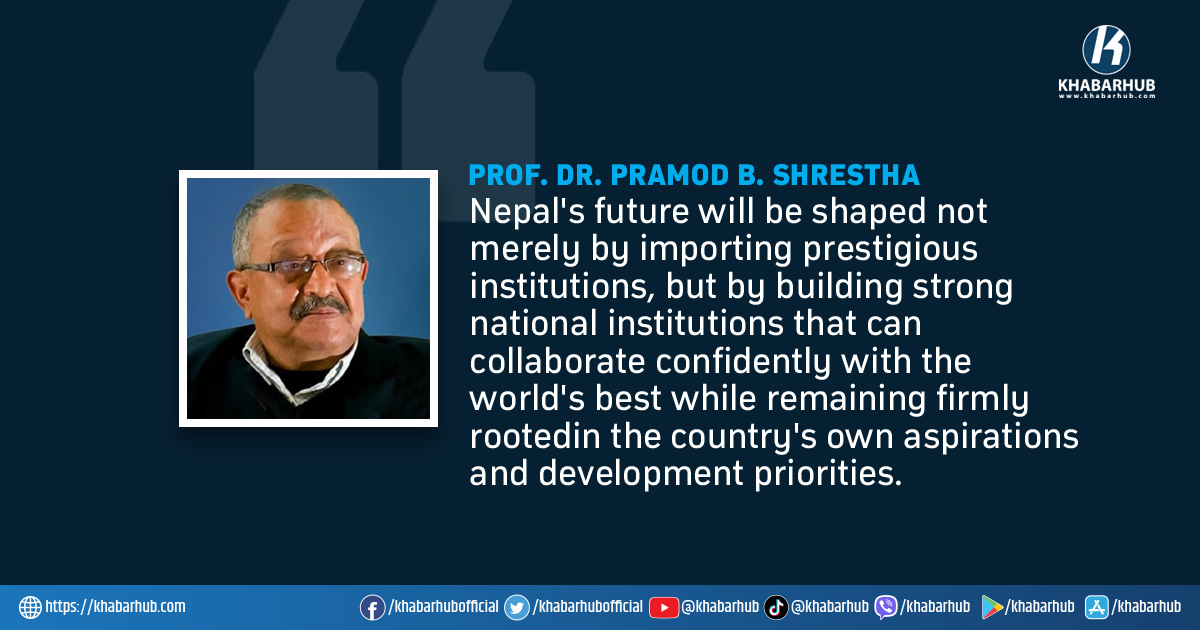
Nepal’s future will be shaped not merely by importing prestigious institutions, but by building strong national institutions that can collaborate confidently with the world’s best while remaining firmly rooted in the country’s own aspirations and development priorities.
Establishing a new IIT campus would require enormous investments in land, infrastructure, administration, faculty recruitment, and long-term operational support. Those same resources could instead transform existing institutions that already educate thousands of Nepali students every year.
Imagine the impact if these investments were directed toward modernizing laboratories and workshops, expanding master’s and doctoral programmes, establishing internationally competitive research centres, strengthening faculty development, creating innovation and entrepreneurship hubs, enhancing university-industry collaboration, improving digital research infrastructure, and achieving international accreditation.
Such investments would strengthen Nepal’s entire engineering education ecosystem rather than creating a separate island of excellence. The choice before us should not be framed as “IOE versus IIT.” Rather, it should be “IOE with IIT.”
I therefore propose a Government of Nepal–Government of India partnership that emphasizes collaboration rather than duplication. Such cooperation could include faculty and student exchanges, joint research addressing Himalayan and regional challenges, co-supervision of master’s and doctoral students, curriculum modernization, technology transfer, startup incubation, and joint centres of excellence in emerging fields such as artificial intelligence, renewable energy, water resources, infrastructure resilience, climate adaptation, and advanced manufacturing.
Through such a partnership, Nepal would benefit from IIT’s world-class expertise while simultaneously strengthening its own institutions and preserving national ownership of higher education.
The fundamental question before us is simple:
Do we merely wish to host a prestigious foreign institution, or do we aspire to build world-class Nepali institutions that stand confidently alongside the best in Asia?
International partnerships are indispensable in today’s interconnected world. Yet they should strengthen national capacity rather than substitute for it. The Institute of Engineering and Nepal’s public universities have served the nation faithfully for decades. They deserve renewed investment, greater autonomy, stronger governance, and meaningful international collaboration.
I therefore respectfully urge the Government of Nepal to place the strengthening of existing national institutions at the centre of any future educational cooperation with India or any other country. Let us build upon the foundations we already possess. Let us invest in institutions that belong to the people of Nepal. Let international cooperation become a catalyst for national capacity-building rather than a replacement for it.
Policy recommendations
To translate this vision into action, I respectfully offer the following recommendations, while recognizing that they are not exhaustive:
1. Enact an Umbrella University Act establishing a transparent national legal framework for all future public, private, and international universities to ensure quality, accountability, coordination, and national relevance.
2. Promote public and public-private partnership (PPP) models with clearly defined governance structures, sustainable financing mechanisms, and strong institutional accountability.
3. Transform Pulchowk Campus into Nepal’s first autonomous engineering university, while preserving its public mission and ensuring academic excellence.
4. Upgrade the IOE regional campuses at Pokhara, Dharan, and Chitwan into autonomous regional technical universities to decentralize high-quality engineering education.
5. Align universities with national priorities by encouraging specialization in strategic sectors such as hydropower, water resources, agricultural technology, digital infrastructure, disaster resilience, climate adaptation, manufacturing, and sustainable urban development, supported by rigorous accreditation and performance evaluation.
6. Redirect the proposed IIT investment toward strengthening Nepal’s existing engineering institutions through modern laboratories, doctoral education, research centres, faculty development, and digital infrastructure.
7. Establish an IOE-IIT Strategic Partnership Framework focusing on faculty exchange, collaborative research, graduate co-supervision, curriculum modernization, technology transfer, innovation ecosystems, and startup incubation, without creating a parallel foreign institution.
This approach would embody a genuine “Make in Nepal” model of higher education development. It would preserve national ownership and institutional autonomy while ensuring that international academic collaborations strengthen Nepal’s own institutions, governance systems, research capacity, and long-term self-reliance rather than creating dependence.
Nepal’s future will be shaped not merely by importing prestigious institutions, but by building strong national institutions that can collaborate confidently with the world’s best while remaining firmly rooted in the country’s own aspirations and development priorities.






Comment