




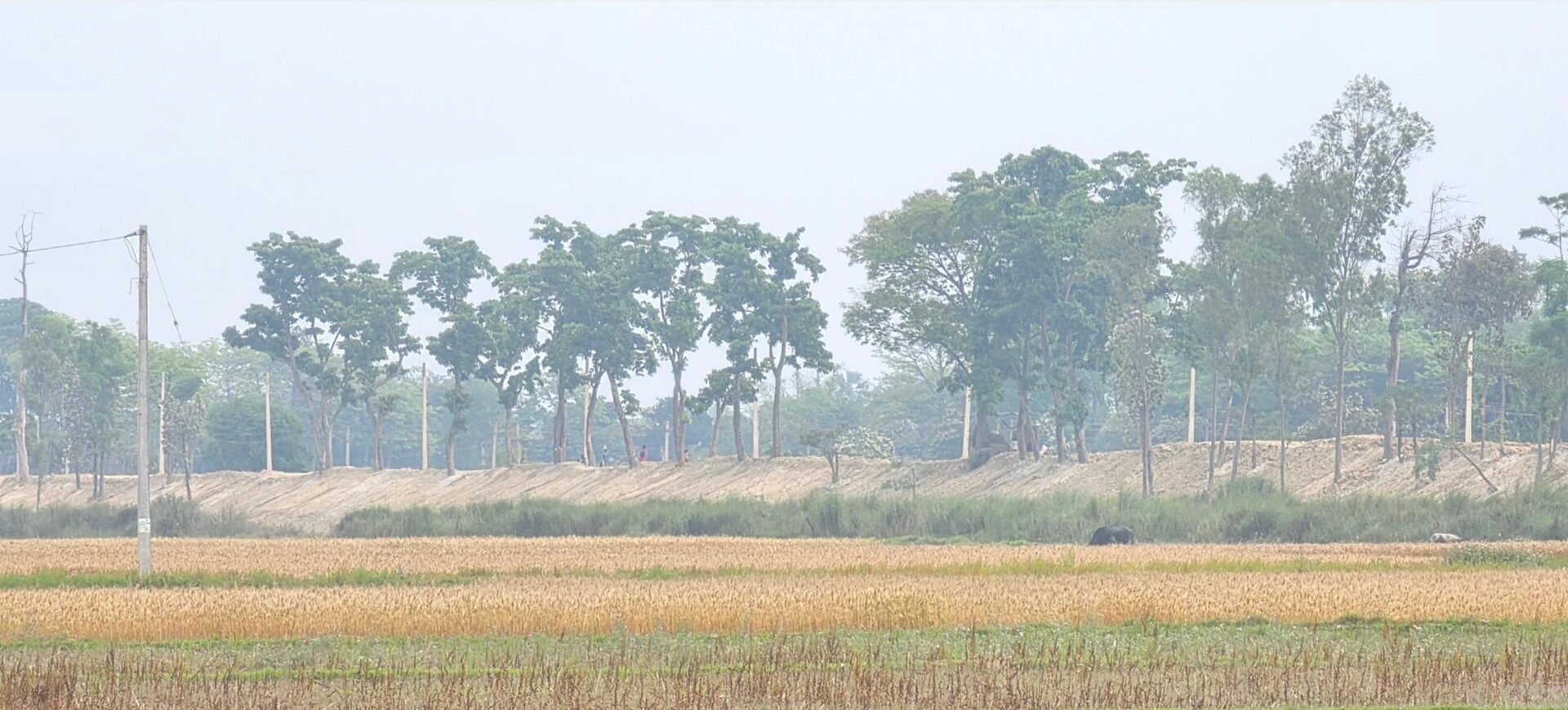
RAUTAHAT: Concerns have grown in Rautahat after the Indian side reportedly raised and reinforced an embankment along the Nepal–India border near Gaur under the pretext of maintenance, prompting fears of increased flooding in Nepali settlements during the monsoon season.
Local residents and officials claim that the embankment, located between Gaur in Nepal and Bairgania in India, has been heightened and widened without prior consultation with Nepal. Under existing bilateral understandings, physical structures near the border are generally expected to be constructed, expanded, or modified only through mutual coordination.
According to local resident Amit Keshari, the embankment has obstructed the natural flow of floodwaters during the rainy season, putting dozens of Nepali villages, including the district headquarters Gaur, at risk of inundation, according to RSS, Nepal’s government news agency.
Keshari said India had previously constructed a 15-foot-high embankment stretching approximately five kilometers to protect Bairgania and surrounding areas in Bihar from floods. However, he alleged that the structure has diverted floodwaters toward the Nepali side, resulting in recurring inundation in Gaur and nearby settlements.
He further claimed that floodwaters accumulate in Nepal when sluice gates on the eastern section of the embankment remain closed during periods of heavy rainfall.
Gautam Shrestha, secretary of the Rautahat chapter of the Federation of Nepali Journalists and a resident of Gaur, said the raised embankment has hindered the discharge of water from the Lal Bakaiya and Bagmati rivers flowing from Nepal into India. As a result, water backs up and enters settlements on the Nepali side.
According to Shrestha, additional soil has recently been added to the ring embankment in the Bairgania area, further restricting the natural drainage of floodwaters and increasing the risk of flooding in Gaur and surrounding communities. He warned that recurring inundation has caused significant losses of property and, in some cases, human lives.
Former Gaur Municipality Mayor Ajay Kumar Gupta also expressed concern over the ongoing work. He said previous attempts to raise the embankment had been halted following objections from Nepali authorities and security agencies.
Gupta argued that unilateral construction or expansion of large structures such as embankments and roads near the border violates the spirit of bilateral agreements governing border management.
According to Gupta, the embankment extends from the Bagmati River area in the east to Banjaraha village across the Bakaiya River and has contributed to annual flooding in Gaur Municipality and neighboring settlements.
He recalled that during his tenure as mayor in 2077 BS, Indian authorities had objected to Nepal’s efforts to construct a flood-control embankment along the Bakaiya River in Mahadevpatti of Gaur Municipality-2. He questioned why similar concerns were not being applied to the ongoing expansion work on the Indian side.
Gupta further alleged that the closure of sluice gates installed beneath the embankment has worsened flooding conditions in Gaur, as accumulated water is unable to drain effectively during the monsoon season.
Meanwhile, Rautahat Chief District Officer Dinesh Sagar Bhusal said the issue had been raised with his Indian counterpart, Sitamarhi District Magistrate Ruchi Pandey. According to Bhusal, Pandey informed him that the work was part of a repair and maintenance project being carried out by the Indian central government.
Bhusal noted that because the matter involves an international border and bilateral agreements, a long-term solution would require diplomatic engagement between the governments of Nepal and India.
He added that provincial leaders and former chief ministers of Madhesh Province have repeatedly urged the federal government to address the issue through diplomatic channels.
Local residents say that since the embankment was constructed, areas including Belbichuwa, Brahmapuri Laxmipur, all nine wards of Gaur Municipality, and several settlements in Ishanath Municipality—such as Bairiya, Auraiya, and Banjaraha—have experienced annual flooding.
The recurring inundation has reportedly caused losses worth millions of rupees each year, damaging homes, agricultural land, and crops across the affected areas.




Comment