




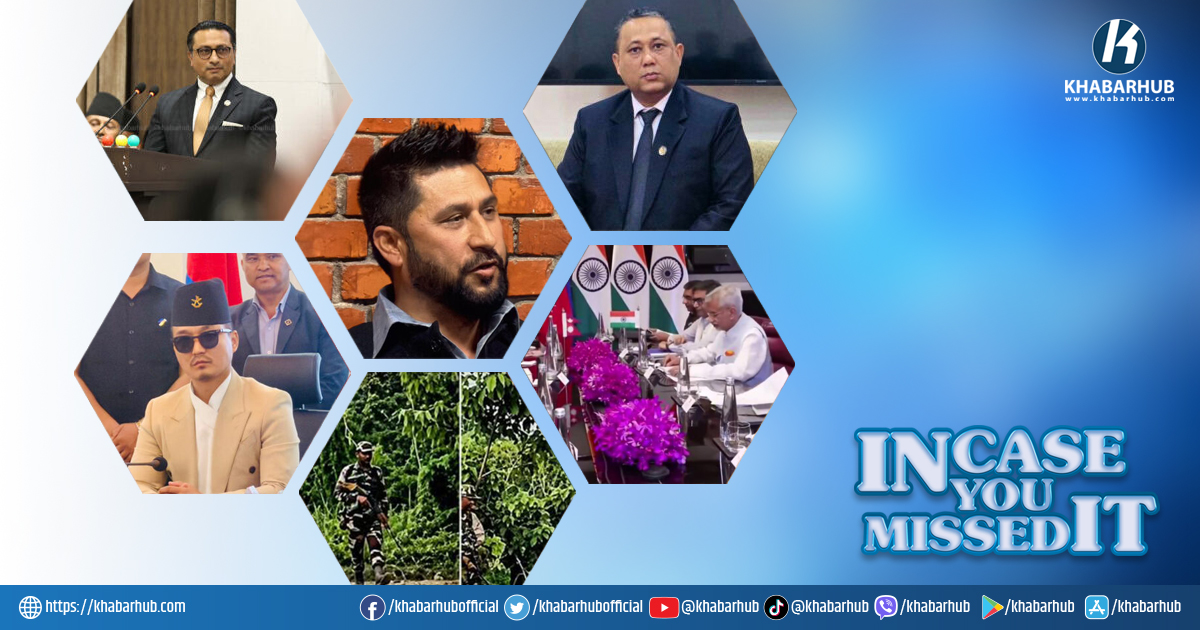
KATHMANDU: The past week in Nepal’s politics was defined by a striking contradiction. On one hand, the government led by Prime Minister Balendra Shah projected itself as a champion of accountability, institutional reform and good governance. On the other, several of its decisions raised serious questions about consistency, selective justice and the credibility of its reform agenda.
At the center of the debate was the government’s decision to reappoint Sudan Gurung as Home Minister despite a report by the National Human Rights Commission (NHRC) linking his actions to the escalation of the 2025 Gen-Z protests. The decision has not only reignited debate about the government’s commitment to accountability but has also exposed a growing tension between political expediency and institutional integrity.
The Gurung controversy illustrates perhaps the most significant challenge facing the Shah administration: whether it can maintain public trust while exercising power in ways that increasingly resemble the political establishment it once criticized.
The government’s rise to power was built largely on promises of transparency, anti-corruption measures and a break from the traditional political culture associated with Nepal’s major parties. Yet the treatment of different investigation reports reveals an apparent inconsistency.
The House of Representatives’ approval of the Appropriation Bill for detailed consideration allowed budget discussions to advance, but concerns about fiscal sustainability persist.
The government moved rapidly to act upon the findings of the Gauri Bahadur Karki Commission investigating the Gen-Z protests, resulting in the arrest of former Prime Minister KP Sharma Oli and former Home Minister Ramesh Lekhak. However, when the NHRC’s own investigation pointed toward the role of Sudan Gurung in escalating the same protests, the government’s response was markedly different.
The contrast is difficult to ignore. While one report led to arrests of opposition figures, another report implicating a member of the ruling establishment has remained largely unimplemented. The reappointment of Gurung has therefore fueled accusations that accountability is being applied selectively rather than universally.
The issue is not merely about one individual minister. It concerns the broader question of whether state institutions are treated equally regardless of whose interests are affected. Public confidence in democratic governance depends heavily on the perception that laws and investigations apply to everyone. When citizens perceive different standards for allies and opponents, trust in institutions inevitably suffers.
Adding another layer to the debate is the report of the government-appointed committee that cleared Gurung of allegations related to his assets and property disclosures. The committee’s conclusion that inconsistencies stemmed from weaknesses in state systems rather than deliberate misconduct may be legally significant. Yet politically, it has done little to silence criticism.
The committee’s findings raise broader questions about Nepal’s administrative structures. If weaknesses in land registration, asset declaration systems and financial reporting are widespread enough to create repeated discrepancies, then institutional reform becomes an urgent necessity.
The government’s defense of Gurung rests heavily on systemic shortcomings rather than a straightforward rebuttal of every allegation. In effect, the controversy has shifted attention from individual accountability to the quality of governance itself.
Interestingly, Gurung wasted little time in making his presence felt after reassuming office. His announcement of four major initiatives—including a fresh probe into the 2001 Narayanhiti Royal Palace massacre, a review of cases linked to the Gen-Z protests and efforts to tighten information security within the Home Ministry—signals an attempt to demonstrate decisiveness and political confidence.
The proposal to reopen investigations into the 2001 royal massacre is particularly notable. More than two decades after one of the most traumatic events in Nepal’s modern history, public interest and unanswered questions remain. Whether the renewed investigation produces substantive findings or becomes another politically symbolic initiative remains to be seen. Nevertheless, it reflects the government’s willingness to engage with issues carrying significant historical and emotional weight.
Beyond domestic political controversies, foreign policy developments also occupied a prominent place in the week’s agenda. Foreign Minister Shishir Khanal’s diplomatic engagements with both India and China reflected Nepal’s longstanding effort to maintain balanced relations with its two powerful neighbors.
Khanal’s visit to India resulted in several practical achievements, including the operationalization of cross-border peer-to-peer payment systems and agreements related to reconstruction projects and digital infrastructure cooperation. These developments suggest that Nepal-India relations continue to move forward despite periodic political tensions.
Perhaps more importantly, Khanal repeatedly reaffirmed Nepal’s commitment to resolving border disputes with India through diplomatic channels. His statements regarding Lipulekh, Limpiyadhura and Kalapani demonstrated continuity in Nepal’s official position while emphasizing dialogue rather than confrontation.
The foreign minister’s subsequent departure for China further highlighted Nepal’s delicate balancing act. Successive engagements with New Delhi and Beijing underscore Kathmandu’s effort to avoid appearing aligned too closely with either side. This balancing strategy has become increasingly important in an era of heightened geopolitical competition across South Asia.
Yet the border issue remains politically sensitive. Reports from Susta alleging incursions by India’s Sashastra Seema Bal generated local concern and revived longstanding anxieties regarding border management. While official verification remains absent, the incident demonstrates how local-level tensions can quickly intersect with national politics and diplomatic relations.
The judiciary also played a significant role during the week, producing decisions with potentially far-reaching consequences. The Supreme Court’s refusal to extend an interim order blocking the government’s decision to dissolve trade unions effectively strengthened the executive’s position.
Supporters of the move argue that excessive unionization within government agencies has often hindered administrative efficiency. Critics, however, see the decision as potentially weakening workers’ rights and collective representation.
Equally significant was the Supreme Court’s mandamus order in the former child soldier case involving allegations linked to Nepal’s armed conflict. Although the full verdict remains pending, the ruling signals the judiciary’s continuing willingness to engage with unresolved issues from the country’s conflict-era past.
At the same time, the Cabinet’s decision to extend the deadline for a constitutional amendment taskforce suggests that broader institutional reforms remain under consideration.
The decision could have broader implications for transitional justice and accountability. Nepal’s peace process has long been criticized for delays and inconsistencies in addressing wartime abuses. Any judicial intervention that advances these issues is likely to attract considerable public attention.
Meanwhile, developments surrounding Rastriya Swatantra Party (RSP) leader Rabi Lamichhane provided another example of shifting legal and political fortunes. Court decisions dropping organized crime charges against him in multiple cases represent significant relief for both Lamichhane and his party. Although cooperative fraud allegations remain, the narrowing of charges strengthens his political position and potentially enhances his ability to challenge opponents.
These developments are especially important because the RSP remains central to Nepal’s evolving political landscape. As one of the country’s newer political forces, the party’s future will depend heavily on whether it can maintain its anti-establishment appeal while exercising governmental authority.
Economic governance also remained a major focus. The House of Representatives’ approval of the Appropriation Bill for detailed consideration allowed budget discussions to advance, but concerns about fiscal sustainability persist. Opposition lawmakers questioned the balance between recurrent and capital expenditure, while Finance Minister Swarnim Wagle defended the government’s strategy.
Wagle’s allegations that vested interests are targeting both him and the Prime Minister reveal another recurring theme in Nepalese politics: the struggle between reformist narratives and entrenched power structures. Whether these claims reflect genuine resistance to anti-corruption efforts or simply political rhetoric is difficult to determine. However, they highlight the increasingly confrontational atmosphere surrounding governance reforms.
The appointment of Mahabir Pun as Minister for Science, Technology and Innovation was one of the week’s more broadly welcomed developments. Pun enjoys significant public credibility due to his work promoting innovation and community-based technological development. The creation of a dedicated ministry reflects growing recognition that technological advancement will be critical to Nepal’s future competitiveness and economic transformation.
The ability of leaders and institutions to navigate this tension will help determine not only the success of the current government but also the future trajectory of Nepal’s democratic governance.
At the same time, the Cabinet’s decision to extend the deadline for a constitutional amendment taskforce suggests that broader institutional reforms remain under consideration. Constitutional debate has remained a sensitive issue since the promulgation of the 2015 Constitution. Any effort to revisit constitutional provisions will require careful political management and broad consensus.
Taken together, the events of the past week reveal a government navigating multiple pressures simultaneously. It seeks to present itself as reformist while facing accusations of selective accountability. It promotes institutional strengthening while confronting concerns about political interference. It pursues balanced diplomacy while managing sensitive border issues. It advances governance reforms while encountering resistance from both political opponents and established interests.
The central challenge for the Shah administration is consistency. Public expectations remain exceptionally high because the government came to power promising a different style of politics. Citizens who supported change will judge not only the government’s intentions but also whether its actions match its stated principles.
The Sudan Gurung controversy has become a test case for that broader question. The issue is no longer simply whether one minister should remain in office. It is whether the government’s commitment to accountability applies equally to friends and opponents alike.
As Nepal moves forward, the credibility of institutions such as the NHRC, the courts and parliamentary oversight mechanisms will become increasingly important. Democratic systems function effectively when institutions are respected regardless of political convenience. The coming weeks will therefore be closely watched for signs of whether the government intends to address concerns about selective implementation of investigative findings.
Ultimately, the past week’s developments suggest that Nepal’s political transition remains a work in progress. The demand for accountability is stronger than ever, but so too are the temptations of power. The ability of leaders and institutions to navigate this tension will help determine not only the success of the current government but also the future trajectory of Nepal’s democratic governance.




Comment