




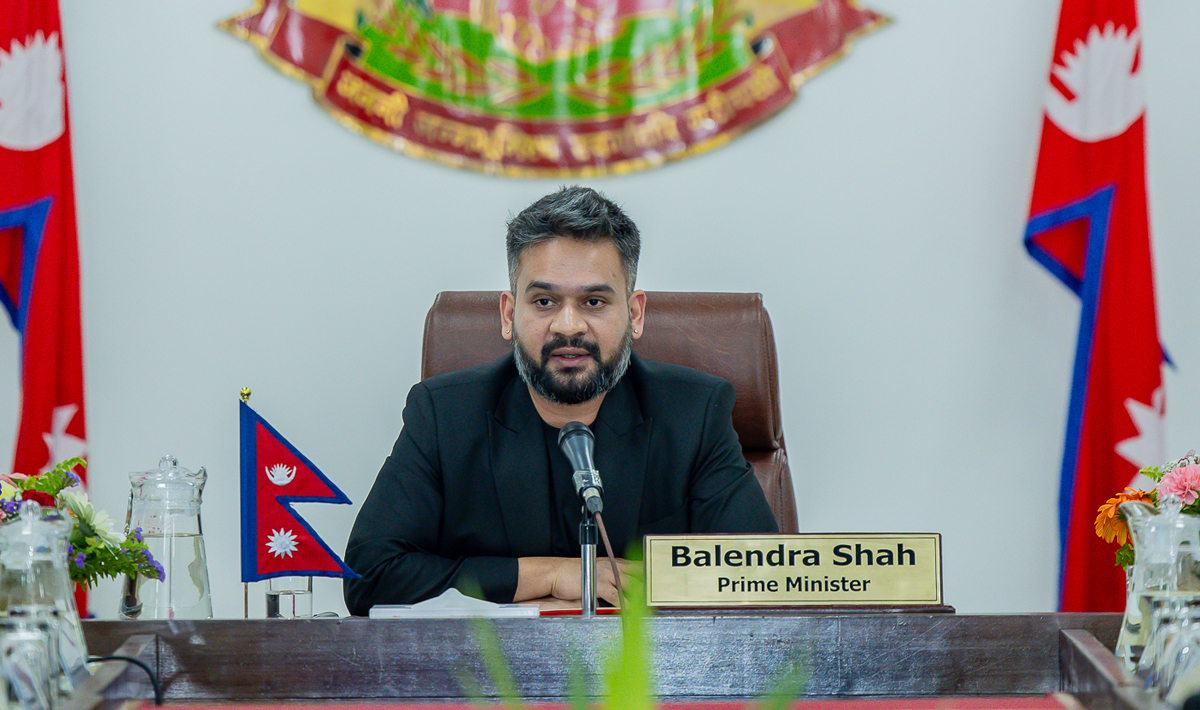
KATHMANDU: In recent weeks, criticism has been mounting that the powerful government led by Prime Minister Balen Shah has begun moving in a wrong and questionable direction.
The party, which secured 182 seats—just short of a two-thirds majority—after making promises to lower-income communities, is now accused of repeatedly targeting those very groups. As mainstream Nepali media continue to defend the interests of ordinary citizens, the government itself appears to have turned against the press.
On Monday, the government was seen confronting the media, which had increasingly taken on the role of a strong opposition by raising questions over its actions. There are growing concerns that a coordinated effort is being planned from Singha Durbar to target mainstream media in a suspicious manner.
Facts that have surfaced in the controversy indicate the alleged involvement of Prime Minister Balen Shah’s chief adviser, Kumar Ben. While suspicious vehicles were reportedly parked outside media houses as part of what critics describe as a retaliatory campaign against the press, Prime Minister Shah and those close to him have remained silent.
Meanwhile, Rastriya Swatantra Party (RSP) General Secretary Bipin Acharya has issued a statement demanding an impartial investigation into the incident. The development has fueled speculation of growing differences between those aligned with Prime Minister Shah and those close to party chair Rabi Lamichhane.
Since becoming prime minister on March 28, Shah has remained at the center of public criticism. Barely a month after assuming office, the government began forcibly removing informal settlements on April 25. The government has yet to answer the questions raised over the eviction campaign.
Residents of the informal settlements, many of whom were displaced in tears, later found themselves submerged by floodwaters. Those who had been removed in the name of protecting them from floods were ultimately left vulnerable by the government’s actions. So far, three displaced residents have reportedly lost their lives.
The government’s budget for the new fiscal year has also drawn criticism for placing additional burdens on low-income families. Amid rising inflation and mounting financial pressure, Ganesh Nepali, who struggled to support his family, died by self-immolation after allegedly being unable to withstand pressure from municipal police.
As these and similar incidents continued to unfold, suspicious vehicles were found parked from early Monday morning outside the offices of major media organizations and the homes of political leaders. According to the police’s preliminary investigation, the vehicles are linked to leaders associated with the Rastriya Swatantra Party. Police launched an investigation after suspicious vehicles were found outside the residence of Nepali Congress leader Gagan Thapa and the offices of Onlinekhabar, Kantipur, and Himalaya Television.

However, police only moved to remove the vehicles nearly seven hours after they were first discovered.
Prime Minister Shah’s governing style has increasingly become a source of concern for many leaders within the RSP.
Several leaders have begun expressing their dissatisfaction in different ways. From the very beginning, leaders including Dr. Amaresh Kumar Singh and Purushottam Yadav had voiced concerns over Shah’s style of governance.
More recently, Ranju Darshana, Pukar Bam, Manish Jha, Ashika Tamang, Prakash Pathak, Jagadish Kharel and others have publicly expressed their dissatisfaction through social media and public statements. They have warned that the government must remain on track, arguing that losing its direction could lead to serious consequences.
Apart from leaders considered close to Prime Minister Shah, many others within the party are also believed to be unhappy with his working style, although that dissatisfaction has not yet surfaced openly.
Party Chair Rabi Lamichhane, General Secretary Bipin Acharya, leader Kabindra Burlakoti, Energy Minister Biraj Bhakta Shrestha, Foreign Minister Shishir Khanal, Ganesh Parajuli, Pradip Chandra Pariyar, who joined the RSP from Bibeksheel Sajha, party whip Krantisikha Dhital, Joint General Secretary Hari Dhakal, Nisha Dangi and several others are seen as having indirectly expressed dissatisfaction with the prime minister’s approach.
Even Ganesh Karki, a leader regarded as being close to Shah, has reportedly expressed strong dissatisfaction with the government’s working style.
Prime Minister Shah has also faced criticism for what detractors describe as prejudice against ordinary citizens and unfair treatment of lower-income communities. While these concerns continue to be raised within the party, Shah’s secretariat has remained active in defending him.
Political analyst Indra Adhikari says the dissatisfaction has not yet become public because the party won its overwhelming mandate largely by projecting Shah as its face.
“Leaders inside the party appear deeply restless because of Balen’s working style,” Adhikari said. “The moment that restlessness becomes public, there will be very few people left to stand by him. That is why it is time for serious reflection.”




Comment