




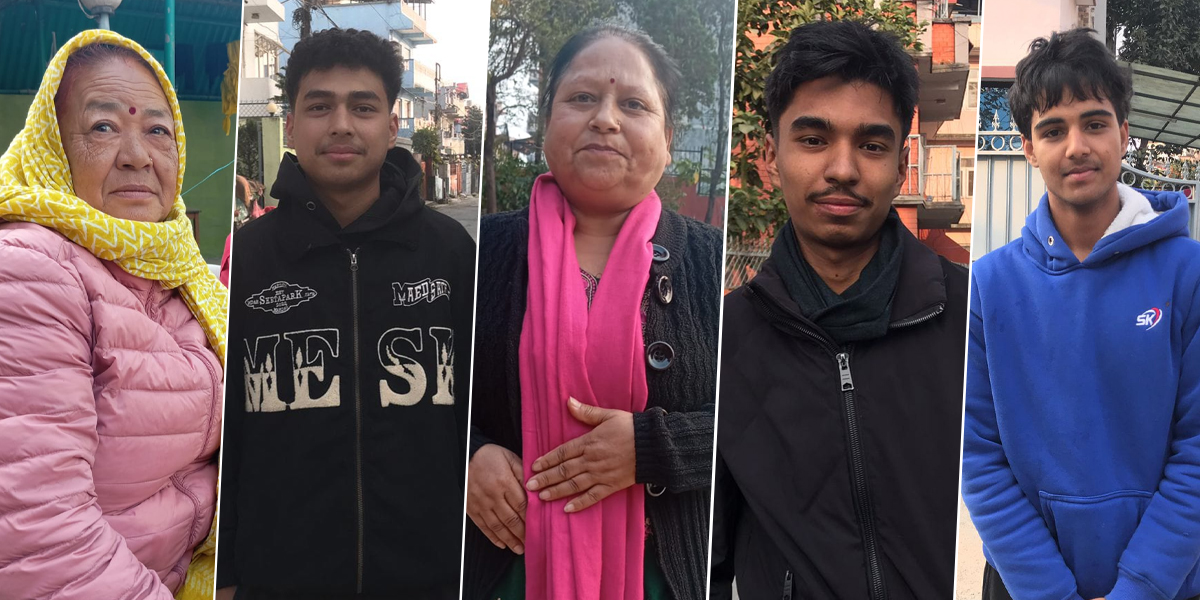
KATHMANDU: The upcoming House of Representatives election scheduled for March 5, announced in response to the demands raised during the Gen-Z movement on September 8 and 9, has generated visible enthusiasm among voters in Kathmandu-4.
With public expectations high that the election will lay the foundation for good governance, Khabarhub reached Budhanilkantha Municipality-8, Golfutar, to gauge voter sentiment. Locals expressed eagerness to cast their ballots, though opinions remain divided between continuity and change.
Seventy-year-old Begmaya Gurung said she has consistently voted for the Nepali Congress since relocating to the area in 2017 and has no plans to switch allegiance this time.
“After moving here in 2017, we voted for Gagan Thapa. We will vote for Nepali Congress again,” she said. “There is no plan to change our vote. We have some difficulty with drinking water here. That problem should be addressed.”
Gurung added that her family members, including her children, have encouraged her to continue supporting the Congress candidate, describing him as a capable and energetic leader. “At this age, why change my vote? I will stick with Nepali Congress,” she said.
However, another voter from the same locality, Mathura Acharya, expressed hope in emerging political forces. A homemaker, she said she is considering shifting her support to a new party, believing fresh leadership could introduce new policies.
“For years, I voted for the Nepali Congress. But the old parties have not delivered much. This time, I am thinking of voting for a new party,” she said. “We need a new Prime Minister who can do better for the country.”
Acharya admitted she was not aware of the specific candidate representing the new party in her constituency. “I don’t know who is contesting here. The candidate may come during door-to-door campaigning. Even if I don’t recognize them, I will vote for the new party,” she said enthusiastically.
She also voiced frustration with the previous government led by KP Sharma Oli, alleging that restrictions on social networks during his tenure forced young people into protest. “Our children were compelled to join protests. When people demanded jobs and industries, bullets were fired. Do they care about others’ children?” she questioned, criticizing what she described as a disconnect between leadership and public concerns.
Meanwhile, Gen-Z voters in the area said they would prioritize candidates committed to curbing corruption and ensuring accountability.
Sudin Paudel, a young voter, said anti-corruption measures must be the central agenda of both candidates and the next government. “After Grade 12, there should be employment opportunities. The government must ensure proper utilization of the budget collected from our taxes,” he said, recalling his visit to Parliament as a student and stressing the need for effective lawmaking and budget oversight.
Another youth voter, Kripesh Ghimire, said he would evaluate candidates based on their commitments and past performance rather than party affiliation.
“Whether new or old, we must look at what they have promised. If they are old candidates, we should assess what they previously pledged and what they actually delivered,” he said.
Ghimire acknowledged that development in his locality has been relatively satisfactory but emphasized the need for balanced development across the country. “Cities may have facilities, but roads to villages are in poor condition. The next government must ensure equal services and infrastructure in both urban and rural areas,” he added.
Echoing similar concerns, another voter, Saksham Dongol, linked the Gen-Z protests directly to widespread corruption and unfulfilled promises by political leaders.
“Leaders go to power but fail to work as promised. That is why the Gen-Z movement happened,” he said. “It is not enough to make commitments after winning. They must deliver.”
Dongol stressed the need for reforms in the education sector from early grades and called for equitable access to modern facilities such as smart boards. He also raised concerns about alleged irregularities in the Secondary Education Examination (SEE) process, saying the government must ensure transparency and accountability.
As Kathmandu-4 prepares for the March 5 election, voter sentiment reflects a mix of party loyalty, demand for generational change, and a strong call for good governance and anti-corruption reforms.





Comment