




This article does not evaluate the political effect of the March 5, 2026, elections in terms of liberal or nationalist principles. Instead, it focuses on how the political scene is changing and the growing capacities within it. Voters now expect more than just charismatic figures or symbolic gestures; they want transparent administration, strong institutions, better public services, and concrete policy results.
Less than six months ago, the electorate used democratic processes to oppose the long-standing, control-focused politics of politicians like Dahal, Oli, Deuba, Bhattarai, Nepal, and Khanal, who have been associated with instability, corruption, unemployment, youth migration, weak governance, and the accumulation of power and resources.
Nearly forty years after Nepal gained nominal political and civil freedom, its citizens still face social and economic challenges. Parliament remains the primary forum for political debate, institutional development, and socioeconomic reforms. However, it no longer solely controls the pace of political change or the success of public policies.
While elections are credible, they have not fully stabilized democracy, as leaders hesitate to strengthen the institutions, procedures, and authority essential to democratic governance. Therefore, Nepal needs to strengthen its institutions, democratic processes, and citizen engagement, especially by leveraging modern information and technology, which are critical to democracy.
From a political science perspective, chaos and order relate to governance, that is, addressing issues and building new institutional frameworks to maximize benefits. Federalism and local governments mark a new phase, promoting decentralization and devolution. Local authorities are gaining influence, reducing the dominance of central power. For federalism to succeed, core elites must cede decision-making authority to empower local institutions.
Whether deliberate or not, these tactics threaten genuine political renewal and may revive old patterns of domination. Nonetheless, Nepal has experienced notable progress, with citizens becoming more informed, politically aware, and less willing to accept previous practices.
The key question is whether these reforms are supported by broader political and societal changes. Structural reforms alone are not sufficient; shifts in political culture, beliefs, and the functioning of institutions are also necessary.
Unfortunately, these deeper issues are often overlooked or inadequately addressed by government policies. The main goal goes beyond merely holding free elections; it involves building a political system that upholds the rule of law, accountability, and effective governance.
Such a framework would enable structural reforms, economic growth, and proactive development. Without strong institutions, Nepal risks slow economic progress, a fragile democracy, and ineffective governance.
Political change alone is insufficient if it merely replaces politicians without reforming the underlying system. As Francis Fukuyama notes in The Great Disruption (1999), harmful social norms can persist across generations. Therefore, sustainable democratic reform requires broad public consensus on a legitimate political order that replaces outdated practices with institutions grounded in integrity, transparency, accountability, and the rule of law.
For Nepal, genuine reform must begin by combating systemic corruption and holding officials accountable. Although the Balen government has made early efforts, the structural conditions that enable corruption and patronage remain largely intact, casting doubt on the prospects for meaningful reform.
Although many see voters as a powerful influence in Nepal’s politics, the rise of the Rastriya Swatantra Party (RSP) mainly indicates a public desire for results-driven governance rather than an ideological divide. Additionally, Nepal should aim to build consensus to kick-start a new phase of rapid economic growth, focusing on efficiency, productivity, reforms, responsiveness, and real outcomes, reflecting the idea that governments should be judged based on their performance, not party loyalty.
Currently, Nepal faces the critical challenge of its sluggish bureaucracy, which requires reform grounded in Weber’s principles, such as hierarchy, meritocracy, specialization, clear rules, integrity, impartiality, and professionalism, to improve functionality and encourage innovation.
Of course, much of the bureaucracy remains politicized, often serving partisan interests rather than the public good. This has fueled public frustration, diminished trust in state institutions, and deepened dissatisfaction with governance. Likewise, a regime-generated partisan judiciary, instead of independently safeguarding the Constitution and upholding the rule of law, has increasingly served autocratic interests.
It appears to have become an unmitigated failure, with the situation worsening over time. Perceived political interference, inconsistent accountability, and institutional fragility have further eroded public confidence. As a result, both institutions struggle to fulfill their constitutional roles, thereby weakening democratic governance and the rule of law.
Recognizing these issues is crucial because they stem from more than thirty years of ineffective governance. The country’s decline is the result of prolonged misrule by six leaders: Girija, Pushpa, Khadga, Baburam, Madhab, and Jhalnath. As Mahatma Gandhi observed, “Nature can meet your needs, but not your greed.” The nagging question is whether the well-being of the Nepali people and their living conditions have become the nation’s foremost concern. The most critical determinant of progress is economic reform, effectively addressing the country’s persistent economic ills. Achieving this requires more than a change in leadership; it demands far-reaching institutional reforms.
To realize its goals of political renewal, the RSP must actively cultivate a clear and inclusive vision of democracy, along with a culture of peace, security, and good governance, instead of remaining, in Winston Churchill’s words, “a riddle wrapped in a mystery inside an enigma.” Genuine reform is unlikely without replacing patronage networks and biased actors in the bureaucracy and judiciary with institutions founded on merit, professionalism, integrity, and the rule of law.
Without accountability, reforms are merely political slogans. As Karl Deutsch observed, social and political change arises from various interacting forces, not fixed outcomes. In Nepal, greater social mobilization, an informed public, and the expansion of digital communication have empowered ordinary citizens to challenge entrenched political elites and demand greater transparency, responsiveness, and accountability.
A society develops only in the absence of conflict. Although Nepal experienced a decade-long Maoist armed insurgency (1996–2006), which generated significant tensions, the country is now relatively peaceful and is governed by a democratically elected prime minister from the RSP. This marks a stark contrast to previous governments led by the ODD (Oli, Dahal, and Deuba), which governed in an increasingly autocratic manner and lacked democratic legitimacy.
While regime-generated stagnation inevitably invites trouble, it does not improve the prospects for peaceful coexistence. Undoubtedly, democracies tend to demonstrate greater patience, with civil society playing a vital role in shaping state-society relations.
I cannot precisely define what a model of democratic excellence, generally understood as government by the people, would look like. Our society is becoming more complex and dynamic, and for the political system to be effective, it must inspire the younger generation and engage society at large. It needs to offer diverse ideas that resonate with different individuals, who will inevitably respond in various ways.
It has long been clear, for better or worse, that Nepal lacks the political capital to support meaningful democratic change. Hopefully, traditional political philosophy holds the key to understanding what has gone wrong with Nepal’s political order.
Research on good governance has evolved through various stages. According to Gerson and Rubin (2015), good governance can coexist with a constitution and should be integrated into liberalism to deepen its understanding of individual rights. Nonetheless, democracy requires more than formal debates; it must promote tangible changes in how the state and society operate. While Nepal’s party system is still developing, it lacks national consensus, has fragmented structures, and lacks a clear ideological direction.
The RSP can help by promoting greater civic engagement among Nepal’s diverse population, strengthening institutions, and sustaining reform efforts.
Nepal’s democratic challenges today paradoxically arise from diminishing party ideologies, distorted electoral incentives, widespread corruption, clientelism, and cronyism. The country’s democratic institutions face challenges at various levels. Instead of promoting a unified national identity and addressing issues across political, social, cultural, and economic spheres, some political groups focus on reclaiming power by spreading distrust and division and targeting figures such as the RSP, Rabi Lamichhane, and Balen Shah.
Whether deliberate or not, these tactics threaten genuine political renewal and may revive old patterns of domination. Nonetheless, Nepal has experienced notable progress, with citizens becoming more informed, politically aware, and less willing to accept previous practices.
Although no political party is permanently excluded from returning to power, electoral competition is essential to democracy, and efforts to divide or weaken reform movements can harm not only individual politicians but also public trust. History shows that strategies designed to block popular initiatives often backfire.
The core issue extends beyond the dominance of specific groups and the flaws of the state, despite legal and institutional reforms that have improved Nepal’s electoral democracy. Furthermore, some supporters justify or defend these practices, thereby undermining accountability.
Ultimately, Nepal’s primary challenge is not merely changing leaders but transforming political culture. Unless the country moves away from patronage, impunity, and personal control and toward accountability, transparency, and institutional integrity, changes in leadership will have limited and short-lived effects.
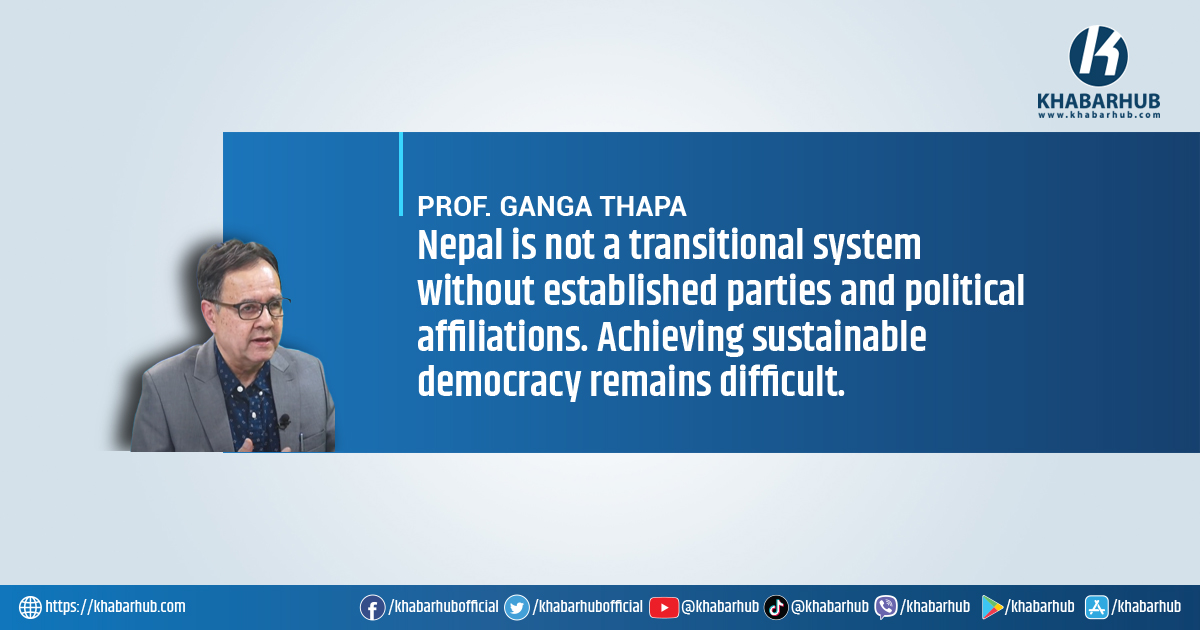
Nepal is not a transitional system without established parties and political affiliations. Achieving sustainable democracy remains difficult. Nonetheless, as prime minister, Balen has a vital opportunity and duty to advance democratization, good governance, and economic reform. The RSP can help by promoting greater civic engagement among Nepal’s diverse population, strengthening institutions, and sustaining reform efforts. While setbacks are common in democratic progress, the lessons they teach often outweigh immediate victories.




Comment