




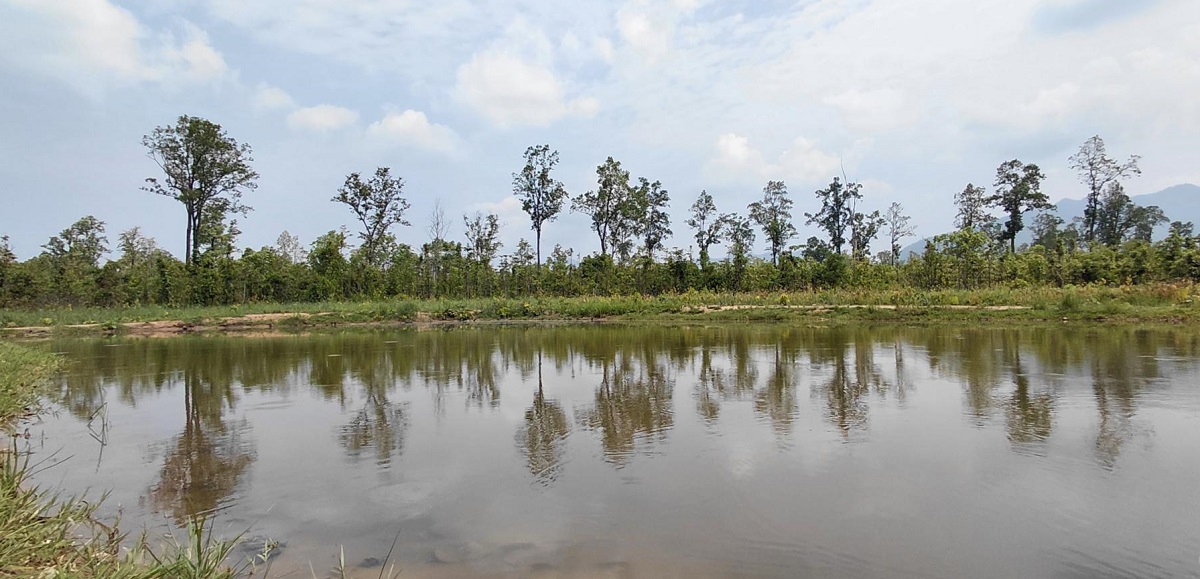
KATHMANDU: Artificial ponds constructed by Banke National Park have significantly contributed to wildlife conservation and the reduction of human-wildlife conflict, according to park authorities.
The national park has built 30 artificial ponds, helping address the long-standing water shortage in the Chure and Bhabar regions while reducing the movement of wild animals into nearby human settlements.
Park officials said that year-round water availability within the protected area has decreased the number of animals leaving the forest in search of water. The improved access to water has also enhanced the overall condition of wildlife residing in the park.
Senior Conservation Officer Birendra Prasad Kandel said the initiative has played a key role in improving habitat conditions for wildlife.
Established to expand tiger habitat, Banke National Park represents the Chure and Bhabar ecosystems. Due to its geographical characteristics, surface water has historically been scarce, particularly during the dry season, forcing wildlife to venture outside the park in search of water.
The park’s only natural water sources are the Chagai Stream and Muguwa River. With no other reliable year-round water sources, wildlife frequently moved beyond park boundaries, increasing the risk of conflict with local communities.
To address the problem, the park installed solar-powered deep-boring systems to supply water to the artificial ponds. Through this technology, water availability has been ensured across approximately 72 kilometres of the park area.
Authorities said that improved water access, combined with better grassland management, has strengthened both food availability and habitat quality for wildlife. According to Kandel, populations of key prey species for tigers—including spotted deer, four-horned antelope, barking deer, nilgai, and other herbivores—have increased significantly.
The growth in prey species has, in turn, had a positive impact on tiger conservation efforts within the park.
Wild animals that previously strayed into villages in the buffer zones of Banke, Dang, and Salyan districts due to shortages of water and food are now increasingly concentrated within the park’s core area.
Officials say this shift has reduced human-wildlife conflict while improving the sense of safety and confidence among local residents.
“This practice of constructing artificial ponds has simultaneously strengthened wildlife conservation, ecological balance, and the safety of local communities,” Kandel said.
According to park authorities, the initiative is now being viewed as a model conservation practice that could be replicated in other Chure and Bhabar region conservation programmes across Nepal.





Comment