




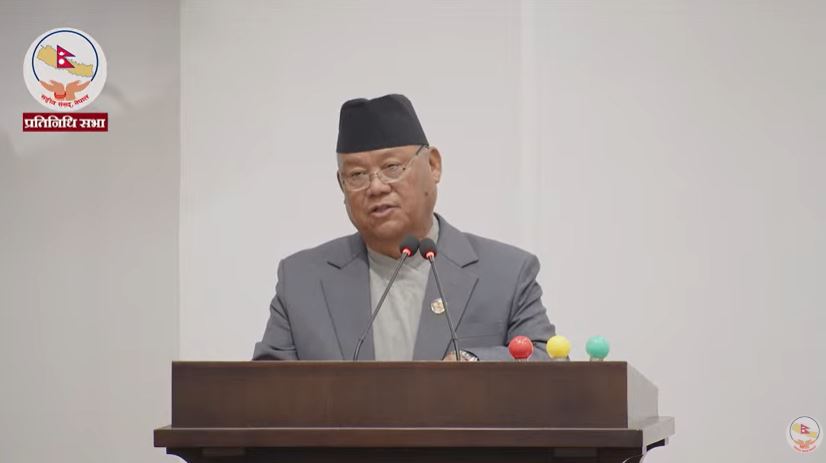
KATHMANDU: The main opposition Nepali Congress has launched a strong political and constitutional attack on the government at the start of the House of Representatives’ budget session, accusing it of bypassing Parliament, weakening democratic norms, and governing through ordinances.
Addressing Tuesday’s parliamentary meeting, opposition leader Bhishmaraj Angdembe accused the government of undermining Parliament’s legislative authority by introducing around 150 amendments and new laws through ordinances after postponing the House session despite already announcing the session.
“The primary duty of Parliament is lawmaking, but the government snatched that authority and chose the ordinance route,” Angdembe said. “This raises serious questions about the government’s commitment to the parliamentary system.”
He compared the growing use of ordinances to “a collapsing cliff,” warning that the expansion of ordinance culture against the spirit of the Constitution could have long-term consequences.
“This is an unparliamentary style of governance,” he said.
Angdembe recalled that the current government was formed amid slogans linked to the so-called “Gen-Z uprising” and said the Nepali Congress had initially pledged constructive support. However, he said the government’s governing style had now become deeply disappointing.
“We have reached a stage where the government has to be searched for on Facebook,” he remarked. “Governance without dialogue is not the democratic way.”
Stressing that democracy is not ruled from closed rooms, Angdembe said Parliament represents the center of democratic culture built on dialogue, debate, consensus, and accountability.
He accused the government of ignoring concerns raised by elected representatives and urged it to respond seriously to issues raised through Parliament in the coming days.
The opposition leader also raised concerns over inflation and the deteriorating living conditions of ordinary citizens, claiming that rising prices had pushed more people toward poverty.
He criticized the government over the treatment of landless squatters, elderly citizens, children, persons with disabilities, and postpartum women during eviction drives.
“Security personnel in disguised uniforms have been deployed to suppress poor settlements,” he said. “The state should act as a guardian, not as a cruel executioner.”
While acknowledging the need to protect public land and manage unplanned settlements, Angdembe argued that the government had ignored humanitarian sensitivity in the process.
He further accused the government of attacking constitutional rights guaranteed under Articles 16 and 17 of the Constitution, relating to equality and freedom.
According to him, democratic rights were shrinking as the government allegedly used force against workers, employees, students, and professional organizations.
Angdembe also accused the government of displaying double standards on corruption. He claimed the government publicly speaks about good governance and corruption control while failing to conduct an impartial investigation into serious allegations raised against a former home minister.
“Why was the investigation against the then home minister halted?” he asked through the Speaker.
Welcoming the formation of a commission to investigate illicit property, Angdembe questioned why past reports, including the Lamsal Commission report examining wealth accumulation between 1990 and 2002, had not been implemented.
“If reports are prepared only to be locked away in drawers, then there is no meaning in forming new commissions,” he said.
The Nepali Congress leader also expressed skepticism over Prime Minister Balendra Shah’s recently announced “100-point agenda for 100 days,” describing it as a populist declaration lacking implementation capacity.
“Even promises supposed to be completed within 30 days remain unfulfilled,” he said. “This could ultimately become a betrayal of public trust.”
He warned that Parliament would objectively review the government’s performance once the 100-day period concludes.
Angdembe further criticized the government for failing to allow sufficient time for pre-budget discussions despite the commencement of the budget session.
He argued that Parliament and stakeholders should have been given at least two months for extensive consultations and accused the government of failing to treat Parliament seriously.
Commenting on the government’s annual policy and program, he said that while new terminology such as “strategic infrastructure,” “digital economy,” “remote work,” and “service exports” had been introduced, there were no concrete implementation plans behind them.
“Policy is moving in one direction and the budget in another,” he said, criticizing the continued practice of distributing the budget “like scattered grains.”
He also raised concerns over rising public debt, weak capital expenditure, and the credibility of the national budget.
The Nepali Congress leader criticized the government’s approach to constitutional amendment, saying the process should not be treated as merely administrative but as a matter tied to public ownership and national consensus.
He proposed forming a “Constitution Reform Recommendation Commission” led by a sitting or former Supreme Court justice and comprising political parties and experts.
On foreign and security policy, Angdembe urged the government to adopt a practical approach toward the Nepal-India open border and criticized new customs regulations, saying the “Rs 100 customs rule” had created unnecessary disturbance.
He also accused the government of failing to prepare adequately for disasters despite growing climate-related risks and criticized the absence of effective leadership at the Home Ministry.
In the final part of his address, Angdembe mocked Prime Minister Balen for leaving Parliament while President Ram Chandra Paudel was presenting the government’s policy and program.
“In which country in the world does a prime minister walk out while his own government’s policy and program is being presented? Now perhaps the name will enter the Guinness Book,” he remarked sarcastically.
He claimed the prime minister’s conduct had hurt both parliamentary dignity and public morale.
If the prime minister had left due to health problems, Angdembe demanded that the government inform Parliament about his medical condition.
He also described the prime minister as appearing “arrogant and unstable,” adding that the incident had made the nation “feel humiliated.”





Comment