




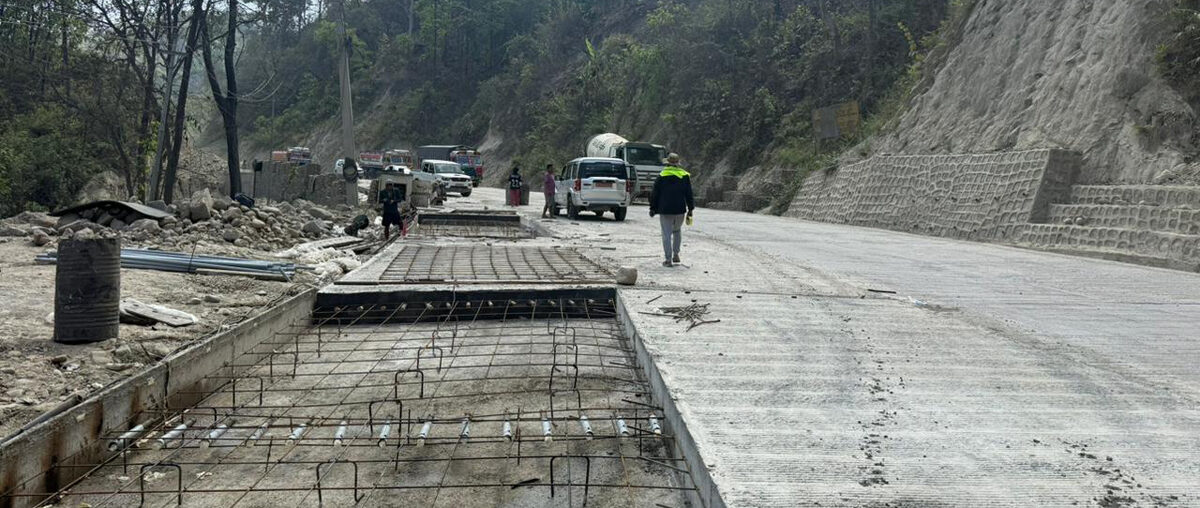
KATHMANDU: Rising geopolitical tensions in West Asia, particularly the conflict involving Iran and the United States, have disrupted global oil transport routes through the Strait of Hormuz, creating ripple effects in Nepal’s construction and transport sectors.
Officials say the shortage and rising price of petroleum products, especially bitumen used in road surfacing, have forced the suspension of blacktopping works in key national projects.
Engineer Shiva Khanal, Information Officer of the eastern section of the Narayanghat–Butwal Road Expansion Project, said that while diesel and petrol prices have risen, the more serious impact is the shortage of bitumen, which has stalled final-stage road surfacing.
The project, launched in fiscal year 2075 BS with Asian Development Bank (ADB) assistance under the South Asian Subregional Economic Cooperation (SASEC) framework, aims to upgrade around 115 kilometres of the East–West Highway into a four-lane corridor.
Of the 65-kilometre Narayanghat–Daunne section, about 98 percent of structural and paving work has been completed, but the final blacktopping layer remains unfinished.
Although vehicle movement in the section remains largely unaffected, Khanal noted that finishing works such as drainage, fencing, and road safety structures are still pending. He also pointed to earlier delays caused by tree cutting, utility pole relocation, Covid-19 disruptions, and contractor-related issues. The project, valued at about USD 256.5 million with ADB financing of USD 186.8 million, now faces uncertainty over meeting its deadline in Shrawan.
Altogether, construction entrepreneurs argue that rising fuel and material costs, combined with a weak or delayed price adjustment mechanism in government contracts, have pushed the sector into crisis, slowing down or halting large-scale infrastructure development nationwide.
A similar slowdown has been reported in the Nagdhunga–Muglin road expansion project. Engineer Sachendra Mishra, information officer for the western section, said that only 42 percent of the 38-kilometre stretch has been completed so far, including 13 kilometres of blacktopping. He added that rising bitumen prices and supply constraints have led contractors to slow down work significantly.
Both projects highlight how external shocks in global energy and commodity markets are increasingly affecting Nepal’s infrastructure development timelines, particularly in large-scale highway expansion efforts.
He said that out of the six bridges planned in the section, four are in the final stage of construction.
“The delay was earlier caused because two bridge houses had to be removed, but that issue has now been resolved and bridge construction has resumed,” he said.
Officials say these represent only some of the recurring problems affecting the project. Government representatives involved in implementation acknowledge that progress has been slowed primarily due to shortages of construction materials rather than contractor inefficiency alone.
As a result, construction entrepreneurs are now demanding a revision of contract rates to reflect rising input costs. They have warned of work stoppages and possible strikes if their concerns are not addressed in time.
“Before the conflict, diesel was priced at Rs 139 per litre. It has now reached Rs 225. Bitumen has increased from Rs 75 to Rs 155. The government must urgently address both supply and price adjustments for construction materials,” said Nicholas Pandey, president of the Federation of Construction Entrepreneurs.
Meanwhile, Shyam Bahadur Khadka, spokesperson and Deputy Director General of the Department of Roads, said discussions are ongoing with the government regarding the issue.
“Blacktopping work on roads across the country has slowed due to the shortage of bitumen,” he said, adding that contractors are also seeking revisions in contract agreements in line with increased costs. “We are currently in dialogue with the government on this matter,” he added.
Situation of price hike and impact on construction sector
According to data from the Federation of Construction Entrepreneurs, the sharp rise in diesel and bitumen prices has caused severe financial strain on contractors, with estimated losses of around Rs 10 billion so far. The federation also reports that nearly 30,000 infrastructure projects across the country have been affected or stalled due to escalating input costs.
In fiscal year 2081/82, Nepal consumed about 1,466,285 kilolitres of diesel, of which construction activities account for roughly 20–25 percent. During the peak construction period from Falgun to Ashar alone, around 146,628 kilolitres of diesel is used. With diesel prices increasing by Rs 86 per litre, contractors say this has added an estimated burden of about Rs 14.66 billion to the sector.
The federation further claims that around Rs 6 billion in losses have already been incurred from diesel price hikes alone. In addition, the price of bitumen has risen by Rs 75 per kg, contributing an extra cost burden of about Rs 7.13 billion, with current estimates placing losses from bitumen price escalation at around Rs 4 billion.
Altogether, construction entrepreneurs argue that rising fuel and material costs, combined with a weak or delayed price adjustment mechanism in government contracts, have pushed the sector into crisis, slowing down or halting large-scale infrastructure development nationwide.





Comment