




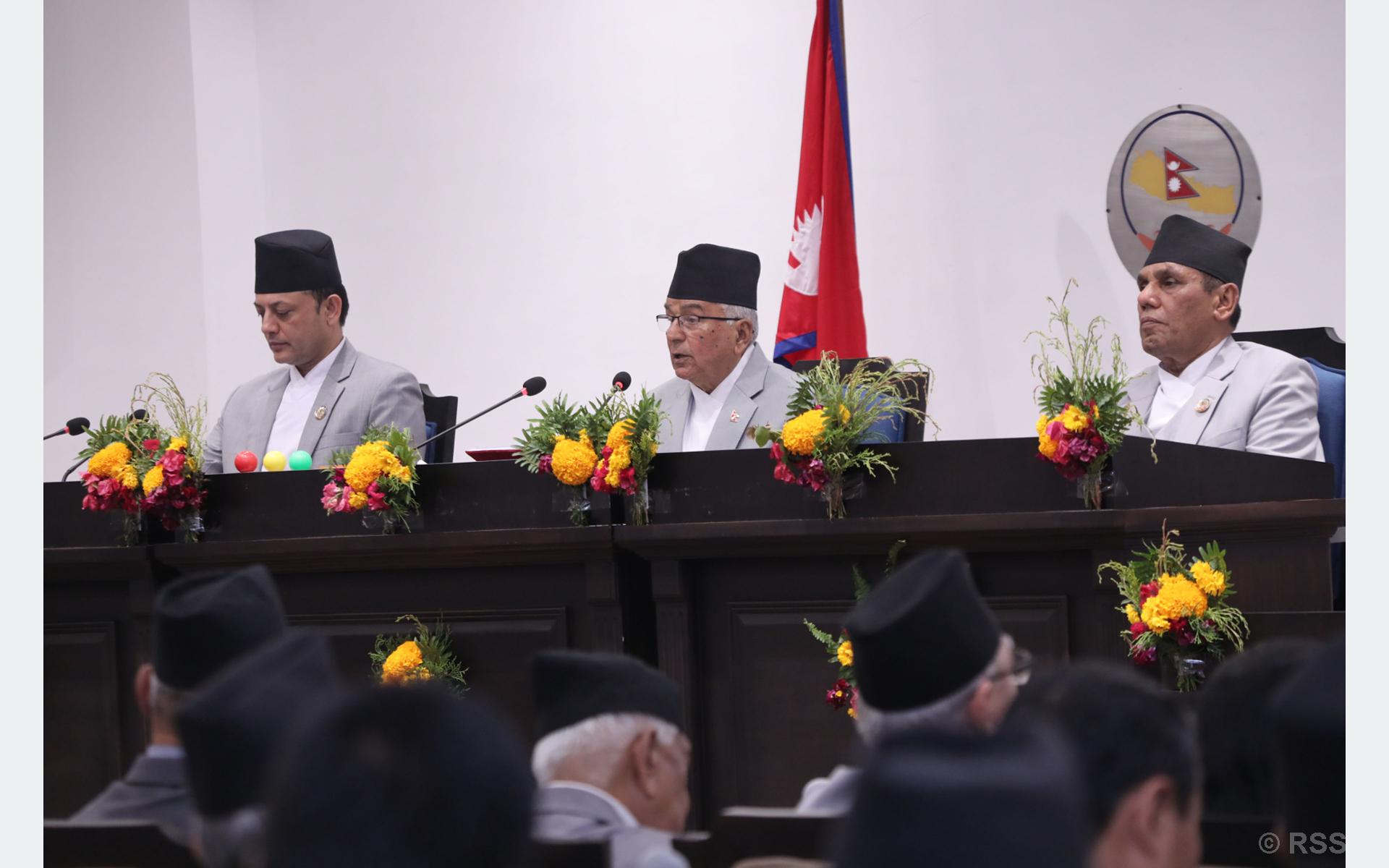
KATHMANDU: President Ram Chandra Paudel presented the Government of Nepal’s Policy and Programme for the fiscal year 2026/27 before a joint sitting of the Federal Parliament on May 11, 2026, in accordance with Article 95 of the Constitution. The document outlines the government’s annual policy direction and serves as the basis for the upcoming national budget.
The policy and programme has been presented at a politically important time following the March 5, 2026 general election, which resulted in a clear parliamentary majority after a period of coalition instability.
It also comes in the wake of the 2025 Gen Z protests, which the government has described as a landmark movement calling for stronger civic authority, improved governance, anti-corruption measures, accountability, and broader economic reform.
Structured as both a constitutional requirement and a development roadmap, the 100-point policy framework sets out priorities across key sectors including economic reform, digital governance, infrastructure development, agriculture, hydropower, education, health services, tourism, foreign relations, anti-corruption initiatives, and civil service restructuring.
The Government Policy and Programme is an annual document that every elected government in Nepal must present before Parliament. As mandated by Article 95 of the Constitution, the President addresses a joint session of both the House of Representatives and the National Assembly at the beginning of the first parliamentary session following a general election, and at the start of each subsequent annual session.
To address supply chain inefficiencies, the policy proposes the development of public–private agricultural enterprises and cold chain infrastructure to reduce post-harvest losses. Export-oriented agriculture will be supported through quality standards, certification systems, and laboratory testing facilities at border points and markets to ensure compliance with pesticide and safety requirements.
The document presented by President Paudel is therefore a constitutional obligation rather than a political statement. It marks the first such address by the government formed after the March 5 election, which delivered a clear majority mandate to the Rastriya Swatantra Party.
Policy and programme lays foundation for national budget and signals government priorities
The Policy and Programme serves as the foundational document on which Nepal’s annual national budget is later prepared. It communicates the government’s intended direction across all major sectors of national life to Parliament, citizens, investors, and development partners, outlining both immediate priorities for the coming fiscal year and broader medium-term goals. The presentation of this year’s document formally marks the beginning of the government’s legislative and budget session.
The document begins with President Ram Chandra Paudel expressing pride in addressing the joint session of Parliament on behalf of a government formed with a clear electoral mandate from the March 5 general election. Before introducing any policy measures, it offers a solemn tribute to martyrs of Nepal’s democratic struggles, with special emphasis on citizens and public servants who lost their lives during the youth-led movement of September 8 and 9, 2025.
That movement is described as a defining moment of youth participation, driven by demands for civic supremacy, good governance, accountability, anti-corruption measures, and economic transformation. The government extends condolences to bereaved families and wishes for the recovery of those injured.
The document further frames these sacrifices as the moral foundation of governance, stating that they will be honoured through results-oriented policymaking. In doing so, it places the entire 100-point agenda under an ethical obligation—framing governance as a responsibility owed to those who lost their lives during the movement, and accountability as a binding national debt rather than a procedural requirement.
The first policy point emphasizes political stability as the essential prerequisite for national transformation. It highlights the formation of a single-party majority government as a rare opportunity for policy consistency, governance reform, and structural change.
The government commits to treating good governance as the central pillar of national development, alongside a zero-tolerance approach to corruption, improved public service delivery, economic revitalization, and social progress as part of a campaign-style national mission.
On constitutional reform, the approach is explicitly consensus-driven. Instead of unilateral action, the government pledges dialogue with all political parties to identify shared areas for amendment and to develop a formal constitutional reform roadmap based on broad agreement.
At the same time, it commits to implementing the already announced 100-point governance reform agenda, combining institutional continuity with reform-driven governance. Together, these elements define a political approach that balances majority strength with negotiated constitutional change.
The second policy priority sets an ambitious economic target of sustaining an average annual real GDP growth rate of 7 percent over the next decade, with the long-term goal of graduating Nepal into a middle-income economy.
To support this objective, the government proposes a “New Phase of Economic Reform Series” focused on lowering production costs, simplifying regulatory frameworks, and removing legal and policy bottlenecks that hinder investment.
The policy also emphasizes attracting domestic, foreign, and diaspora investment through improved economic incentives and institutional predictability. A key structural commitment is the creation of a stable policy environment designed to ensure continuity and reduce uncertainty caused by political transitions, thereby strengthening investor confidence and long-term economic planning.
The policy envisions a strengthened institutional coordination system to maintain continuity in national development priorities from planning through selection and implementation stages. It also commits to formulating and executing sector-specific policies across all priority areas.
Together, these measures—combined with ambitious growth targets and structural reforms—signal a shift away from short-term, politically influenced economic management toward a more stable and system-driven governance model.
Points 3 and 4 of the policy outline a broad restructuring of Nepal’s economic transaction and fiscal systems. A key reform is the gradual transition of all economic transactions onto a cashless digital platform, aimed at increasing transparency and reducing opportunities for tax evasion and corruption associated with cash-based dealings.
The government also plans to ease the tax burden on entrepreneurs and middle-income households through a review of the tax structure. It aims to encourage voluntary tax compliance by improving taxpayer-friendly services and introducing a fast-track mechanism for resolving tax disputes, thereby reducing prolonged legal and administrative delays.
In addition, Nepal will expand double taxation avoidance agreements with more countries to support cross-border trade and investment. Fragmented taxes such as pollution-related charges and various surcharges are expected to be consolidated into a unified Green Tax framework.
The policy further proposes stricter controls on counterfeit goods at customs checkpoints and the full automation of tax refund systems, including VAT refunds, with strict timelines to minimize delays, discretion, and potential misuse.
Collectively, these reforms are designed to make the revenue system more business-friendly while simultaneously strengthening controls against evasion, smuggling, and corruption.
Points 5 and 6 focus on strengthening financial sector stability, particularly in cooperatives and capital markets. In the cooperative sector, the government commits to aligning regulation, supervision, and enforcement with international anti-money laundering standards through a risk-based framework.
The National Cooperative Regulation Authority will be strengthened to improve oversight and governance. To address the ongoing crisis of unpaid savings in troubled cooperatives, a unified Depositor Protection Fund will be established to safeguard and reimburse affected depositors.
The policy also emphasizes recovery from defaulting borrowers, with proceeds directed toward repaying depositors. A debtor information system will be introduced to curb excessive lending, financial fraud, and misuse of credit.
In the capital market, structural reforms will be undertaken in NEPSE and the clearing system to improve efficiency and transparency. The government plans to broaden market participation by institutional investors such as pension funds, insurance companies, mutual funds, and non-resident Nepalis.
To deepen the financial market, new instruments—including a bond market, infrastructure bonds, and risk management tools—will be developed to enhance long-term investment capacity and financial stability.
Points 7 and 8 of the policy outline a shift in how infrastructure is financed and how public spending is managed. On financing, the government plans to mobilise alternative sources of development finance, including diaspora investment, concessional funding, and other blended finance models to support major infrastructure projects.
Large-scale projects will be redesigned with clearly defined outputs, fixed budgets, and strict deadlines. A key reform is the commitment that project leadership will remain unchanged until completion, reducing the long-standing problem of frequent transfers that weaken accountability. Project monitoring will also be digitised to ensure real-time tracking of progress and performance.
On public expenditure, the policy prioritises results-based spending. Public institutions will be systematically reviewed and reorganised based on their relevance and performance. This may include mergers, public–private partnerships, strategic collaboration models, or divestment where appropriate.
This restructuring aims to address the long-standing issue of fragmented and overlapping public bodies that have increased fiscal burden without proportional outcomes. Together, these reforms signal a move toward performance-driven governance, where spending is evaluated by results rather than procedural compliance.
Points 9 and 10 introduce a strategic shift under the concept of a “Borderless Economy” and tariff-free trade orientation. The policy identifies five key sectors as the main drivers of future economic transformation: information technology-based services and exports, hydropower, tourism, high-value agriculture, and green industrialisation.
These sectors are positioned as the core pillars for reshaping Nepal’s economic structure. At the same time, the policy explicitly seeks to reduce reliance on foreign labour migration and remittance-driven growth, and instead transition toward a more diversified economy based on knowledge services, digital trade, remote work, and value-added production.
To support this shift, the government plans to legally recognise international payment gateways to facilitate cross-border digital transactions. It also aims to improve export competitiveness through trade diversification, integrated logistics planning, and industrial coordination.
Points 12 and 13 focus on improving Nepal’s investment climate through major procedural simplification. A key proposal is the “Investment Express” system, under which business registration and construction approvals could be completed within a single day, significantly reducing bureaucratic delays.
The Foreign Investment Act will be revised to expand automatic approval mechanisms and reduce discretionary administrative barriers. The policy also introduces an “Investment Visa” for qualifying foreign investors, designed to provide a streamlined entry and residency process for high-value investment.
In addition, the government plans to expand Special Economic Zones and develop integrated “industrial villages” with shared infrastructure facilities. Sector-specific clusters such as IT parks, agricultural production hubs, and innovation-based industrial zones will also be promoted, with linkages to industrial tourism to further enhance economic activity and investment appeal.
The policy introduces a “Startup Nepal Portal” designed to streamline entrepreneurship through a single-window system. It will allow same-day access to company registration, tax exemptions, and seed capital, significantly lowering entry barriers for young entrepreneurs.
In addition, the information technology sector is designated as a national strategic industry. It will receive targeted policy support, including facilitated investment procedures, government co-investment, financial incentives, and tax benefits aimed at encouraging research, innovation, and startup growth.
Points 14 to 17 outline a broad agriculture transformation strategy focused on both production incentives and market access improvements. A key commitment is the introduction of minimum support prices for major crops before the planting season, ensuring farmers receive price certainty in advance rather than after harvest.
For returning migrant workers, a digital “Skill Passport” will be introduced to record overseas work experience and link it with internationally recognised vocational certifications. This is intended to make their skills formally verifiable and economically valuable within Nepal’s labour market.
Payments under this system will be transferred directly into farmers’ bank accounts through digital channels, reducing reliance on intermediaries. The government also plans to provide subsidies to companies and cooperatives that procure agricultural products at these support prices, alongside strengthening the Food Management and Trading Company.
To address supply chain inefficiencies, the policy proposes the development of public–private agricultural enterprises and cold chain infrastructure to reduce post-harvest losses. Export-oriented agriculture will be supported through quality standards, certification systems, and laboratory testing facilities at border points and markets to ensure compliance with pesticide and safety requirements.
To tackle land underutilisation, a land bank system will be introduced to mobilise fallow land for productive use. This initiative targets young people, women, and marginal farmers, while also promoting contract farming, cooperative farming models, and agroforestry practices to expand agricultural productivity and rural employment.
Points 21 to 25 present a structured forestry and environmental management agenda that integrates conservation with economic use. Sustainable forest management is positioned as a means to expand timber production, herbal medicine industries, carbon trading, eco-tourism, and other forest-based enterprises, thereby increasing the sector’s contribution to the national economy.
The policy prioritises value addition and processing of non-timber forest products for both domestic use and export markets. It also promotes grassland development and livelihood opportunities linked to forest resources. Selected forest-based materials will be used by local communities and private enterprises to produce products such as organic fertiliser, biochar, and eco-friendly construction materials like bricks.
To strengthen climate-related initiatives, a Nepal Carbon Authority will be established and the REDD+ carbon credit programme expanded. Community forest user groups are expected to receive direct financial benefits from carbon credits, reducing reliance on intermediaries and ensuring that climate finance more directly supports local communities.
The policy proposes the establishment of a “Forest Fire High Alert Centre” equipped with continuous monitoring systems using drones and satellite technology to detect and respond to forest fires more effectively.
On human–wildlife conflict, the government acknowledges the growing pressure on communities living near forests and protected areas. It commits to a multi-pronged approach that includes compensation for losses, early warning systems, construction of preventive structures, and, where necessary, wildlife translocation and relocation. The policy also promotes alternative cropping patterns to reduce crop damage and ease tensions between conservation goals and local livelihoods.
Point 29 sets an ambitious long-term target of generating 10,000 megawatts of electricity within the next decade. To support this goal, the government plans coordinated legal reforms across the energy, forest, land, and environment sectors, alongside the introduction of a single-window clearance system. This is intended to reduce delays caused by overlapping approvals from multiple ministries, a long-standing barrier to hydropower development.
A notable policy shift is the proposal to offer equity shares to citizens in project-affected areas instead of traditional cash compensation. This is aimed at increasing local ownership, reducing disputes, and accelerating project implementation.
Points 30 and 31 expand the energy vision further by ensuring guaranteed participation of the private sector in generation, transmission, distribution, and energy trade. The policy also prioritises expanding domestic energy consumption by promoting energy-intensive industries to improve the commercial viability of hydropower.
In addition, off-grid renewable solutions such as solar, wind, and micro-hydro will be expanded to underserved areas. Emerging green industries—including green hydrogen, green ammonia, and fertiliser production—will receive tax incentives, customs exemptions, subsidised electricity, and investment facilitation. The policy also introduces initial steps toward developing hydrogen-based infrastructure for transport.
Points 41 to 44 outline a major labour market transformation agenda. The most significant announcement is the declaration of FY 2026/27 to 2035/36 as the “Employment Promotion Decade,” positioning job creation and labour market reform as a long-term national priority rather than a short-term policy goal.
To support this, the government plans to introduce a new National Employment Policy that integrates skills development, education, labour market data systems, social security, and employment services into a unified framework.
A key initiative is the launch of a national apprenticeship programme based on a “Learn While You Earn” model, aimed at bridging the gap between education and employability and expanding structured job training opportunities within the domestic labour market.
The policy introduces a “Remote Work Policy” that legally recognises Nepalis who are employed by foreign companies while residing in Nepal, bringing a growing informal practice into the formal economy.
Points 60 to 62 outline a time-bound commitment to ensure universal access to clean drinking water and basic sanitation by 2030, requiring coordinated implementation across federal, provincial, and local governments.
For returning migrant workers, a digital “Skill Passport” will be introduced to record overseas work experience and link it with internationally recognised vocational certifications. This is intended to make their skills formally verifiable and economically valuable within Nepal’s labour market.
To redirect remittance inflows toward productive use, a “Remittance–Investment Matching Fund” will be created to channel part of remittances from consumption into investment-oriented activities. The policy also provides dedicated banking services and facilitation mechanisms for outgoing migrant workers, alongside a unified incentive package designed to encourage return migration.
Points 45 to 48 set out a broad education reform agenda spanning basic to tertiary levels. The policy guarantees free education up to the secondary level and provides supporting measures such as free textbooks, midday meals, and school uniforms to minimise the financial burden on families and improve school retention.
At the curriculum level, reforms will focus on making education more practical, updated, and employment-oriented, shifting away from rote-based learning. Public investment in education will be increased, while private institutions will be regulated to ensure quality, accountability, and service orientation rather than purely commercial motives.
Digital transformation is a key pillar, with expanded use of e-learning platforms, virtual classrooms, open digital resources, and AI-enabled learning systems. Around 10,000 community schools will be upgraded with high-speed internet and digital infrastructure to support modern learning methods.
In higher education, governance reforms will aim to better align universities with labour market needs. Recruitment, promotion, and evaluation of teachers will be made merit-based and transparent, supported by improved pay structures, professional development opportunities, and incentive schemes for high-performing educators.
The policy also includes targeted support for children with autism and neurodiversity through inclusive education systems, therapy services, assistive technologies, and specially trained teachers. All scholarship schemes will be consolidated into a merit-based system with direct digital transfers to students’ bank accounts.
Points 55 to 59 present a comprehensive overhaul of the health system aimed at ensuring universal access and improved service quality. A national minimum standard for basic health services will be introduced to guarantee that all citizens receive essential healthcare with adequate staff, medicines, equipment, and infrastructure at the local level.
The role of community health workers and female community health volunteers will be expanded, with improvements in training, capacity, and service coverage. The existing health insurance system will be restructured to improve financial sustainability and effectiveness.
Telemedicine services will be expanded to connect remote populations with specialist doctors, addressing geographic barriers to healthcare access.
Two new national institutions are also planned: a “Centre for Disease Control” to strengthen disease surveillance and epidemic preparedness, and a “National Health Accreditation Authority” to ensure quality standards across healthcare providers and facilities.
The policy proposes the establishment of a federal-level “National Biomedical Research Laboratory” to strengthen the country’s capacity in biological research, epidemic preparedness, and disease control.
Mental health is explicitly elevated to a core component of public health policy rather than being treated as a peripheral issue. The government commits to implementing a national mental health policy, alongside broader promotion of wellbeing through yoga, meditation, and community-based health programmes.
Disability services are also expanded significantly. The policy envisions advanced rehabilitation centres offering prosthetics, physiotherapy, and specialised care services. These services will be decentralised and integrated into local government systems to improve accessibility and ensure continuity of care at the community level.
New urban settlements will be planned along the Mid-Hill Highway to promote balanced regional development. The National Building Code will be strictly enforced for all new construction, with mandatory compliance for earthquake-resistant design and fire safety standards.
Points 60 to 62 outline a time-bound commitment to ensure universal access to clean drinking water and basic sanitation by 2030, requiring coordinated implementation across federal, provincial, and local governments.
The policy prioritises completing long-delayed water supply projects and introduces targeted interventions for the Terai–Madhesh region, where arsenic contamination remains a serious public health concern. These measures include the expansion of arsenic-free water systems, deep tube wells, and surface water infrastructure.
Sanitation systems will be upgraded to reduce pollution and improve river health, with strengthened sewage treatment infrastructure forming a central part of river restoration efforts. Water quality monitoring will be institutionalised through laboratories and regular testing mechanisms to ensure consistent safety standards.
To promote environmental branding and value addition, Nepal’s water resources will be marketed under a “Himalayan Origin Certified Water” identity.
In major urban centres, including the Kathmandu Valley, integrated sewage treatment plants will be developed. Treated wastewater will be reused for agriculture and industrial purposes, reducing river pollution and improving overall water resource efficiency.
The policy commits to restoring the Bagmati and other major rivers to environmental health through coordinated ecological rehabilitation efforts. Alongside river clean-up, it prioritises long-term water security and climate adaptation measures, including groundwater recharge systems, rainwater harvesting, reservoir-based water projects, and the conservation of natural springs. These interventions are intended to reduce water stress while strengthening resilience to climate variability.
Points 63 to 70 outline an extensive infrastructure development agenda spanning roads, transport systems, and urban planning. Key national highway corridors—including the Hulaki Highway, Pushpalal (Mid-Hill) Highway, and the North–South corridors—will be expanded and upgraded to improve national connectivity. The Kathmandu–Terai–Madhesh Fast Track expressway is identified as a priority project for expedited completion.
The policy aims to ensure that all local governments are connected through all-weather road access, improving year-round mobility and service delivery. In urban transport, electric mass rapid transit systems will be developed to modernise public transportation and reduce environmental impact.
Regulatory reforms will also be introduced in public transport and road safety laws, alongside the implementation of stricter engineering standards and a more disciplined contracting system for major infrastructure projects.
A unified National Transport Master Plan will integrate all modes of transport—road, rail, water, ropeway, and air—into a single coordinated framework. To improve safety and efficiency, the government will deploy GPS-based tracking systems, AI-enabled traffic monitoring cameras, digital traffic management tools, and stricter speed enforcement mechanisms aimed at reducing road accidents nationwide.
The policy expands urban infrastructure planning with a strong focus on inclusivity, safety, and multimodal connectivity. Dedicated pedestrian walkways and cycling lanes will be developed, alongside measures to ensure safe and accessible public transport for women.
In Kathmandu, the design and implementation of a Bus Rapid Transit (BRT) system will be formally initiated to improve urban mobility. At the same time, feasibility studies for major railway corridors—including Kerung–Kathmandu and Raxaul–Kathmandu—will be advanced to strengthen long-term regional connectivity.
The National Vigilance Centre will be restructured into a dedicated “Anti-Corruption Unit” with a more focused mandate to monitor, detect, and prevent corruption across public institutions.
Urban development priorities also include the introduction of integrated waste management systems and the expansion of affordable housing programmes targeted at homeless populations, marginalized communities, and disaster-affected families.
New urban settlements will be planned along the Mid-Hill Highway to promote balanced regional development. The National Building Code will be strictly enforced for all new construction, with mandatory compliance for earthquake-resistant design and fire safety standards.
Points 71 and 72 mark a shift from reactive disaster response to a structured preparedness-based system. The policy institutionalises risk mapping, early warning systems, and regular disaster preparedness drills to reduce loss of life and property.
A unified command structure involving the Nepal Army, Nepal Police, and Armed Police Force will be established to coordinate search and rescue operations. The government also plans to integrate modern technologies such as drones and helicopters, with private sector collaboration for faster and more efficient emergency response.
This approach aims to embed disaster readiness into institutional systems rather than relying on ad hoc responses after crises occur.
The policy introduces a “Zero-Day Procurement Policy” to address chronic delays in public spending. Under this system, procurement processes will begin immediately from the first day of the fiscal year (July), rather than being concentrated at the end of the year, particularly in June.
To ensure timely implementation, the policy requires that detailed project reports, environmental assessments, and land acquisition processes be completed before budget approval. Large-scale procurement will be conducted through open and competitive bidding to improve transparency and reduce irregularities.
Together, these reforms aim to improve budget execution efficiency and address long-standing inefficiencies in public procurement and capital expenditure management.
Several interconnected provisions outline a shift toward fully digital governance systems designed to reduce administrative discretion and improve service efficiency. A National Digital Infrastructure framework will be established, including a central government cloud system and a National Data Policy.
The government will expand the use of artificial intelligence, data analytics, and cybersecurity systems to support a knowledge-based economy and improve public sector efficiency. Telecommunications monitoring and spectrum management will also be strengthened.
To reduce the digital divide, connectivity will be expanded in remote and underserved areas. An e-KYC system will enable unified digital identity verification across banking, telecommunications, and government services.
A key reform is the creation of an interoperable government database based on a “one document for all services” principle, allowing citizens to submit information once for use across multiple agencies. This is intended to significantly reduce duplication, delays, and opportunities for bureaucratic inefficiency.
The policy commits to major expansion of digital public service delivery. At least 100 government services will be integrated into a unified “Citizen App,” allowing citizens to access a wide range of services through a single digital platform.
All public services will be subject to legally defined time limits, with automatic accountability mechanisms for officials who fail to meet deadlines. This is intended to reduce procedural delays and enforce performance-based governance.
A “One Identity Card Policy” will integrate multiple identity systems by linking national ID with citizenship records, banking, healthcare, education, and social security databases. This unified identity framework is designed to simplify access to services and improve data coordination across institutions.
The document concludes by framing governance as a long-term nation-building project anchored in accountability, stability, and public trust. It emphasizes that national resources and public investment will be mobilized to promote social justice, equal opportunity, and accelerated economic development, explicitly tying these commitments to election mandates and cross-party agreements.
In addition, Single Service Centers will operate seven days a week across government offices, ensuring continuous access to essential public services.
Points 95 and 96 outline a strengthened institutional framework for combating corruption. The Commission for Investigation of Abuse of Authority (CIAA) will be institutionally reinforced, with improvements to its investigative capacity, prosecutorial effectiveness, and accountability mechanisms.
The National Vigilance Centre will be restructured into a dedicated “Anti-Corruption Unit” with a more focused mandate to monitor, detect, and prevent corruption across public institutions.
A formal whistle-blower protection and reward system will be introduced to encourage citizens and public officials to report corruption without fear of retaliation. This is intended to create a safer and more credible reporting environment for exposing misconduct.
Senior public officials will be required to publicly disclose their assets on an annual basis, increasing transparency around wealth accumulation and strengthening public oversight.
Overall, the policy emphasizes digitisation, transparency, and reduction of human discretion in key governance areas such as procurement, revenue administration, and bureaucracy, aiming to minimise opportunities for corruption and enhance institutional accountability.
The document concludes by framing governance as a long-term nation-building project anchored in accountability, stability, and public trust. It emphasizes that national resources and public investment will be mobilized to promote social justice, equal opportunity, and accelerated economic development, explicitly tying these commitments to election mandates and cross-party agreements.
This linkage signals an intention to make governance performance measurable against political promises. In its final point, the policy elevates political stability—achieved through citizens’ sovereign participation—into a historic opportunity for transformation, stating that accountable and result-oriented governance will be institutionalized as a core state culture.
The closing message ultimately positions the entire 100-point agenda not merely as an administrative program, but as a foundational framework for strengthening Nepal’s federal democratic republic and rebuilding citizen trust in the state through effective, transparent, and citizen-centered governance.






Comment