




Recently, I had the opportunity to follow Bangladeshi Prime Minister Tarique Rahman’s visit to China from June 22 to 26. The visit marks an important milestone in Bangladesh’s evolving foreign policy.
While the agreements on trade, investment, infrastructure, and connectivity are significant, the decision by the two countries to elevate their ties to a Comprehensive Strategic Cooperative Partnership is even more consequential.
The joint statement’s commitment to expanding defense cooperation, establishing a structured diplomatic and defense dialogue, and exploring new avenues of collaboration signals a new phase in China-Bangladesh relations.
Equally noteworthy is China’s involvement in the Teesta River Comprehensive Management and Restoration Project. Although primarily a development initiative, the project has attracted attention across South Asia, particularly in India and Nepal.
Its significance extends beyond infrastructure. It raises a broader geopolitical question: Do large-scale development projects foster greater trust among neighboring countries, or do they inadvertently deepen strategic suspicion?
For Nepal, this is not simply a question about Bangladesh or China. It is a question about Nepal’s own future.
Geography We Cannot Change
History may alter governments, alliances, and economic priorities, but geography remains constant. China, India, Bangladesh, and Nepal—regardless of the partnerships they pursue—will always remain neighbors.
In an era of intensifying geopolitical competition, Nepal should resist becoming part of any country’s sphere of influence. Instead, it should aspire to be a nation trusted by all but dominated by none.
This is one of the enduring realities of geopolitics. Nations may choose their friends, but they cannot choose their neighbors. Nepal’s foreign policy, therefore, should not be driven by sentiment, ideology, or temporary geopolitical shifts. Its guiding principle must remain clear and consistent: the protection and promotion of national interest.
Bangladesh’s Emerging Strategic Role
For decades, Nepal’s strategic outlook has focused primarily on India and China. Despite offering Nepal one of its closest gateways to the sea, Bangladesh has not always received the strategic attention it deserves.
That is changing rapidly.
Today, Bangladesh is among South Asia’s fastest-growing economies. Its expanding manufacturing sector, improving infrastructure, and increasingly confident diplomacy are positioning it as an influential regional actor.
For Nepal, Bangladesh is more than just a neighboring country. It is an important long-term partner in energy trade, connectivity, transit, and broader regional economic integration.
The Teesta Project: More Than a Water Issue
The Teesta project is about far more than river management. It encompasses engineering, flood control, irrigation, environmental restoration, satellite mapping, financing, and institutional cooperation.
Major infrastructure projects often carry long-term strategic implications alongside their development benefits. It is therefore understandable that India closely follows developments surrounding the Teesta, given the river’s direct relevance to its security and water diplomacy.
At the same time, Nepal should avoid viewing every regional development solely through the prism of India-China strategic competition. Doing so would unnecessarily constrain Nepal’s own strategic thinking and limit its diplomatic options.
Rather than asking whether Nepal is expanding its influence in Bangladesh, the more important questions are: How can Nepal export clean hydropower to Bangladesh? How can it secure easier access to Bangladeshi ports? How can Nepal-India-Bangladesh trilateral cooperation be made mutually beneficial? And how can Nepal position itself as a bridge for regional cooperation rather than a battleground for competing powers?
These are the questions that will shape Nepal’s future prosperity.
A line from an editorial I recently read left a lasting impression on me: “No nation should ever be dependent on a single strategic partner.” That principle applies equally to Nepal.
Strategic autonomy does not mean isolation, nor does it mean maintaining equal distance from every country. Rather, it means engaging constructively with all partners while preserving the freedom to make independent decisions based on national interest.
A sovereign nation should diversify its partnerships in trade, investment, technology, security, and diplomacy rather than becoming overly dependent on any single power. Dependency narrows a country’s choices; diversification strengthens its sovereignty.
Nepal’s Silent Strategic Advantage
Among South Asian nations, Nepal occupies a uniquely important geopolitical position. It shares borders with two of Asia’s major powers—India and China—while also enjoying close and friendly relations with Bangladesh.
This geography should not be viewed as a strategic dilemma but as a strategic opportunity.
Nepal has the potential to emerge as a regional exporter of clean energy, a bridge connecting South Asia with broader Asian markets, a transit and logistics hub, and a trusted partner that maintains constructive relations with all while remaining aligned with none.
Realizing this vision, however, requires political stability, strong institutions, a competitive economy, and a mature foreign policy firmly anchored in national interest.
Chanakya’s Enduring Lesson
Only a few days ago, I began reading Chanakya Niti. More than two millennia ago, Chanakya advised rulers to cultivate friendships widely while never surrendering their ability to make independent decisions in the national interest.
That wisdom remains remarkably relevant today.
A nation’s diplomatic success should not be measured by the number of strategic partnerships it signs. The more important question is whether those partnerships expand or constrain its freedom to pursue its own national interests.
Conclusion
The growing China-Bangladesh partnership is understandably of greater strategic significance to India, given its implications for India’s security, water diplomacy, and regional influence.
For Nepal, however, its significance is different. It signals that South Asia is entering a new geopolitical era—one in which both the opportunities and the responsibilities for smaller states are expanding.
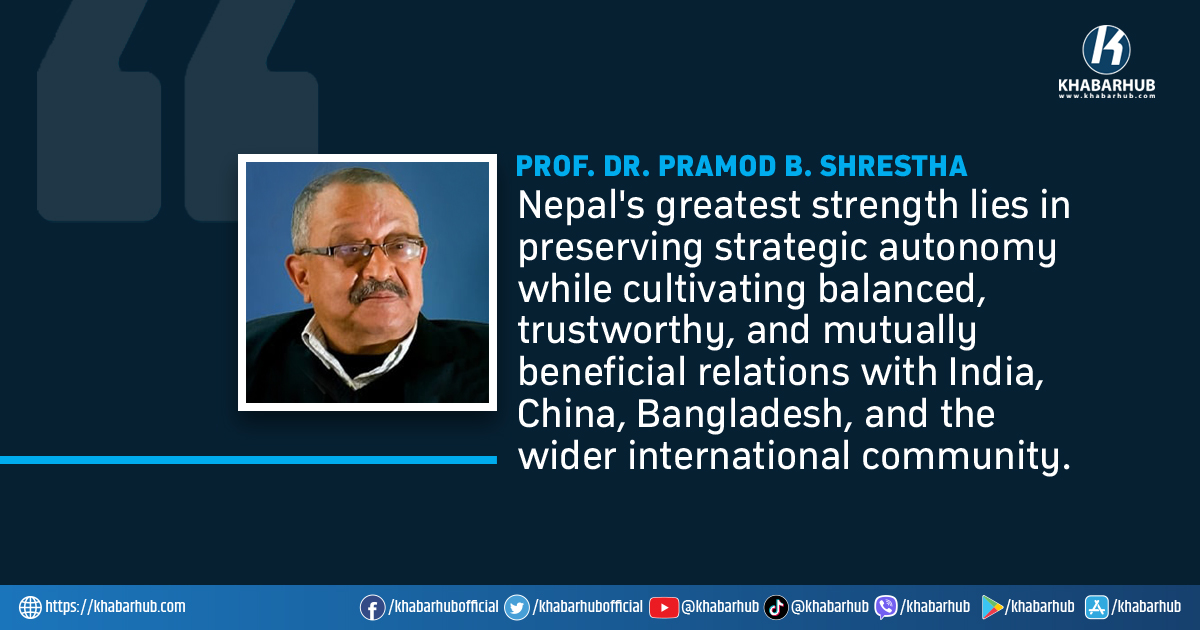
Nepal’s greatest strategic assets are not only its mountains and rivers. Its greatest strength lies in preserving strategic autonomy while cultivating balanced, trustworthy, and mutually beneficial relations with India, China, Bangladesh, and the wider international community.
In an era of intensifying geopolitical competition, Nepal should resist becoming part of any country’s sphere of influence. Instead, it should aspire to be a nation trusted by all but dominated by none. After all, the essence of sovereignty—both in diplomacy and in national life—is the ability to preserve one’s freedom of choice.
(The author is a retired Professor at the Dept of Mechanical Engineering, Institute of Engineering, Tribhuvan University)






Comment