




Nepal is a democracy with elections, a constitution, federalism, and elected governments—its fundamental pillars. However, challenges remain before it can be considered a success. An interesting paradox is that many citizens feel political power is still concentrated among a small group of leaders, business interests, and senior bureaucrats.
This raises questions, especially since the ‘wait-and-watch’ approach in politics means that many problems and deficiencies persist. Such characteristics do not necessarily indicate true democratization. It is unnecessary to delve deeply into this issue here.
Essentially, while democracy exists in name, Nepal needs to develop genuine practices and behavioral norms that reflect full democratic principles. For analysis, I acknowledge Nepali democracy’s resemblance to Western models, but there is a significant difference, with limited impact on overall quality of life.
This situation is unhealthy and poses risks of falsehoods. The political landscape appears competitive because governments change often, coalitions form and dissolve, and prime ministers come and go.
Yet the underlying power structure remains largely unchanged. Elections may replace leaders but rarely alter the true decision-makers. A key feature of Nepali politics is the close link between politicians, business elites, and bureaucrats.
More importantly, stability and predictability are required. Another question is why political leaders and parties do not explicitly adopt a platform that specifically aims to serve the interests of the masses of people.
Businesses support elections financially; politicians protect their interests through policies and contracts; bureaucrats ensure continuity regardless of the ruling party. This system endures political crises, constitutional changes, and public protests.
At this point, it is important to recognize the growing public demand for a government that can effectively address chronic poverty and corruption. Such efforts should not only improve governance but also create opportunities for young citizens who are eager to contribute to the country’s development. A modern democratic society requires citizens who are willing to participate actively in public life, support economic growth, hold leaders accountable, and work collectively for the common good.
The September 2025 Gen-Z movement demonstrated that Nepal’s younger generation is prepared to confront national challenges rather than remain passive observers. It reflected a growing desire among young people to participate as full and effective citizens in strengthening democratic processes and promoting greater accountability.
If this energy can be channeled constructively, politics may gradually become more people-centered and institution-based rather than leader-centered. Political parties would be encouraged to compete on ideas, policies, and clear ideological visions rather than on personalities alone.
This would also require stronger internal party democracy, more regular leadership renewal, and greater tolerance for debate and dissent. Healthy democracies depend not only on elections but also on political organizations that are open, accountable, and responsive to their members.
It should be noted, however, that federalism was introduced to decentralize power and bring government closer to the people. It was also viewed as an important component of Nepal’s broader development strategy, leading to the creation of new provincial and local institutions.
In principle, federalism has the potential to strengthen democratic consolidation, improve policy responsiveness, and provide greater stability in a politically fragmented environment. Yet its record has been mixed.
While it has expanded the number of political actors and institutions, it has done relatively little to reduce the burden on the central government or to generate tangible economic improvements in the lives of ordinary citizens.
More importantly, many provincial and local governments are often governed in much the same way as the center, influenced by patronage networks, personal relationships, and contractor interests. As a result, although political authority has been decentralized on paper, genuine citizen empowerment has not always followed.
In this context, one hopes that future constitutional reforms may address these shortcomings by creating a more realistic and effective political framework, since strong institutions are essential for sustainable development.
At the same time, Nepal must continue to develop a federal system that reflects its own social and political realities. Federalism should not be viewed as an end in itself, but as a means of promoting both democratic participation and economic development.
Having said that, Nepal’s experience suggests that when large segments of the population remain excluded from economic opportunity and social mobility, development efforts must be accompanied by democratic reforms.
Such reforms should not remain abstract ideals but be translated into practical measures that engage citizens, particularly the younger generation. The push for democratization—whether led by political actors, students, or youth movements—must strengthen democratic processes, accountability, and public participation. It is therefore essential that public services improve, policy implementation becomes more consistent, and governments focus on pressing issues such as education, healthcare, employment, and climate challenges.
This is not to deny the gap that exists between democratic expectations and actual outcomes. Nepal’s deeply rooted hierarchical political culture continues to hinder democratic progress and must gradually be overcome if democracy is to become more meaningful and inclusive. This gap has contributed to growing frustration, particularly among young people and members of the diaspora.
Against this backdrop, figures such as Balen Shah and Rabi Lamichhane have gained popularity. Their appeal largely stems from being perceived as outsiders who challenge established political practices and elite networks. To the extent that they encourage political competition and public debate, this development can be viewed positively.
However, there is also a risk that politics simply becomes a competition for power, where authority, once obtained, is distributed through personal networks rather than institutional rules. Ultimately, individual leaders alone cannot transform the system. Lasting change requires stronger institutions, greater accountability, and a political culture that places public interest above personal or factional interests.
While I am not an economist by training and do not possess specialized expertise in economic theory or policy, I believe that, from a layperson’s view, building institutional and societal capacity for sustainable development is both crucial and urgent.
Beyond Weberian perspectives on capitalist growth, societies must establish mechanisms capable of responding to evolving social, economic, and political challenges in an increasingly complex world. It is also important to recognize that economic growth is rarely smooth or linear, and democratization follows a similar pattern.
Throughout history, development and democracy have progressed unevenly, creating winners and losers along the way. Additionally, no society has achieved a perfect or pure form of democracy; defining democracy in an ideal sense remains philosophically challenging.
Ever since Lipset published his seminal article, many views have emerged either supporting or refuting the idea that economic growth is a necessary condition for democracy. However, the budget proposed by Finance Minister Wagle under the Balen administration seems to focus on policies that mainly benefit a small middle-class group by reducing barriers to the movement of goods, services, and capital.
While these steps may boost economic activity and investment, they could also impose disproportionate costs on the most vulnerable and least flexible segments of society. Without addressing fairness, social protection, and inclusive growth, economic reforms risk deepening inequalities and causing political unrest among large portions of the population.
Sustainable development needs both economic efficiency and social legitimacy. A development approach seen as favoring only the wealthy could threaten democratic progress and long-term economic stability. There is a danger that economic policymaking becomes limited to a narrow group of beneficiaries, reinforcing the perception that governance serves a ‘Rabi-Balen club’ of the rich rather than the broader public interest.
Large bodies of research suggest that extreme forms of narcissism are often linked to psychological disorders. Individuals with such tendencies frequently see themselves as infallible, all-knowing, and superior to others. Lucian W. Pye, an expert on Asian politics who conducted extensive research, argued that Asian conceptions of good governance tend to challenge the Western ‘cult of the individual’ by emphasizing resilience, social harmony, and a political culture rooted in moral and humanistic values—qualities seen as essential in politics.
For instance, in a parliamentary democracy, it is the prime minister’s responsibility to maintain social harmony and prevent a widespread loss of confidence in government institutions. Of course, there must be room for divergent political views. At times, ordinary citizens may feel overwhelmed by the activities and communication style of the Balen administration.
Still, his remarks on border-related issues—which I believe were poorly worded—ended up heightening tensions. If I view that as an honest mistake, it probably will not lead to a political downturn unless a clearer, more carefully articulated official stance is adopted. Winning an election is undoubtedly important in a democracy, but it does not grant unlimited freedom to make statements that hurt public sentiment and trigger national sensitivities.
Regardless, the prime minister needs considerable time to examine parliamentary methods, norms, and practices and to explore several important questions. Many Nepali prime ministers—from B.P. Koirala to outgoing Sushila—have faced criticism and become popular for the wrong reasons.
The current leadership, too, cannot escape public scrutiny. History shows that flawed political decisions can push countries into serious crises. For this reason, national interest, diplomatic sensitivity, and long-term stability must take precedence over short-term popularity.
On another note, some analysts argue that the Rastriya Swatantra Party (RSP) may struggle to sustain long-term success in governance and that its current popularity could decline sooner than expected. Personally, I am not entirely convinced by that assessment. Still, it is hard to deny that the weak institutionalization of democracy in Nepal is closely tied to weaknesses in political leadership.
A single careless statement can have far-reaching consequences. Public officials must therefore exercise responsibility and caution in their public expressions. Politics is inherently unpredictable, but strengthening democratic practice remains in Nepal’s long-term interest.
What are the prospects for democratic institutions functioning most successfully, with basic values and orientations in which politics focuses specifically on a set of rules and procedures that affect public policymaking, and how do they depend on the success of promoting well-being, with what specific content, and toward what political goals?
Without that, the country risks just cycling through leaders without any real change—democratic on paper, but still unable to spread power and opportunity beyond the usual elite circles.
More importantly, stability and predictability are required. Another question is why political leaders and parties do not explicitly adopt a platform that specifically aims to serve the interests of the masses of people.
Similarly, with every new government, the incoming administration is responsible for appointing individuals to serve throughout the executive branch and to assist in fulfilling the constitutional responsibility to faithfully execute the laws of the land, without researching or considering the perspectives of these appointees, as we know thus far.
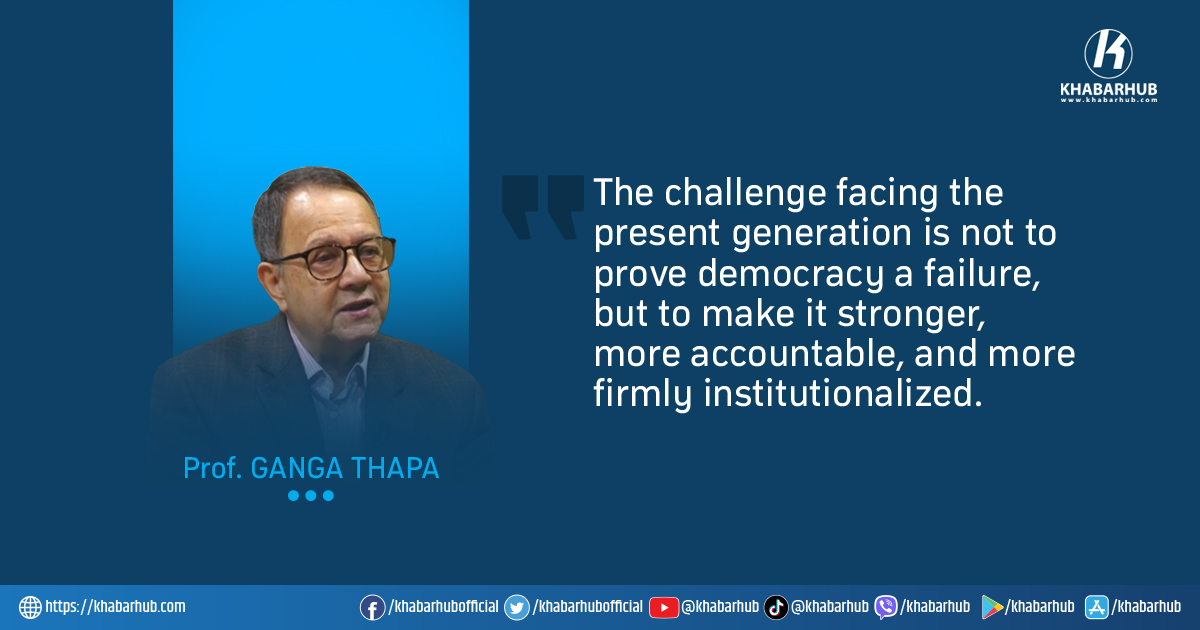
The challenge facing the present generation is not to prove democracy a failure, but to make it stronger, more accountable, and more firmly institutionalized.
In the end, Nepal’s democratic problem is not simply a matter of changing leaders or governments. The deeper challenge lies in reforming the political culture, institutions, and power structures that continue to shape decision-making regardless of who is in office. Sure, elections, federalism, and constitutional reforms have given more people a voice, but they have not actually shifted where the real power lies.
For democracy to take root, Nepal may not need a philosophical orientation, but it seems natural that both political leadership and political parties should make concerted efforts to ensure political responsiveness, a leadership that has consequences for the very process by which public policy is made, that are both efficient and fair, and that zealously advocate the interests of the country.
Without that, the country risks just cycling through leaders without any real change—democratic on paper, but still unable to spread power and opportunity beyond the usual elite circles.





Comment