




Every child has the right to be protected from harm, abuse, neglect, exploitation, and violence in every situation. It is everyone’s responsibility to ensure children’s physical safety, emotional well-being, and holistic development.
It is the collective responsibility of everyone to prevent physical, emotional, sexual, digital, and verbal abuse, as well as child labour, trafficking, and child marriage, all of which are criminalized under Nepal’s legal framework.
Every child deserves a safe, nurturing family and community environment, with accessible and child-friendly services available without exception. Child protection in the context of Nepal should operate from prevention to response, ensuring the rights to survival, protection, participation, and development.
These legal entitlements demand financial commitment from all three tiers of government to translate them into reality.
Nepal’s Constitution, guided by the United Nations Convention on the Rights of the Child, envisions children’s rights in Article 39, as well as through their mainstreaming across multiple other articles for the actualization of child rights.
Article 18 guarantees equality before the law for every child. Article 24 prohibits discrimination based on caste or untouchability. Article 31 provides every child with the right to free and compulsory education up to Grade 8 and free education up to Grade 12.
Sufficient sports materials, play materials in ECED centres, recreational resources in classrooms, and career counselling services are not luxuries; they are constitutional entitlements that require dedicated budget allocations.
This article mandates that visually impaired children receive learning materials in Braille, children with hearing and speech impairments have access to sign language interpreters, and every child has the right to receive basic education in their mother tongue up to Grade 8, addressing linguistic barriers to inclusion.
Article 38 provides rights specific to women and girls, including equal rights to ancestral property, access to sexual and reproductive health and rights services, and the prohibition of discrimination between sons and daughters.
This article directly affects how girls experience education. Article 42 guarantees the right to social justice, ensuring that the most vulnerable children receive targeted government support.
The Act Relating to Children, 2075, further strengthens these constitutional provisions. Section 57 of the Act mandates that any organization working with children must formulate and implement child protection standards.
The law specifies special protection measures for vulnerable children, including provisions for rescue, rehabilitation, and protection from harm, exploitation, abuse, neglect, and violence.
It establishes the principle that the best interests of the child must guide all decisions and actions, and affirms the responsibility to respect, protect, promote, and fulfill children’s rights.
Children also hold rights beyond protection. Every child has the right to a name, birth registration, and national identity. They have the right to live with their parents and maintain family bonds. Children have the right to participate in decisions that directly affect them, to freedom of expression, and to access information relevant to their lives.
They have the right to associate peacefully through child clubs and community activities. They also have the right to privacy, covering their body, residence, property, documents, data, and correspondence, all of which should be explicitly protected. Adult activities must not negatively affect children’s lives.
Children with disabilities have additional rights, including the right to dignity and identity, independent living, social inclusion, accessible education, healthcare, and employment opportunities equivalent to those available to other children.
All public services must be physically accessible to children with disabilities. The right to nutrition and health is also guaranteed for every child, including access to clean water, nutritious food, and breastfeeding up to two years of age.
Despite this robust legal framework, significant gaps persist between what the law promises and what children experience daily. Nepal continues to record cases of child, early, and forced marriage every year, despite the practice having been criminalized for more than two decades.
Child trafficking cases are increasing. School-related gender-based violence remains prevalent. Corporal punishment, which is explicitly prohibited by law, continues to be practiced in many schools across the country.
Children with disabilities still do not have full access to the accessible learning resources they require. Public services are not yet fully physically accessible. Government website materials are not comprehensively available in Braille or sign language formats, and there is an insufficient number of sign language interpreters in many public spheres.
Children from marginalized communities, including Dalit children, children of endangered indigenous groups, and children in remote areas, continue to face multiple, compounding barriers to realizing their rights.
It is estimated that nearly 770,000 children remain outside the formal school system nationwide. Cyberbullying among children is increasing without an adequate institutional response. Children are being used in political campaigns, rallies, sit-ins, and strikes, which are direct violations of their rights.
Cases of unsafe touch, sexual harassment, and exploitation continue to be reported. Children are trafficked in the name of religious practice or migration. Some children are kept in care homes despite having living parents, used in circus performances, forced into child marriage, or subjected to unauthorized medical experimentation.
All of these are criminalized violations requiring a systematic government response backed by dedicated budget allocations, rather than insufficient, untargeted, and poorly monitored public financing for the actualization of child rights.
Nepal’s federal structure places enormous responsibility on local governments to translate constitutional and legal mandates into programmatic reality. Palikas should allocate adequate budgets in their annual plans to realize these constitutional provisions for children.
The evidence suggests that most are not doing so systematically. A one-size-fits-all approach to child rights financing will not serve Nepal’s diverse local realities.
Each Palika must ground its planning in its own data on out-of-school children, child marriage rates, the prevalence of child labour, disability inclusion gaps, and child trafficking risks within its jurisdiction. Data-driven planning and budgeting are no longer optional; rather, they are a governance imperative.
Several specific financing priorities must be embedded in every Palika’s annual budget. The midday meal programme currently operates only up to Grade 5. However, since free and compulsory education extends to Grade 8 under the Constitution, local governments are obligated to finance nutritious, locally produced school meals for all children through Grade 8.
Civil society organizations, NGOs, INGOs, and CBOs play a complementary role through proactive approaches embedded in staff recruitment and screening, codes of conduct, risk assessment, child-friendly infrastructure, complaint and reporting mechanisms, training, and safer programme design.
Age-appropriate sexual and reproductive health and rights education, aligned with the Health, Population, and Environment curriculum, must be adequately resourced in every school. Teachers must be trained on these subjects, and budgets must provide for such training.
Sufficient sports materials, play materials in ECED centres, recreational resources in classrooms, and career counselling services are not luxuries; they are constitutional entitlements that require dedicated budget allocations.
A dedicated Child Fund must be established and made fully operational in every Palika. Each Palika must have a trained Child Welfare Officer alongside a qualified psychosocial counsellor or social worker. Child Rights Committees at the Palika level must be adequately funded to perform their mandated functions.
Juvenile courts, Nepal Police child desks, and the roster of psychologists and social workers maintained at the Palika level must also be adequately resourced. Breastfeeding rooms should be established in all government offices, and birth registration systems must be fully functional and accessible.
Childcare homes must be strengthened through adequate financing. Children requiring alternative care must be specifically accounted for in annual Palika budgets. Child clubs in schools should receive seed funding to conduct child rights awareness activities, anti-child-marriage campaigns, and community-level advocacy. Children’s participation in decisions that affect them must be institutionalized through appropriate support structures.
Nepal has a multi-layered institutional architecture for the actualization of child rights, including the National Child Rights Council, Judicial Committees chaired by Deputy Mayors or executive members of Palikas, Child Welfare Authorities, Juvenile Courts, Nepal Police, and rosters of psychologists and social workers at the local level. Their effectiveness depends entirely on whether governments adequately finance their operations.
Nepal’s legal mandates are progressive. The institutional mechanisms are defined. The rights are clearly enumerated, and the responsibilities are assigned.
Civil society organizations, NGOs, INGOs, and CBOs play a complementary role through proactive approaches embedded in staff recruitment and screening, codes of conduct, risk assessment, child-friendly infrastructure, complaint and reporting mechanisms, training, and safer programme design.
Section 57 of the Act Relating to Children legally binds all organizations working with children to these standards. Civil society organizations can complement and strengthen government systems, but they cannot substitute for them. The financing and institutional responsibility for child rights ultimately rests with the government through adequate public financing.
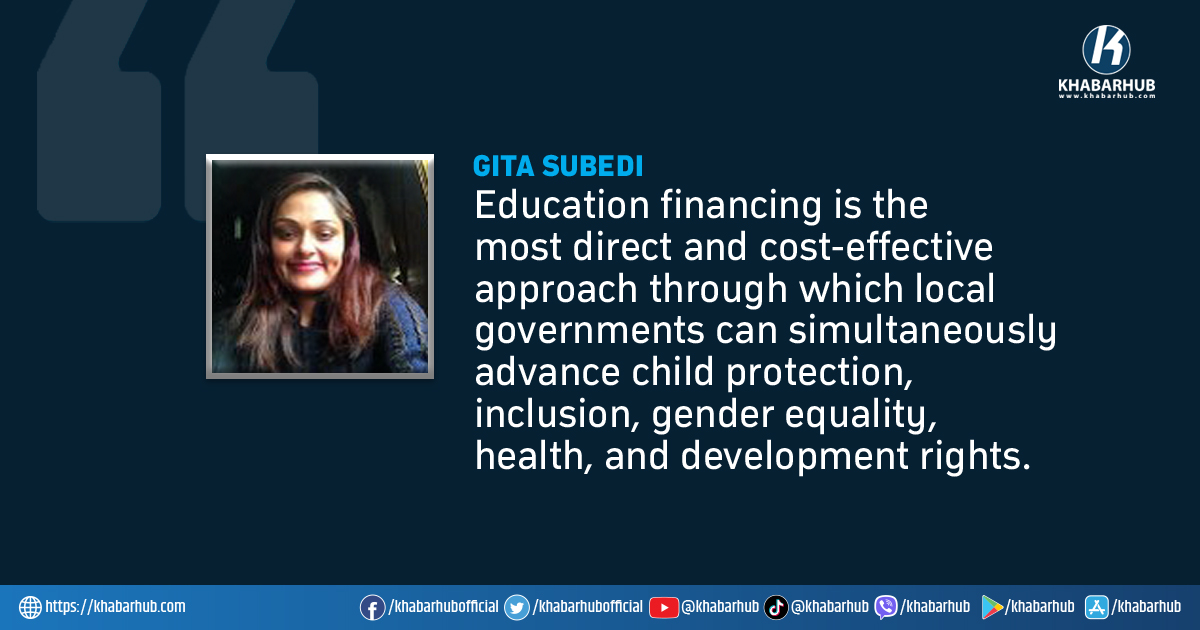
Education financing is the most direct and cost-effective approach through which local governments can simultaneously advance child protection, inclusion, gender equality, health, and development rights.
Every investment in teacher training, school infrastructure, child-friendly learning environments, inclusive curricula, scholarship systems for Dalit and marginalized children, TVET access, and community learning centres is simultaneously an investment in multiple dimensions of children’s constitutional rights.
Nepal’s legal mandates are progressive. The institutional mechanisms are defined. The rights are clearly enumerated, and the responsibilities are assigned.
However, adequate public financing from all three tiers of government, coupled with effective implementation, remains the system’s greatest need. Writing rights into the Constitution and laws is easier, but it is not sufficient. Every budget should adequately contribute to fulfilling this obligation and translating these legal mandates into reality.



Comment