




KATHMANDU: The government led by Prime Minister Balen Shah is preparing a new legal framework aimed at addressing longstanding procedural hurdles in infrastructure development, particularly in the hydropower sector.
The proposed legislation, titled the Infrastructure Facilitation Bill, is being drafted under the leadership of National Planning Commission member Arjun Jung Thapa. Widely referred to as a “Sunset Law,” the bill seeks to simplify legal procedures that developers argue have delayed major infrastructure and energy projects.
The proposal has received support from private-sector hydropower developers, who contend that Nepal will struggle to achieve its ambitious hydropower expansion targets over the next decade without legal reforms.
Developers argue that existing environmental regulations often create lengthy approval processes and implementation challenges, particularly for large-scale hydropower projects. However, environmental and social policy experts caution that efforts to streamline project development should not come at the expense of affected communities and ecological sustainability.
Lessons from international practice
Environmental impact assessment (EIA) remains a mandatory requirement for hydropower projects across most countries.
Internationally, countries such as Norway and Canada are often regarded as having some of the most effective environmental assessment frameworks. Studies and international reports also suggest that major hydropower-producing nations—including China, Brazil, the United States and India—have developed compensation and mitigation mechanisms that extend beyond Nepal’s current practices.
In the United States, hydropower projects are regulated under the National Environmental Policy Act and the Clean Water Act. Projects that threaten native fish species or endangered wildlife can face significant restrictions or even cancellation under environmental protection laws.
India similarly requires hydropower projects to obtain separate environmental and forest clearances before receiving technical and financial approval.
Canada has gone further by integrating indigenous participation, consent and rights into environmental assessment procedures. International studies frequently cite Canada as a leading example in protecting indigenous interests during infrastructure development.
Brazil’s 1988 Constitution also provides strong safeguards for indigenous territories. Hydropower projects in the Amazon region cannot proceed without indigenous consent and parliamentary approval. Courts have, in some cases, halted or cancelled major projects that failed to comply with these requirements.
In addition, Brazilian law prevents the displacement of communities until adequate resettlement and livelihood guarantees are in place.
Nepal’s environmental framework overlooks livelihoods
Nepal currently requires environmental assessments under the Environment Protection Act, 2019, and the Environment Protection Regulations, 2020.
While the framework addresses issues such as forest conservation, pollution control, compensation and the protection of national heritage, critics argue that it inadequately addresses the long-term livelihoods of communities dependent on rivers and natural ecosystems.
Hydropower developers are required to provide a certain percentage of project shares to affected local residents. However, concerns remain over the social and economic consequences of river diversion and dam construction.
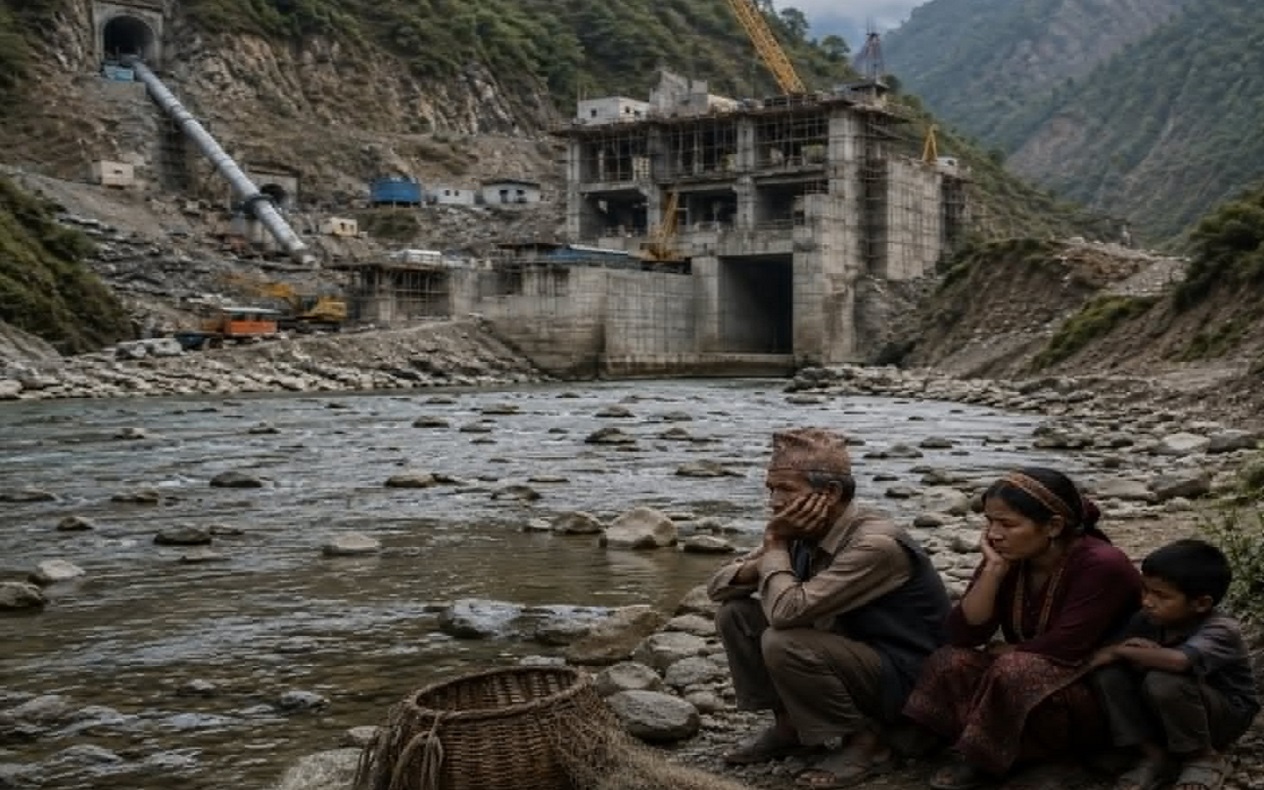
Across several river basins, declining fish populations and disruptions to aquatic ecosystems have affected traditional fishing communities, including indigenous Majhi and other river-dependent groups that have relied on these resources for generations.
Many households that historically depended on rivers for food and income have experienced reduced access to fish and other aquatic resources after project construction.
Critics argue that Nepal’s environmental assessment process does not adequately compare the economic value of electricity generation with the broader social, cultural and ecological value of rivers.
As a result, policymakers often lack a comprehensive understanding of whether the long-term public value of a river ecosystem outweighs the benefits generated through hydropower development in certain locations.
Calls for a broader approach
Experts say that while the proposed Sunset Law may help address issues related to land acquisition, tree clearance and bureaucratic delays, it should also incorporate stronger protections for communities whose livelihoods are directly affected by hydropower projects.
Drawing lessons from countries such as Canada and Brazil, they argue that the legislation should include provisions addressing indigenous rights, livelihood restoration, biodiversity conservation and long-term social impacts.
As the government moves closer to finalizing the draft, the debate is increasingly shifting from how quickly infrastructure can be built to whether development can be accelerated without overlooking the people and ecosystems that bear its costs.
The challenge, experts say, is not simply facilitating hydropower expansion, but ensuring that economic growth and environmental justice advance together.





Comment