




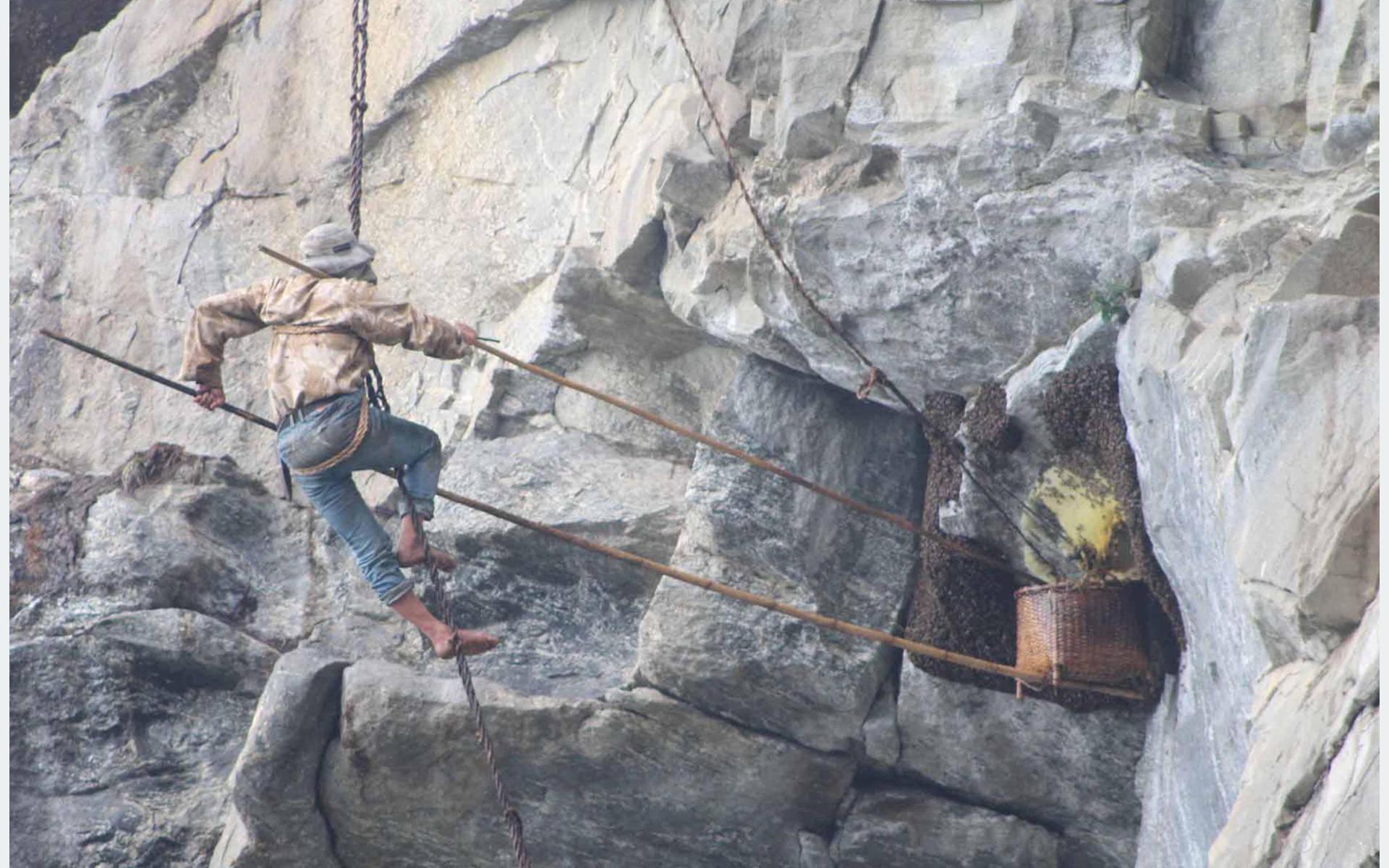
KHOTANG: A ‘Honey Hunting’ festival is set to be organized in Kepilasgadhi Rural Municipality of Khotang in the first week of Jestha. The festival aims to promote tourism while conserving the endangered Himalayan cliff bee.
The event will be held on June 3 at Phedi in coordination with the Koshi Province Government and the Ministry of Tourism, Forest and Environment.
According to Rural Municipality Chairperson Samir Rai, the festival is expected to contribute significantly to both bee conservation and tourism promotion. Phedi lies along the ‘Mundum Trail,’ one of the 100 tourist destinations identified by the Government of Nepal.
“Bees are found on many cliffs in the rural municipality. This year, in coordination with the provincial government, we are organizing the ‘Honey Hunting’ Festival to help conserve the endangered species and connect it with tourism,” Rai said.
“The festival will also showcase traditional foods consumed by the local community. Personalities from various fields related to biodiversity, along with domestic and foreign tourists, are expected to attend the event in the Terawa area of Phedi.”
According to locals, bees have been inhabiting more than a dozen cliffs in the community forest areas of Phedi in Kepilasgadhi Rural Municipality-1 for many years. Local resident Laxman Sampang said bee colonies can be found on cliffs such as Kuhire Chhangabhir in Ripdaula under the Fungalung Community Forest, Mahabhir Jharana in Makhamla under the Chilim Lahure Community Forest, and Terawabhir in Terawa.
Residents of Phedi traditionally hunt cliff bee honey twice a year — during Jestha-Asar and again in Katik-Mangsir. Local honey hunters estimate that honey worth between Rs 500,000 and Rs 700,000 can be harvested from a single cliff in one season.
Hastram Rai, a veteran honey hunter from Phedi who has practiced the tradition for generations as part of Kirat culture, said younger people are now becoming increasingly interested in the profession.
“I started honey hunting in 2035 BS, and now the younger generation is attracted to it,” he said. “We taught them ourselves, and we are happy to see them becoming professionals.”
Traditional honey hunting involves the use of ropes made from Malingo bamboo, safety nets, baskets, canopies, and other locally made tools. Hunters descend steep cliffs using ropes and extract honey using baskets and filtering tools.
In the local language, the person who descends the cliff to collect honey is called a “paryange.” The person responsible for handling ropes and sending tools and supplies to the cliffside hunter is known as a “sutare,” while those assisting with sorting, storing, and smoking the honey are referred to as helpers.
On the day of the honey hunt, residents from the Terawa, Makhamla, and Piping areas gather to celebrate the occasion with food, local beverages, and cultural festivities.
Honey produced is exported to markets including Diktel Bazaar, Dharan, Biratnagar, Kathmandu, and even abroad to countries such as the UK, Hong Kong, and Singapore.
The Kirat Rai (Sampang) community of Phedi also links honey hunting with traditional rituals. Honey collected from the cliffs is first offered to ancestors before being consumed as prasad.
Since the cliff bees gather nectar from medicinal herbs and wildflowers, the honey is widely believed to possess medicinal properties.






Comment