




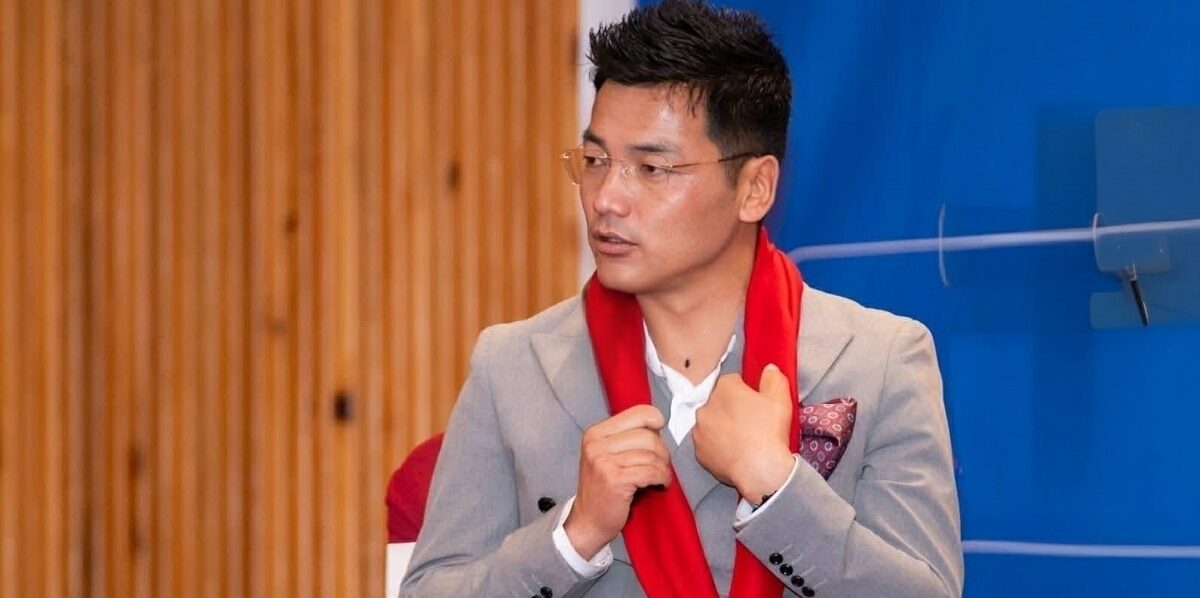
KATHMANDU: Nepali Congress (NC) Chief Whip Niskal Rai is regarded as an intellectual young leader with a strong interest in research and public policy. Elected from Ilam Constituency-1 on March 5, Rai is the same age as current Prime Minister Balendra Shah.
He says the Prime Minister should move beyond populism and focus on socialism and people-oriented governance. Born in 2047 BS in Suryodaya Municipality-4, Ilam, Rai has long been involved in politics alongside studies, research, social service, and the monitoring and evaluation of educational and financial institutions. Beginning his political journey through the Nepal Students’ Union, he studied management at Shankardev Campus.
Currently pursuing an MPhil in Economics, Rai also taught at Shankardev Campus for several years. He believes the public has accepted political change within the Nepali Congress because reform is necessary.
“The people have accepted change, but they are also beginning to feel how autocratic a leader emerging from that change can become, and that is very wrong,” Rai said.
“Our demand is for people-oriented governance and fair politics alongside change. Nepali Congress may have failed in some of its agendas, but it still carries its legacy. We are still here, and now the party will move forward by changing its thinking, behavior, and working style.”
Rai, who rose through student politics, has opposed the government’s move to dissolve student and fraternal organizations. He argues that such actions threaten personal freedom and constitutional rights.
“Looking at the government’s behavior, it appears increasingly autocratic. It should correct itself,” he said.
Rai said the opposition had initially adopted a strategy of refraining from criticizing the government for its first three months in office, but added that remaining silent was no longer possible once the government began moving toward “authoritarianism.”
He claimed the public is also beginning to oppose the government, arguing that its policies target poor and vulnerable people rather than poverty itself.
“What I want to suggest to the Prime Minister is this: if you want to survive in the long run, do not trample on poor and suffering people. First manage their problems, then work toward eliminating poverty,” he said.
Rai further stated that since the government claims to prioritize unity, the Prime Minister should focus more on practical governance and social issues rather than popularity. He added that while the Nepali Congress remains united in its decisions, the party still faces some internal challenges.
Khabarhub spoke with Niskal Rai about the government’s recent activities, contemporary politics, and the Nepali Congress’s position on current developments.
The government is dissolving various organizations, including trade unions. What is your view on this decision?
Judging by its actions, the government appears to be moving in an increasingly authoritarian direction. Once a government begins following an authoritarian path, neither the opposition nor the people will remain silent forever. They may stay quiet for some time, but that silence cannot last indefinitely. There is an attempt to curtail individual freedoms and the constitutional right to form organizations.
The Nepali Congress is clear that such distortions must be corrected. The constitutional rights granted to citizens should be institutionalized and protected, not suppressed. It is unfortunate that the government is attempting to undermine these rights. Democracy cannot be strengthened if the government ignores or weakens the basic freedoms guaranteed by the Constitution.
To strengthen democracy, constitutional rights must reach the grassroots level and be guaranteed to the people. A government cannot become stronger by suppressing everything. The government has also failed in addressing issues such as the squatter problem and the ordinance recently introduced.
Some argue that dissolving trade unions, party organizations, and commissions is justified because of the deviations seen in them. What do you say?
Our party meeting today also focused on this issue, and there was extensive discussion. The Central Working Committee has already made its position public.
A political party is an institution guided by ideology. It is a space for different principles, ideas, policies, philosophies, and programs. Debate and discussion are part of the democratic process, and political parties should engage in dialogue and negotiations based on ideas.
It is true that distortions have emerged within party organizations and commissions. We are aware of those problems. In today’s discussions, we focused on how to reduce and eliminate such distortions while developing these organizations into stronger ideological platforms.
The Constitution itself guarantees the right to establish and operate organizations. Restricting that right amounts to suppressing citizens’ ideological freedom and beliefs.
The government also appears to be considering reducing the number of ministries while adding new ones if necessary. Is that appropriate?
We must evaluate whether reducing ministries is practical, transparent, impartial, and result-oriented. If the government genuinely intends to act impartially, it should consult all stakeholders.
The existing ministries were established after years of debate, discussion, and sacrifice to protect important political achievements. Any decision to merge or restructure them should be made through broad consultation. We demand that the government hold discussions with all concerned parties before making such changes.
So, do you believe the government’s current approach is wrong?
In my personal view, the government has completely failed in some of its current programs, particularly regarding squatters. Many squatters are also voters and citizens of Nepal. They have exercised their democratic rights and contributed to the country. They also have the right to live and reside in this country.
Instead of eliminating poverty, the state now appears to be targeting poor people themselves. In the past, the state sought to reduce poverty, not remove the poor. Poor citizens are among the most honest and hardworking people in the country. They also dream of contributing to nation-building.
Removing them without proper preparation or rehabilitation measures is unjust. For many of them, even a small hut represents a lifelong dream. Sending bulldozers to demolish those homes reflects an authoritarian tendency.
Parliament should have been functioning properly, especially when the government enjoys a near two-thirds majority. Yet the government is trying to bypass the House of Representatives and govern through ordinances.
Ruling the country through ordinances is neither a healthy democratic practice nor the right constitutional approach. Such actions weaken both the country and the parliamentary system.
We hold no personal grudge against the government, its electoral success, or the mandate it received from the people. The people voted for them, and we respect that. However, the country must be governed according to the Constitution, laws, democratic norms, and established practices.
Nepal belongs to everyone — rich and poor alike. Whether people own land or not, all citizens, including squatters, should have the right to live with dignity in this country.
Have you, as the opposition, also become weak?
The Nepali Congress is not a party that suppresses the people’s voice. It is a party that listens to and respects public opinion. Congress does not make decisions impulsively. The concerns raised by the people are debated and discussed within the party.
Not only is Congress engaged in this process, but it is also playing an important role in bringing opposition parties together. We may be weak numerically, but we are not weak in our voice.
As Parliament resumes, party leaders are discussing various forms of protest and response — speaking in Parliament, raising issues within the party and organizations, and even taking to the streets in coordination with other parties. This process may continue if necessary. When a government becomes authoritarian and suppresses the people, opposition forces are compelled to protest. We are currently discussing how to move forward.
It has been said that Nepali Congress could not effectively criticize the government because of its own internal disputes. Is that true?
There are different ideological groups within our party, and that is natural. There are factions, and there should be. Open and fair competition among different schools of thought is necessary in a democratic party. In fact, those diverse perspectives are what keep the party alive.
Our party’s tradition is to bring together different ideas under a common philosophy. However, on serious national issues — such as governance, citizens’ rights, parliamentary functioning, and public suffering caused by poor services — we are united in our views.
So, is Nepali Congress prepared to protest both inside Parliament and on the streets against the government’s actions?
Yes, we are prepared. We are getting ready. If the government continues in this direction, the Nepali people themselves will also be ready to respond. I want to repeat that it has not even been three months since this government was formed.
The government should function according to its policies, laws, and the Constitution. We had committed not to criticize the government for its first three months, but after seeing citizens punished and mistreated, remaining silent no longer makes sense.
What would Nepali Congress have done if the government had acted differently?
We had welcomed the government’s 100-point action plan. At that time, and even now, our concern has been about how it would be implemented. Some points in the plan appear to go beyond constitutional provisions.
We advised the government to proceed within the framework of the law. During meetings with the Prime Minister, we raised legal concerns and urged the government not to violate the law while implementing the plan.
If the government had consulted all stakeholders, respected parliamentary practices, and moved forward through the House by enacting laws properly, we would have acknowledged its positive work.
However, we do not believe the government’s current approach — weakening Parliament and restricting constitutional rights — is appropriate, and I do not think others believe so either.
You and the Prime Minister are often described as belonging to the same generation and sharing similar thinking. As a citizen, what advice would you give him?
Everyone must respect the rule of law, especially those in positions of power. The law should apply equally to both elected leaders and ordinary citizens. A country functions on the basis of the rule of law. No one can sustain themselves politically by disregarding it. They may survive for some time, but not in the long run.
If a leader wants long-term credibility, their actions must be transparent, clean, and aligned with the expectations of the people from the very beginning.
So, do you believe the Prime Minister is moving beyond the law and the Constitution?
That is what it appears to be. Looking at his actions, it seems he is heading in that direction. I would humbly urge him to work within the Constitution, laws, rules, and policies. We are prepared to offer full support and trust if he does so.
The Prime Minister should not govern based solely on popularity. He should work in a practical and socialist-oriented manner. What I want to tell the Prime Minister is this: if you want to endure in the long run, do not trample on poor and suffering people. First manage their situation properly, and only then move toward reform.






Comment