




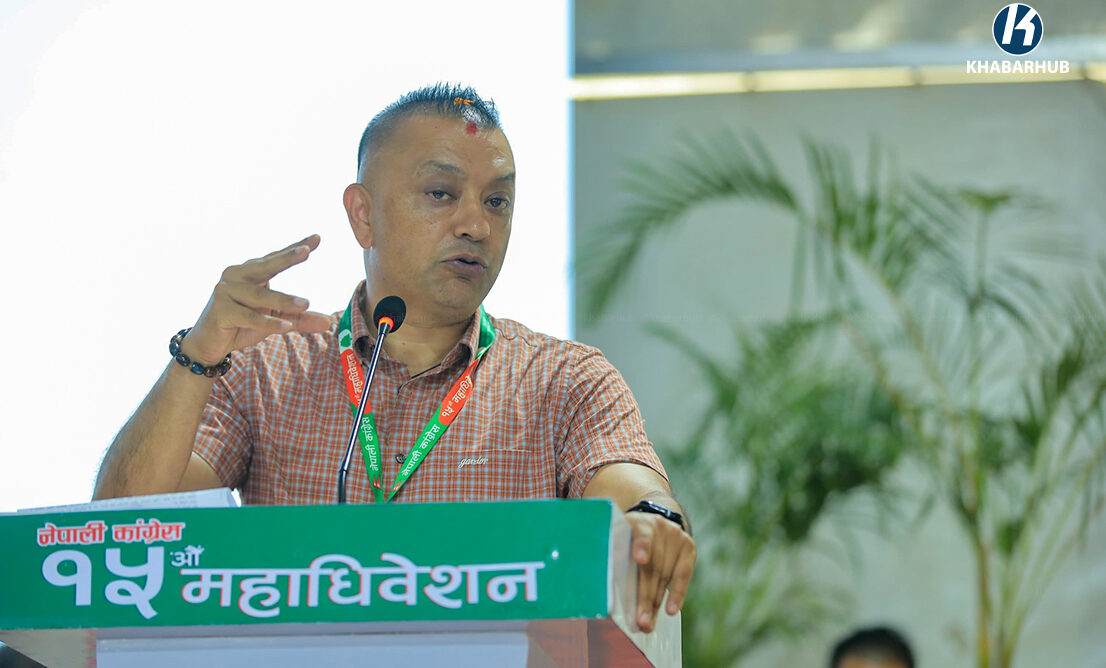
KATHMANDU: Nepali Congress (NC) President Gagan Thapa has presented a political report at the party’s 15th General Convention.
Thapa presented the report during the closed session on the second day of the convention, outlining his assessment of the country’s contemporary political situation, the role of the Nepali Congress and the party’s future political direction.
Addressing the closed session, Thapa said the country’s problems cannot be viewed solely in terms of the government, opposition or political parties. He argued that hostility and intolerance have spread throughout society and even into families.
“The problem is not only between the government and the opposition; there are problems within every household. Hatred and intolerance toward one another have become widespread,” he said.
Reflecting on various periods of Nepal’s political history, Thapa referred to the Congress’s performance in the 2064 BS Constituent Assembly election, when the party was reduced to 27 seats. He noted that although the Maoists emerged as the largest party in that election, the Constituent Assembly failed to draft a constitution during its first term.
Thapa also pointed to the Congress’s relatively small presence in the current House of Representatives. He argued that the situation could have become even more complicated had the party avoided the recent elections out of fear of defeat.
“If the elections had not been held because the Congress feared losing, the party would not have been in this situation. But if the elections had not taken place, we could have reached a situation where there would have been no elections again,” he said.
Despite the political ups and downs, Thapa said the Nepali Congress has played an important role in bringing different sections of society together and managing conflict.
He said the party has helped reduce social tensions by bringing different communities and identities into the political mainstream.
“The Congress has worked to connect society. It has worked to recognize different identities and help resolve conflicts,” Thapa said.





Comment