




Every year, World Environment Day reminds us of our shared responsibility to protect the planet. In 2026, the theme Climate Action comes at a critical moment. Across the globe, climate change is no longer a future concern but a present reality.
Rising temperatures, extreme weather events, biodiversity loss, environmental degradation, and pollution are affecting ecosystems, economies, and communities on an unprecedented scale.
The last decade has been the warmest on record globally. Climate-induced disasters now affect hundreds of millions of people every year, causing losses worth hundreds of billions of dollars. Yet the impacts are not shared equally.
Countries like Nepal, which contribute less than 0.1 percent of global greenhouse gas emissions, are among the most vulnerable to climate change. Climate action is therefore not simply an environmental agenda; it is essential for protecting lives, livelihoods, food security, and future generations.
Nepal at the Frontline of Climate Change
Nepal’s diverse geography, ranging from the Himalayas to the Terai plains, makes it particularly vulnerable to climate change. Scientific evidence shows that temperatures in the Himalayas are rising faster than the global average, accelerating glacier retreat and increasing the risk of glacial lake outburst floods.
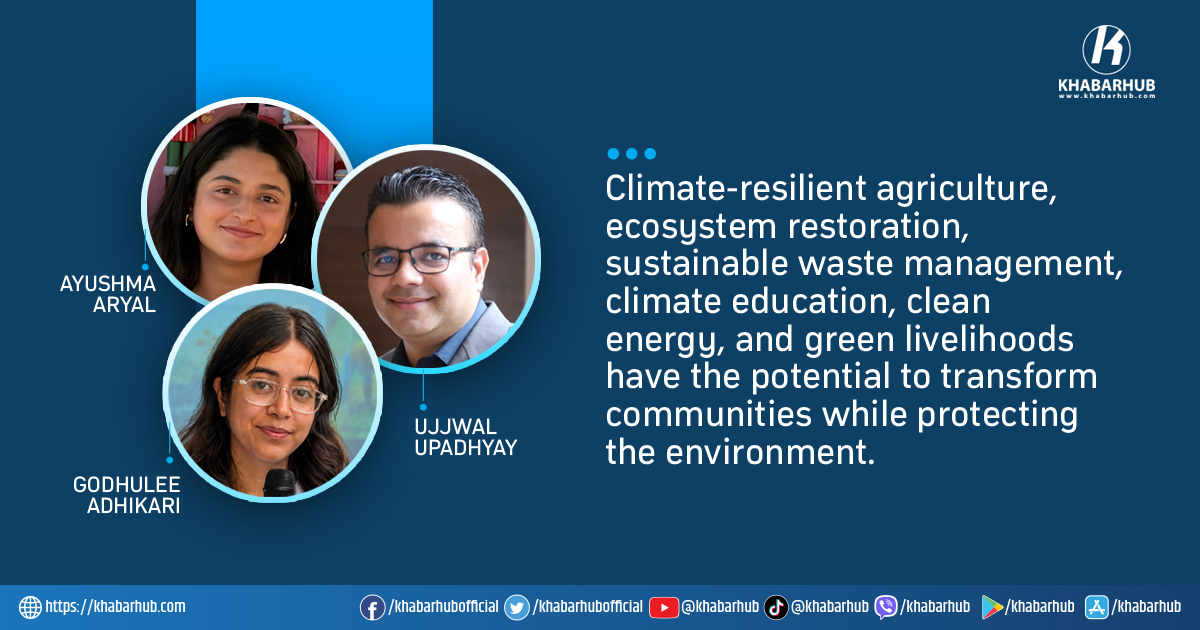
The good news is that the solutions already exist. Climate-resilient agriculture, ecosystem restoration, sustainable waste management, climate education, clean energy, and green livelihoods have the potential to transform communities while protecting the environment.
At the same time, climate variability is becoming more pronounced across the country. Communities are facing prolonged droughts, delayed monsoons, erratic rainfall, flash floods, landslides, heatwaves, and forest fires with increasing frequency and intensity. In recent years, the Terai has experienced recurrent winter droughts, delayed monsoon onset, and extreme heat events exceeding 40°C, placing enormous pressure on agriculture, water resources, and public health.
Agriculture, which supports the livelihoods of nearly two-thirds of Nepal’s population and contributes around one-quarter of the national economy, is particularly vulnerable. Farmers increasingly report declining water availability, shifting planting seasons, reduced productivity, and growing uncertainty regarding weather conditions. Soil degradation, erosion, sedimentation, and declining fertility further threaten food production and rural livelihoods.
The country also faces mounting environmental challenges beyond climate change. Forests and ecosystems that provide essential services such as water regulation, biodiversity conservation, carbon sequestration, and disaster protection are under increasing pressure from unsustainable resource use and habitat degradation.
Plastic pollution has emerged as another growing concern. Nepal generates hundreds of thousands of tonnes of municipal waste annually, with plastic waste representing one of the fastest-growing components. Large quantities of unmanaged waste ultimately find their way into rivers, wetlands, forests, and agricultural landscapes, threatening both wildlife and human health.
The combined impacts of climate change, environmental degradation, biodiversity loss, and pollution are creating complex risks that require integrated and community-centred solutions.
Pathways for Climate Action
While the challenges are significant, the solutions are within reach. Effective climate action requires practical interventions that simultaneously strengthen resilience, restore ecosystems, reduce emissions, and improve livelihoods.
- Building Climate-Resilient Agriculture
Agriculture remains the backbone of rural Nepal, yet it is increasingly exposed to droughts, floods, heat stress, pests, and erratic rainfall. Building resilience requires promoting climate-smart agriculture practices that enhance productivity while protecting natural resources.
Practices such as composting, organic farming, efficient irrigation, rainwater harvesting, soil conservation, and climate-informed farming decisions can improve productivity and reduce vulnerability. Healthy soils store more carbon, retain more moisture, and better withstand climatic shocks. Supporting farmers to adopt climate-resilient practices is therefore critical for strengthening food security and sustaining rural livelihoods.
- Restoring Rivers and Ecosystems
Healthy ecosystems are among the most effective natural defences against climate change. Forests, wetlands, rivers, and grasslands regulate water flows, support biodiversity, store carbon, and reduce disaster risks.
Community-led river clean-up campaigns, watershed restoration, wetland conservation, and habitat rehabilitation can significantly reduce pollution while improving ecosystem health. Restoring degraded ecosystems not only benefits wildlife but also strengthens community resilience against floods, droughts, and extreme weather events.
- Advancing Circular Economy and Sustainable Waste Management
Plastic pollution is one of the defining environmental challenges of this time. Addressing it requires shifting from a “take-use-dispose” model towards a circular economy where materials are reused, recycled, and kept in circulation for as long as possible.
Recycling one kilogram of plastic can prevent approximately four kilograms of carbon emissions. Strengthening material recovery facilities, promoting waste segregation at source, and supporting informal waste workers can reduce environmental pollution while generating green employment opportunities. Women, who constitute a significant share of the recycling workforce, can particularly benefit from investments in safer and more inclusive waste management systems.
- Investing in Climate and Disaster Resilience Education
Climate resilience begins with awareness and preparedness. As disasters become more frequent and severe, education has an increasingly important role in protecting lives and livelihoods.
The challenges facing Nepal and the world are interconnected. Climate change, biodiversity loss, deforestation, environmental degradation, and pollution cannot be addressed in isolation.
Climate and disaster risk reduction education helps students understand environmental challenges while equipping them with practical skills for emergency preparedness, environmental stewardship, and community action. Eco-clubs, awareness campaigns, evacuation drills, and school-based environmental initiatives can create a powerful “child-to-home” effect, extending climate knowledge throughout communities.
- Promoting Clean Energy and Human-Wildlife Coexistence
Climate action can begin in the household kitchen. Across many rural communities, dependence on fuelwood continues to contribute to deforestation, indoor air pollution, greenhouse gas emissions, and human-wildlife conflict.
Transitioning to cleaner energy technologies such as electric cooking stoves offers multiple benefits. It reduces pressure on forests, improves indoor air quality, lowers emissions, and minimizes wildlife encounters associated with fuelwood collection. Importantly, electric cooking can reduce kitchen temperatures by more than 10°C compared to traditional firewood stoves, providing substantial relief from heat stress, particularly for women who spend several hours each day preparing meals. As heatwaves become increasingly common across Nepal, this simple transition can significantly improve health, comfort, productivity, and household well-being.
- Empowering Women Through Green Enterprises
Climate solutions become more sustainable when they generate economic opportunities. Women often bear a disproportionate share of climate impacts while simultaneously playing a critical role in household and community resilience.
Supporting women-led green enterprises, sustainable livelihoods, eco-friendly businesses, and climate-smart entrepreneurship can strengthen incomes while promoting environmental sustainability. Skills development, access to finance, and market opportunities enable women to become active leaders in climate action while contributing to local economic development.
Turning Awareness into Action
World Environment Day 2026 reminds us that climate action belongs to everyone. It is not confined to international negotiations or government policies; it begins in our farms, homes, schools, communities, and workplaces.
The challenges facing Nepal and the world are interconnected. Climate change, biodiversity loss, deforestation, environmental degradation, and pollution cannot be addressed in isolation. They require integrated solutions that bring together environmental conservation, sustainable development, social inclusion, and community empowerment.
The good news is that the solutions already exist. Climate-resilient agriculture, ecosystem restoration, sustainable waste management, climate education, clean energy, and green livelihoods have the potential to transform communities while protecting the environment.
This World Environment Day, let us move beyond awareness and commit to action. Every tree planted, every river cleaned, every household adopting clean energy, every farmer practising climate-smart agriculture, and every young person advocating for environmental stewardship brings us one step closer to a more resilient, sustainable, and prosperous future.
(Ujjwal Upadhyay is Climate Expert and Project Coordinator; Ayushma Aryal is Project Associate; and Godhulee Adhikari is Research Associate at the Climate Action Project in Nepal, supported by Konrad Adenauer Stiftung)






Comment