




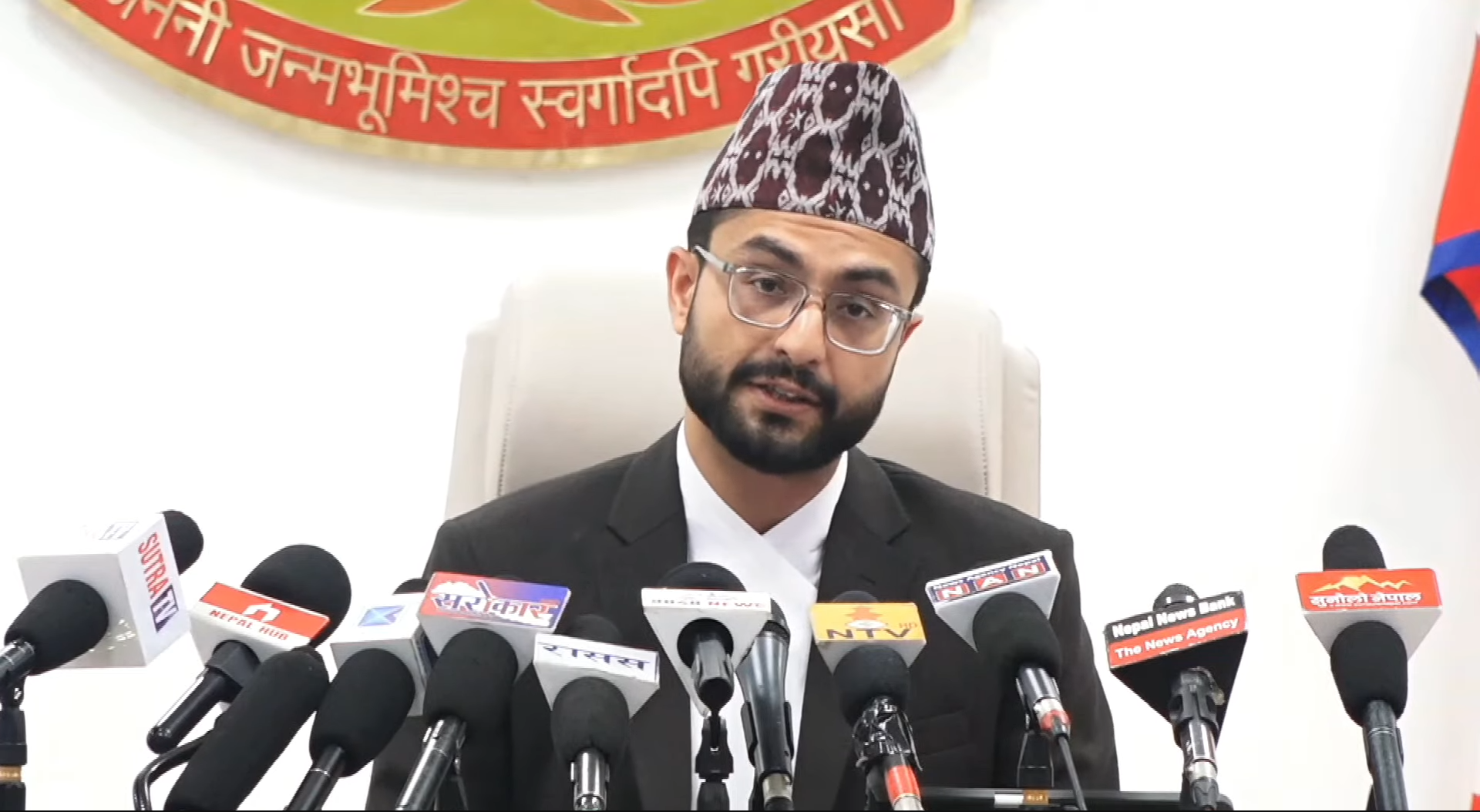
KATHMANDU: Prime Minister Balen Shah’s government has completed its first 100 days in office, highlighting a wide range of governance reforms, anti-corruption measures, digital service expansion, and administrative restructuring as key achievements.
Unveiling its 100-day progress report on Saturday, the government said it had approved a 100-point governance reform agenda during its first Cabinet meeting on March 27, 2026 (Chaitra 13, 2082), describing the initial 100 days as the foundation for long-term institutional reform.
The government said it has prioritized administrative reform, public service delivery, digital governance, fiscal discipline, good governance, and infrastructure development.
Among its major initiatives is the formation of a high-level Asset Investigation Commission under the Commission of Inquiry Act to investigate the assets of political office-bearers and senior government officials who have held public office since the 2006 People’s Movement. The commission has already collected more than 11,000 asset declarations and complaints, which are currently under preliminary review.
The government also said investigations are underway into the alleged misappropriation of public land belonging to Bal Mandir, the unauthorized overseas transfer of children, and the Ncell share transaction controversy.
According to the report, the Department of Money Laundering Investigation has filed seven major cases involving 101 individuals and entities, claiming Rs 118 billion in allegedly illicit assets. The Central Investigation Bureau has also intensified investigations into banking offences and violations of securities laws.
As part of its digital governance agenda, the government has initiated the development of an integrated digital asset registry covering bank accounts, digital wallets, and share investments. It also said more than 200,000 online betting-related domains and websites have been blocked within 24 hours under cyber security measures.
The report states that authorities detained 466 middlemen allegedly involved in irregular dealings at government offices, filing cases against 170 of them. More than 13,000 individuals accused of robbery and attacks on private property have also been detained, with over 6,000 cases registered.
To improve public security, the government said it has deployed special security teams nationwide, installed more than 4,000 CCTV cameras in high-risk areas, and introduced rapid response mechanisms for highway and industrial security.
The government also highlighted the introduction of a National Integrity Policy to strengthen transparency and accountability across public, private, and non-government sectors.
On institutional reform, it said 31 financially burdensome government agencies have been abolished, while others are being merged or restructured. Authorities have also reclaimed 672 government vehicles allegedly used unlawfully by former officials and politically connected individuals.
At Tribhuvan University, more than Rs 132.6 million has been recovered after around 400 faculty members failed to return from study leave within the stipulated period.
The government said it has collected over Rs 434.8 million in outstanding dues from industries operating in industrial estates and disconnected electricity supply to 33 industries for non-payment.
As part of administrative restructuring, the number of federal ministries has been reduced from 22 to 18. The government said several provincial governments have also begun downsizing their ministerial structures.
It further claimed to have abolished politically affiliated civil service trade unions through an ordinance in an effort to depoliticize the bureaucracy.
The report also highlighted reforms in public appointments, stating that positions in the National Planning Commission, universities, and the Securities Board have been filled through open competition and merit-based selection. It added that Nepal is also in the final stage of appointing ambassadors through an open competitive process for the first time.
To improve service delivery, the government said citizenship certificates and passports are now being delivered to citizens’ homes through the postal service in 75 districts. Home delivery of driving licences has also begun in Kaski and Morang.
Customs offices now remain open for at least 12 hours even on Sundays and public holidays, while land administration services have been decentralized to local governments in selected areas.
The government also said mortgage registration and release services have been digitized, and additional certificates can now be downloaded through the Nagarik App, which also supports digital driving licence services.
According to the report, the upgraded Hello Sarkar grievance platform has connected more than 3,700 federal, provincial, and local government offices through an integrated dashboard. The government said complaints increased by 600 percent over the past 100 days, with around 60 percent already resolved. A 24-hour national citizen assistance system has also been launched by the Home Ministry.
The report also cited efforts to reclaim public land, including the implementation of the Rawal Commission report, removal of encroachments in the protected watershed around Phewa Lake in Pokhara, and updating records of government-owned land based on the Nepal Children’s Organization report.
The government said it has begun clearing high-risk settlements along riverbanks in the Kathmandu Valley to create open public spaces and parks.
Regarding landless settlers, the report said more than 1.2 million applications have been collected to build a GIS-based digital database. It added that land ownership certificates have already been distributed to landless families in Bardiya’s Badhaiyatal Rural Municipality.
Families displaced from riverbank settlements have been accommodated in holding centres with food, shelter, education, and healthcare support. The government said each affected family has also received a one-time resettlement grant along with monthly financial assistance.
In the cooperative sector, the government said it has released Rs 250 million to begin refunding deposits to small savers affected by troubled cooperatives.




Comment