




Corruption is often discussed in Nepal as a moral failing, a legal violation, or a political slogan. Yet its true significance extends far beyond these dimensions.
Corruption is fundamentally a strategic challenge that has weakened Nepal’s state capacity, eroded public trust, discouraged investment, distorted development priorities, and undermined national competitiveness. It has affected everything from infrastructure construction and public service delivery to foreign investment, economic growth, and democratic legitimacy.
For decades, Nepal has struggled to address corruption despite repeated commitments from successive governments. In fact, corruption has evolved from isolated incidents to institutionalized corruption. Numerous investigations have been launched, commissions have been established, laws have been amended, and public campaigns have been conducted.
Nevertheless, perceptions of corruption remain high, public confidence in institutions remains fragile, and major scandals continue to emerge with alarming regularity.
Critics frequently portray this approach as rewarding politicians. Yet Singapore viewed compensation as part of a broader integrity system.
This raises an important question: What distinguishes countries that successfully control corruption from those that merely fight it rhetorically?
One of the most compelling answers can be found in Singapore.
Today, Singapore is ranked as the third least corrupt country in the world out of 180 nations, holding the top spot in the Asia-Pacific region. According to Transparency International’s Corruption Perceptions Index (CPI), Singapore has a score of 84 out of 100. International investors trust its institutions, citizens generally have confidence in public administration, and government agencies enjoy a reputation for efficiency and integrity. Yet this was not always the case.
At the time of self-government in 1959 and independence in 1965, Singapore faced many of the same governance challenges confronting developing countries like Nepal today. Corruption was widespread throughout customs offices, law enforcement agencies, licensing authorities, and public administration. Informal payments, patronage networks, and bureaucratic inefficiency were common features of governance.
The remarkable transformation that followed offers valuable lessons for Nepal—not because the two countries are identical, but because Singapore demonstrates that corruption is not an unavoidable cultural characteristic. It is a governance problem that can be addressed through institutional design, political leadership, and sustained reform.
Corruption as a National Security and Development Challenge
A critical reason for Singapore’s success was that its leaders viewed corruption not merely as an ethical issue but as an existential threat to national survival.
Singapore emerged as a small and vulnerable state with few natural resources, limited strategic depth, and uncertain economic prospects. The country’s leadership understood that attracting investment, generating employment, and building international credibility would require trustworthy institutions.
The founding Prime Minister, Lee Kuan Yew, repeatedly argued that a corrupt government could not create a competitive economy. Investors would avoid environments where contracts depended on bribes, regulations were inconsistently enforced, and bureaucratic decisions could be purchased.
For Singapore, therefore, anti-corruption reform became an integral component of its national development strategy.
This perspective holds important implications for Nepal.
Corruption should not be viewed solely through the lens of criminal justice. It is equally an economic, developmental, and strategic issue. Every inflated procurement contract reduces the resources available for education, health care, infrastructure, and social protection.
Every politically influenced appointment weakens institutional effectiveness. Every act of rent-seeking increases transaction costs for businesses and discourages productive investment.
Countries do not become prosperous despite corruption. They become prosperous by reducing it.
The Central Importance of Political Will
The most important lesson from Singapore is neither legal nor institutional. It is political.
Many countries possess anti-corruption laws. Many have investigative commissions and oversight agencies. Yet corruption persists because political leadership lacks either the will or the incentive to enforce accountability consistently.
Singapore’s leadership understood that credibility begins at the top.
The government demonstrated that seniority, political influence, or personal connections would not guarantee immunity. Ministers, senior officials, and politically connected individuals were investigated whenever the evidence justified scrutiny. This created an environment in which citizens increasingly believed that anti-corruption efforts were genuine rather than selective.
This remains one of the greatest challenges confronting many democracies, including Nepal.
Public confidence erodes when anti-corruption campaigns appear politically motivated. Investigations targeting opponents while ignoring allies create perceptions of selective justice. Such practices weaken institutions and reinforce public cynicism.
The fundamental lesson is simple but difficult: anti-corruption efforts succeed only when accountability extends upward rather than merely downward.
When citizens observe powerful individuals facing consequences for misconduct, trust in institutions increases. When accountability applies only to lower-level officials, trust declines.
Building Institutions That Can Investigate Power
Political commitment alone is insufficient without capable institutions.
Singapore’s success was reinforced by strengthening the Corrupt Practices Investigation Bureau (CPIB), an agency tasked with investigating corruption at all levels of government.
The CPIB enjoyed several important advantages—mainly six: operational independence, professional investigative capacity, adequate resources, strong legal authority, the ability to investigate senior officials, and protection from political interference.
Perhaps most importantly, it developed a reputation for impartiality.
This institutional credibility became a powerful deterrent. Public officials understood that corruption carried a meaningful risk of detection and prosecution.
Nepal already possesses institutions designed to perform similar functions, including the Commission for the Investigation of Abuse of Authority (CIAA). However, the challenge lies not merely in constitutional design but in operational effectiveness.
The effectiveness of anti-corruption institutions depends on several factors. Five are particularly important: first, professional investigators; second, adequate financial and technological resources; third, independent leadership; fourth, efficient judicial processes; and finally, public trust.
Without these components, institutions may exist formally while remaining ineffective in practice.
The Often-Ignored Role of Incentives
One of Singapore’s most controversial reforms involved public-sector compensation.
The government concluded that persistent corruption could not be addressed solely through punishment. Public officials also required incentives to remain honest.
Consequently, Singapore gradually linked public-sector salaries to private-sector benchmarks.
Senior civil servants, judges, and ministers received compensation designed to attract talented professionals while reducing incentives for illicit enrichment.
Specialized anti-corruption courts, improved case management systems, judicial modernization, and increased institutional capacity could contribute significantly to strengthening accountability.
Critics frequently portray this approach as rewarding politicians. Yet Singapore viewed compensation as part of a broader integrity system.
The logic was straightforward: if society expects competent and ethical public administration, it must create conditions that support integrity.
Nepal’s economic realities differ significantly from Singapore’s.
Replicating Singaporean salary levels is neither practical nor necessary. Nevertheless, the underlying principle remains relevant. Civil service reform should focus on six areas: merit-based recruitment, performance-based promotion, professional development, career security, competitive compensation, and recognition of integrity.
An anti-corruption strategy based exclusively on punishment neglects the importance of incentives.
Reducing Opportunities for Corruption
One of Singapore’s most effective reforms involved reducing opportunities for corruption before they arose.
Rather than focusing exclusively on catching corrupt officials, policymakers redesigned administrative systems to minimize discretionary authority and bureaucratic complexity.
This included:
Simplifying licensing procedures.
Streamlining regulatory approvals.
Digitizing government services.
Reducing paperwork.
Standardizing administrative processes.
The result was straightforward: fewer discretionary decisions meant fewer opportunities for bribery.
This lesson may be particularly relevant for Nepal.
Many forms of corruption emerge not because individuals are uniquely unethical but because systems create opportunities for rent-seeking. Complex procedures, opaque regulations, multiple layers of approval, and discretionary decision-making generate incentives for informal payments.
Every unnecessary bureaucratic step creates a potential opportunity for corruption.
Digital governance therefore represents one of Nepal’s most promising reform opportunities.
Areas deserving priority attention include:
Land administration.
Customs procedures.
Tax collection.
Public procurement.
Business registration.
Local government services.
Construction permits.
Technology cannot eliminate corruption entirely. However, it can substantially reduce opportunities for direct manipulation and informal transactions.
The Procurement Challenge
Public procurement represents one of the largest sources of corruption vulnerability in developing countries.
Infrastructure projects, public construction contracts, equipment purchases, and service agreements frequently involve substantial financial resources and complex decision-making processes.
Singapore addressed procurement risks through transparency, professional oversight, and strict accountability mechanisms.
Nepal could pursue similar objectives through:
Fully digital tender systems.
Open contract databases.
Independent procurement monitoring.
Real-time public disclosure.
Strengthened auditing mechanisms.
Enhanced parliamentary oversight.
Procurement transparency produces multiple benefits simultaneously. It reduces corruption risks, improves value for money, increases investor confidence, and strengthens public trust.
The Judiciary as the Ultimate Test
No anti-corruption strategy can succeed without an effective judicial system.
Investigations alone do not create accountability. Cases must be resolved efficiently, fairly, and predictably.
Singapore’s judiciary earned a reputation for professionalism, efficiency, and independence. This reinforced confidence in anti-corruption enforcement.
For Nepal, judicial reform represents a critical component of broader governance transformation.
Lengthy delays, procedural complexity, and inconsistent outcomes undermine deterrence. Citizens lose confidence when corruption cases remain unresolved for years.
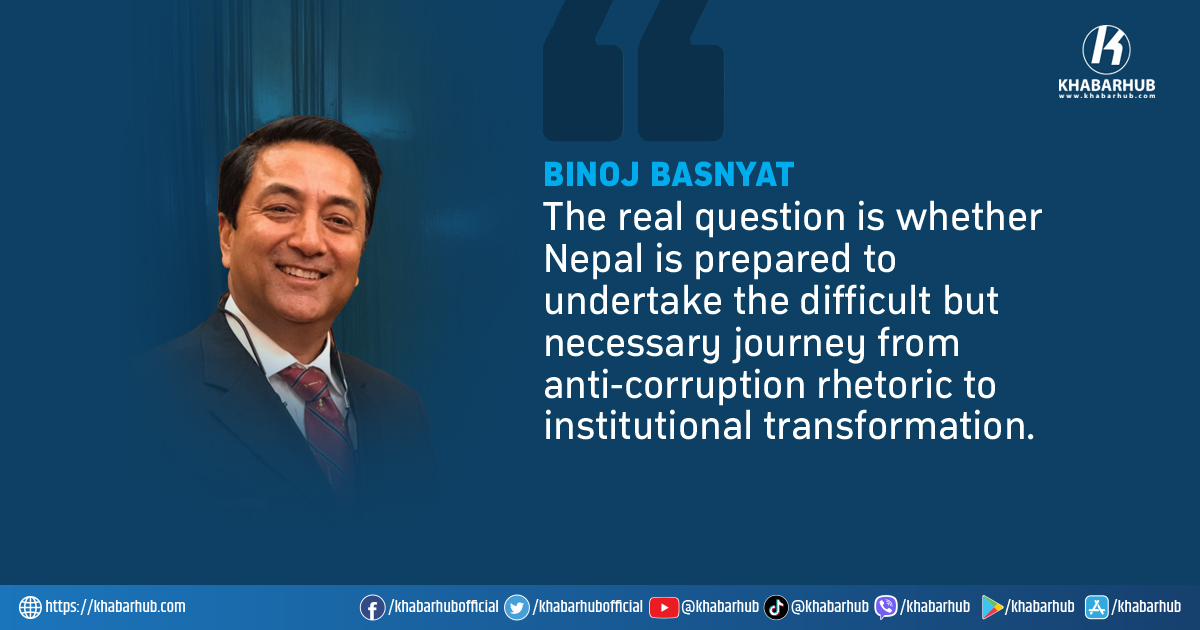
The real question is whether Nepal is prepared to undertake the difficult but necessary journey from anti-corruption rhetoric to institutional transformation.
Specialized anti-corruption courts, improved case management systems, judicial modernization, and increased institutional capacity could contribute significantly to strengthening accountability.
Understanding Resistance to Reform
One of the most misunderstood aspects of anti-corruption reform is the resistance it generates.
Corruption is not merely a collection of isolated illegal acts. It often evolves into networks of mutual benefit involving political actors, bureaucratic interests, business groups, and intermediaries.
Meaningful reform threatens these networks.
Consequently, reformers should expect resistance in various forms:
Political obstruction.
Bureaucratic inertia.
Legal challenges.
Information manipulation.
Institutional sabotage.
Public disinformation campaigns.
Singapore faced many of these challenges during its reform process.
The difference was persistence.
Reforms were sustained over decades rather than across electoral cycles.
This long-term perspective is particularly important for Nepal.
Corruption accumulated over many years and cannot be eliminated through short-term campaigns.
Sustainable progress requires patience, consistency, and institutional continuity.
Can Nepal Become the Singapore of South Asia?
This question frequently arises whenever Singapore’s experience is discussed.
The answer is both yes and no.
No, because Nepal cannot replicate Singapore’s centralized political structure, unique historical circumstances, or city-state model of governance.
Nepal is a federal, pluralistic democracy characterized by coalition politics, geographic complexity, and significant social diversity. These differences matter.
Yet the answer is also yes.
Nepal can adopt many of the principles underlying Singapore’s success:
Political accountability.
Institutional independence.
Administrative professionalism.
Digital governance.
Meritocracy.
Procurement transparency.
Judicial efficiency.
The objective should not be imitation but adaptation.
Countries succeed when they apply universal principles to local realities.
Toward a National Integrity Strategy
Rather than pursuing isolated reforms, Nepal would benefit from a comprehensive national integrity strategy.
Such a strategy could include five major pillars.
First, strengthen independent oversight institutions through professionalization and operational autonomy.
Second, accelerate digital governance reforms to reduce opportunities for discretionary corruption.
Third, reform public procurement systems to enhance transparency and accountability.
Fourth, modernize the civil service through merit-based recruitment and performance-based management.
Fifth, improve judicial efficiency and strengthen enforcement mechanisms.
These reforms are mutually reinforcing. Progress in one area strengthens progress in others.
Most importantly, reform must be sustained across political transitions. Anti-corruption strategies cannot depend on individual leaders alone. They must become embedded within institutions.
Conclusion
Singapore’s anti-corruption success is often described as a miracle. In reality, it was not a miracle at all. It was the product of strategic leadership, institutional reform, administrative modernization, and sustained political commitment over many decades.
The central lesson for Nepal is not that corruption can be eliminated overnight. Rather, it is that corruption can be systematically reduced when governments address its structural causes rather than merely its symptoms.
Singapore succeeded because honesty became more rewarding, corruption became more difficult to conceal, institutions became more professional, and accountability extended to powerful individuals as well as ordinary citizens.
Nepal’s future prosperity, governance effectiveness, and democratic credibility depend on achieving similar outcomes through its own constitutional and political framework.
The question is no longer whether successful anti-corruption models exist. They do.
The real question is whether Nepal is prepared to undertake the difficult but necessary journey from anti-corruption rhetoric to institutional transformation. The answer to that question may ultimately determine the quality of governance, economic growth, and democratic stability that future generations inherit.
(Basnyat is a Maj. Gen. (Retd.) of the Nepali Army and writes on international affairs and geopolitical strategy. He is also a researcher affiliated with Rangsit University in Thailand.)






Comment