




Over the last thirty-six years, we have often seen politicians saying one thing but doing the opposite. This pattern has damaged public trust and weakened democratic institutions. Still, I am cautiously hopeful because this contradiction is no longer ignored.
Around the world—and increasingly in Nepal—people are realizing that what is called “democracy” is gradually shifting toward plutocracy, where wealth, networks, and influence overshadow the will of ordinary citizens.
Researchers seeking to understand social and economic transformations and revolutionaries have noted that many significant changes depend on constitutional reforms requiring capable leadership to prevent the country from falling into chaos, while, at the same time, the politically articulate portion of the population also plays a role, as Susanne Jonas argued in The Battle of Guatemala: Rebels, Death Squads and US Power (1991).
On the question of leadership, I also agree with Pope Francis, who recently warned that tyrants are ravaging the world. His words resonate not only globally but also in our political scene, where a small, unaccountable elite too often holds power.
Even if we start from the collapse of the absolute monarchy following the People’s Movement of 1990, no ruling dispensation has been able to articulate a genuinely new, imaginative, and hopeful vision of a shared national future on one hand, or divergent paths of stable and well-functioning democracy, persistent instability, repression, and state failure on the other.
Simultaneously, assumptions about how policy preferences form need reassessment. The idea that preferences only develop through domestic interest aggregation is outdated. In Nepal, preferences are influenced by internal and external factors like geopolitical pressures, economic ties, and transnational ideas.
Rather than deepening democratic culture, the post-1990 period has often been marked by institutional stagnation and periodic backsliding. Political competition has tended to revolve around power-sharing among elites rather than transformative policy agendas that resonate with broader societal aspirations.
Nepal’s democratic trajectory cannot be easily understood through the lens of moderate individualism, where citizens confidently assert their interests while maintaining trust and civic responsibility toward others.
Instead, Nepal’s experience raises a more fundamental and persistent question: who actually governs? This question has remained unresolved despite successive political transitions.
In the Nepali context, most scholars studying the development of political institutions see governability as a key challenge to democratic legitimacy. Access to public benefits has become more politicized, often serving partisan interests instead of fairness, transparency, and accountability.
Meanwhile, ruling elites have largely failed to provide credible, reform-focused solutions that align with democratic principles. These issues are not just due to hidden political motives but also highlight deeper structural weaknesses within the system.
Such trends have gradually undermined democratic governance, weakening institutions and reducing public trust. Consequently, confidence in the political system has decreased, raising concerns about the long-term viability and responsiveness of democracy.
While it is undisputed that access to public benefits has become increasingly politicized and often serves partisan interests rather than fairness, transparency, and accountability, the democratic character of decision-making remains far below the level necessary to ensure simple, credible, reform-focused solutions aligned with democratic principles.
There may be no better way for the new regime to build a close relationship with the people—especially the broader population—than by holding the political elite accountable for the country’s pressing problems and restoring faith in long-term national interests.
Nepal clearly needs a strong executive capable of overhauling its deeply corrupt system and operating with sufficient authority to act decisively, while remaining subject to essential institutional checks. In particular, urgent reforms are needed in the judicial branch, which currently struggles to meet even the minimum standards of a truly democratic institution.
Everyone recognizes that rebuilding public trust and strengthening democracy often relies on visible acts of accountability. Since 2008, the actions of certain rulers have caused many distortions, leading people to see Nepal as controlled by a small group of leaders and mafias.
Consequently, the Nepali Congress (NC), Communist Party of Nepal (UML), and Maoist Centre (MC) have been removed from power. Although the 2006 peace agreement shifted Nepal’s political landscape, a review of the post-monarchy era shows that fundamental structural change has been limited and democratic processes have been undermined. This has kept the country at a minimal democratic threshold, with political leadership remaining a major obstacle.
Recent electoral losses for these major parties have further destabilized Nepal’s traditional political order. Scholars suggest that the Nepali state might be moving beyond a culture marked by excessive ambition, political extremism, and an aging leadership.
However, some analyses point to a “captive state syndrome,” where power is concentrated among a small group with disproportionate influence. While new political players and changing contexts could bring fresh governance norms, it is too early to say Nepal has fully embraced democracy or established lasting democratic norms.
Political transitions are often seen as chances for meaningful renewal, but they frequently sustain existing power structures under new leadership. The key question is whether current developments will lead to genuine accountable governance and reform, or just another cycle of elite power shifts.
Over recent decades, liberal values like sustainable development, gender equality, and human security have increasingly shaped governance. Yet standards for ministerial selection sometimes seem ignored, causing embarrassment for the Prime Minister and his party. For the first time since 1991, traditional parties like the NC, UML, and
Maoists lost elections in 2026, suggesting they might face more challenges that threaten democratic stability. Nevertheless, the RSP regime has taken a positive step by aiming to uphold impartiality, integrity, transparency, efficiency, professionalism, and service orientation.
The rise of the Rastriya Swatantra Party (RSP) presents both a promising opportunity and a crucial test. To avoid repeating past failures, the RSP must emphasize developing innovative political and economic policies based on a thorough reassessment of institutional roles.
This requires more than superficial reform; it calls for a deep exploration of whether current institutional structures truly match Nepal’s social realities and development needs.
Elections are increasingly seen as costly, and funding in Nepal is notably complex. Public support is essential for successful policy adoption and implementation. While the pluralization thesis suggests that diverse party representation promotes various participation forms, Nepal’s democracy is currently declining due to insufficient responsiveness, representation, and accountability.
Confidence in punishing wrongdoers remains low because the judiciary faces internal disputes, undue influence, and corruption allegations. To combat this, Parliament should pass special legislation to create a robust judicial tribunal with the authority to deliver quick, strict, and binding verdicts.
Its decisions should not be reviewable by ordinary courts, and investigations should be completed within a year. High-level officials—President, Prime Minister, and ministers—must transparently disclose their assets and income sources.
Without transparency, accountability is meaningless. The era of secretive leadership, backdoor deals, and power-sharing is over. Citizens are impatient and demand tangible punishment rather than lip service.
Alternatively, it could be an initial stage of a radical democratic movement aimed at elevating voices that have historically been marginalized. These viewpoints are not mutually exclusive, and the movement’s ideological ambiguity adds to its political strength.
Simultaneously, assumptions about how policy preferences form need reassessment. The idea that preferences only develop through domestic interest aggregation is outdated. In Nepal, preferences are influenced by internal and external factors like geopolitical pressures, economic ties, and transnational ideas.
Understanding this broader context is vital for creating more autonomous and consistent policies. Literature indicates that elected politicians must demonstrate ability, integrity, and experience—key to citizen participation, defending democratic values, maintaining stability, and safeguarding national interests.
Yet how to effectively leverage citizen input remains a debated issue in Nepal. Democratic responsiveness has worsened under leaders Oli, Dahal, and Deuba (ODD), who dominate the current regime. While we oppose “personal politics,” which centralizes power in a single leader at the expense of democratic norms, the present situation is deeply problematic.
These established elites and their aggressive proxies appear intent on sowing division among emerging reformists, both observationally and experimentally, particularly figures such as Rabi Lamichhane and Balen Shah. In fact, existing scholarship on Nepal remains overwhelmingly centered on these two individuals.
The collapse of traditional parties sometimes reproduces what Henschel (2020) describes as “defectivity,” meaning a disturbed relationship between the individual and the state. This strategy reflects a broader pathology within Nepal’s political culture: the deliberate manufacturing of artificial rifts to prevent the consolidation of new, independent leadership.
Many analysts view the RSP’s electoral success not as an anomaly but as the outcome of long-standing mismanagement by leading parties like the Nepali Congress, CPN-UML, and the Maoists. Over the years, weak accountability—both societal and institutional—allowed power to become concentrated in the executive, while the independence of the legislative and judicial branches diminished.
This centralization fostered a governance style heavily dependent on the executive, exemplified by leaders such as ODD. Although describing this era as “without parallel” may be rhetorically powerful, it can also overshadow earlier episodes of institutional imbalance in Nepal’s political past.
In such a context, the concept of state capacity and authority hinges on frequent, intense interactions between the state and its people. The governance system in Nepal till recently reflects the dominance of key political parties—namely, the Nepali Congress, UML, and the Maoists—which has been a significant feature of Nepali politics for over three decades.
Since 2008, this period has been characterized by change, contestation, and confusion, which have since become entrenched. Throughout this time, democracy has been invoked for various purposes, often in contradictory ways, as different regimes utilize it to legitimize themselves through diverse mechanisms and strategies that differ depending on the regime type.
Nepal’s Gen-Z resurgence—often perceived as a purist attitude that condemns anything associated with old politics—can be interpreted in multiple ways. It may represent radical populism, expressing frustration with established elites, or suggest a shift toward delegative democracy influenced by neoliberal ideas.
This legacy presents a significant hurdle for a new generation of leaders, including Rabi Lamichhane and Balen Shah, who are tasked with resolving the chaos of the past. Despite the complexity of the landscape, they must remain resolute; with determination, transparency, and accountability, meaningful change is within reach.
Alternatively, it could be an initial stage of a radical democratic movement aimed at elevating voices that have historically been marginalized. These viewpoints are not mutually exclusive, and the movement’s ideological ambiguity adds to its political strength.
Discussions about decentralization and the authority of local versus central governments are ongoing, and Nepal needs adaptable solutions and open dialogue to progress. Nepali politics has long been characterized by deep sectarianism and clientelism, and the recent public mandate represents a clean break from the past—a broad framework encompassing a wide range of policies and programs to promote institutional transformation.
Looking at Nepal’s past, however, we argue that democratization is closely linked to shifts in political concepts and the attitudes of political leadership—democracy may deepen, or power could become more concentrated.
At the same time, greater engagement by youth and marginalized groups in politics could make democracy more inclusive and offer a new, imaginative, and hopeful vision of our common future.
The emergence of figures like Rabi Lamichhane and Balen Shah aligns with a global trend: the decline of traditional party structures and the personalization of politics. Their popularity largely relies on anti-establishment sentiments, promises of efficiency, and rejection of rigid ideology.
However, this trend raises an important question—whether it signifies genuine democratic renewal or a reorganization of power around new personalities.
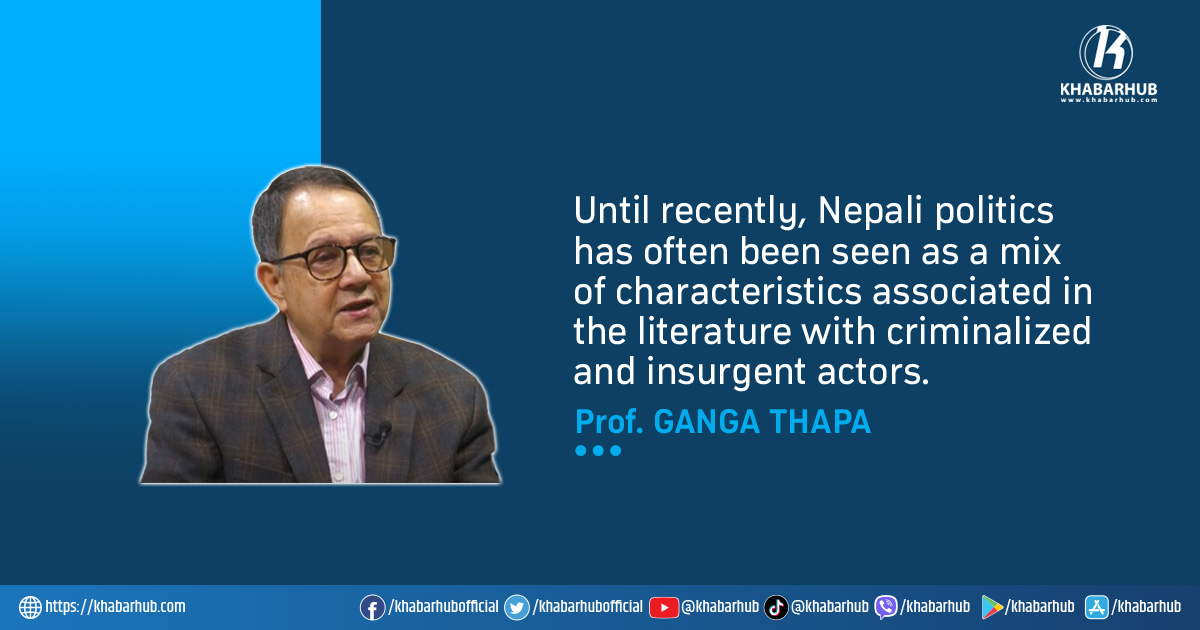
Until recently, Nepali politics has often been seen as a mix of characteristics associated in the literature with criminalized and insurgent actors. Governance has produced deep divisions, while democracy has largely been confined to elite-driven debates in which a small group decides priorities and outcomes.
The RSP regime that emerged following the 05 March 2026 elections is widely viewed as a resurgence of democratic forces and a seismic shock to the existing political order that has long dominated Nepali politics. There are grounds for hope that future governments may adopt a less short-term outlook, helping to establish stable governance and advance development.
Regrettably, since 1990, the majority of those who have served as President or Prime Minister—with the notable exceptions of Krishna Prasad Bhattarai and Manmohan Adhikari—have appeared arrogant, controversial, corrupt, or even treacherous.
This legacy presents a significant hurdle for a new generation of leaders, including Rabi Lamichhane and Balen Shah, who are tasked with resolving the chaos of the past. Despite the complexity of the landscape, they must remain resolute; with determination, transparency, and accountability, meaningful change is within reach.




Comment