




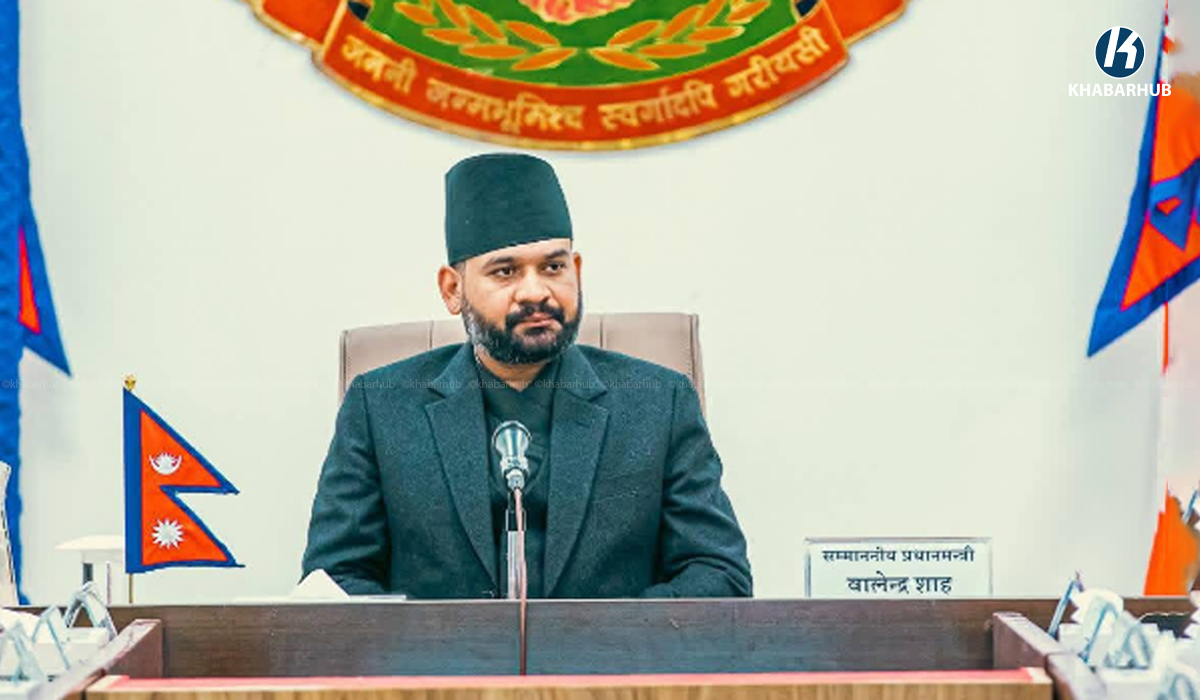
KATHMANDU: The government says a series of economic reforms introduced during its first 100 days in office have begun to produce encouraging results, citing improvements in revenue collection, increased private sector confidence, growing investment, and stronger support from development partners.
The administration led by Prime Minister Balendra Shah has identified economic revival and governance reform as its top priorities, with Finance Minister Dr. Swarnim Wagle spearheading policy changes aimed at creating a more investment-friendly environment.
Focus on a Rs 10 trillion economy
One of the government’s flagship economic goals is to expand Nepal’s economy to Rs 10 trillion, a target that aligns with the Rastriya Swatantra Party’s election manifesto.
The government believes the objective can be achieved by accelerating growth in hydropower, tourism, information technology, agriculture, infrastructure, and institutional reform.
According to the government, the budget for the upcoming fiscal year reflects this strategy and aims to place Nepal on a higher growth trajectory.
The broader vision is to grow Nepal’s economy to more than USD 100 billion within the next five to seven years, achieve annual economic growth of at least 7 percent, and raise per capita income to USD 3,000, enabling Nepal to graduate from its current low-income status toward becoming a middle-income country.
Reform agenda gathers pace
Shortly after assuming office on March 27, Finance Minister Wagle announced plans to repeal 15 outdated laws that were considered barriers to private sector growth and investment.
The ministry said the decision was based on recommendations from a high-level economic reform committee and consultations with business organizations.
The government has also abolished several offices it considers unnecessary, revised tax policies, and simplified regulatory procedures in an effort to improve the business climate.
Officials say reforms have focused on replacing bureaucratic hurdles with digital governance under the principle of “not line, but online,” while emphasizing merit-based public administration and reducing political influence in state institutions.
Five priorities in the national budget
The government has identified five major priorities in the budget for the upcoming fiscal year: good governance, economic recovery, internal and external connectivity, social investment and expansion of Nepal’s soft power through tourism, culture, and history
Officials believe political stability and governance reforms will create a stronger foundation for sustained economic growth.
The government also says it has assessed the potential economic impacts of geopolitical tensions in the Middle East, including possible effects on remittances, petroleum supplies, and fertilizer imports, while introducing policy measures to mitigate associated risks.
Citizens involved in budget preparation
For the first time, the government launched an online portal allowing citizens to directly submit recommendations during the formulation of the national budget.
Managed by the Office of the Prime Minister and Council of Ministers, the platform was designed to improve transparency and encourage public participation in policy-making.
According to the government, citizens, experts, and members of the Nepali diaspora submitted suggestions that were reviewed during the preparation of the annual budget and policy framework.
Officials say the initiative represents a new model of participatory governance by narrowing the gap between policymakers and the public.
‘Mission Mode’ implementation
Finance Minister Wagle has described the government’s implementation strategy as operating in “Mission Mode,” emphasizing measurable outcomes rather than policy announcements alone.
The approach includes digital monitoring of projects, performance indicators, legal reforms, and stronger institutional accountability.
The ministry says unnecessary administrative spending is being reduced, procurement is becoming more competitive, and reforms are intended to shift Nepal’s economy away from dependence on remittances and imports toward production, innovation, and entrepreneurship.
Tax reforms have also been introduced to improve business confidence.
The income tax exemption threshold has been doubled, allowing individuals earning up to Rs 1 million to pay only one percent income tax, while the highest personal income tax rate has been reduced by 10 percent.
Budget prioritizes growth and middle-class expansion
The government has presented a Rs 2.114 trillion budget for the upcoming fiscal year with the stated objective of expanding Nepal’s middle class while supporting economically vulnerable communities.
The budget allocates Rs 1.27 trillion for recurrent expenditure, Rs 431.1 billion for capital expenditure, and Rs 422.64 billion for financial management.
Revenue is projected to contribute Rs 1.405 trillion, while foreign grants are expected to provide Rs 61.74 billion.
The remaining financing gap of Rs 657.29 billion is planned to be covered through Rs 247.28 billion in foreign loans and Rs 410 billion in domestic borrowing.
Special budgetary emphasis has been placed on Karnali and Sudurpaschim provinces, while infrastructure development, energy expansion, and digital governance remain key investment priorities.
The government expects the budget and accompanying reforms to deliver around 7 percent economic growth while keeping inflation below 6 percent.
Economic diplomacy and investment promotion
The Finance Ministry has also intensified economic diplomacy to attract foreign investment.
According to the government, discussions have been held with multinational companies and private sector representatives on investment protection and improving Nepal’s investment climate.
Finance Minister Wagle recently addressed the ministerial session on financing for development at the United Nations Economic and Social Council and participated as a keynote speaker at The Nepal Discourse, organized by Harvard University and the Massachusetts Institute of Technology (MIT).
The government has also advanced discussions on a 28.5 billion Japanese yen grant for the improvement of Tribhuvan International Airport.
Meanwhile, the Investment Board Nepal has continued consultations to resolve forestry and environmental issues affecting major infrastructure projects, while recommendations from a committee tasked with restructuring the Nepal Stock Exchange have begun to be implemented from fiscal year 2082/83.
The government says these combined policy, legal, and institutional reforms are intended to build investor confidence and lay the groundwork for long-term economic transformation.





Comment