




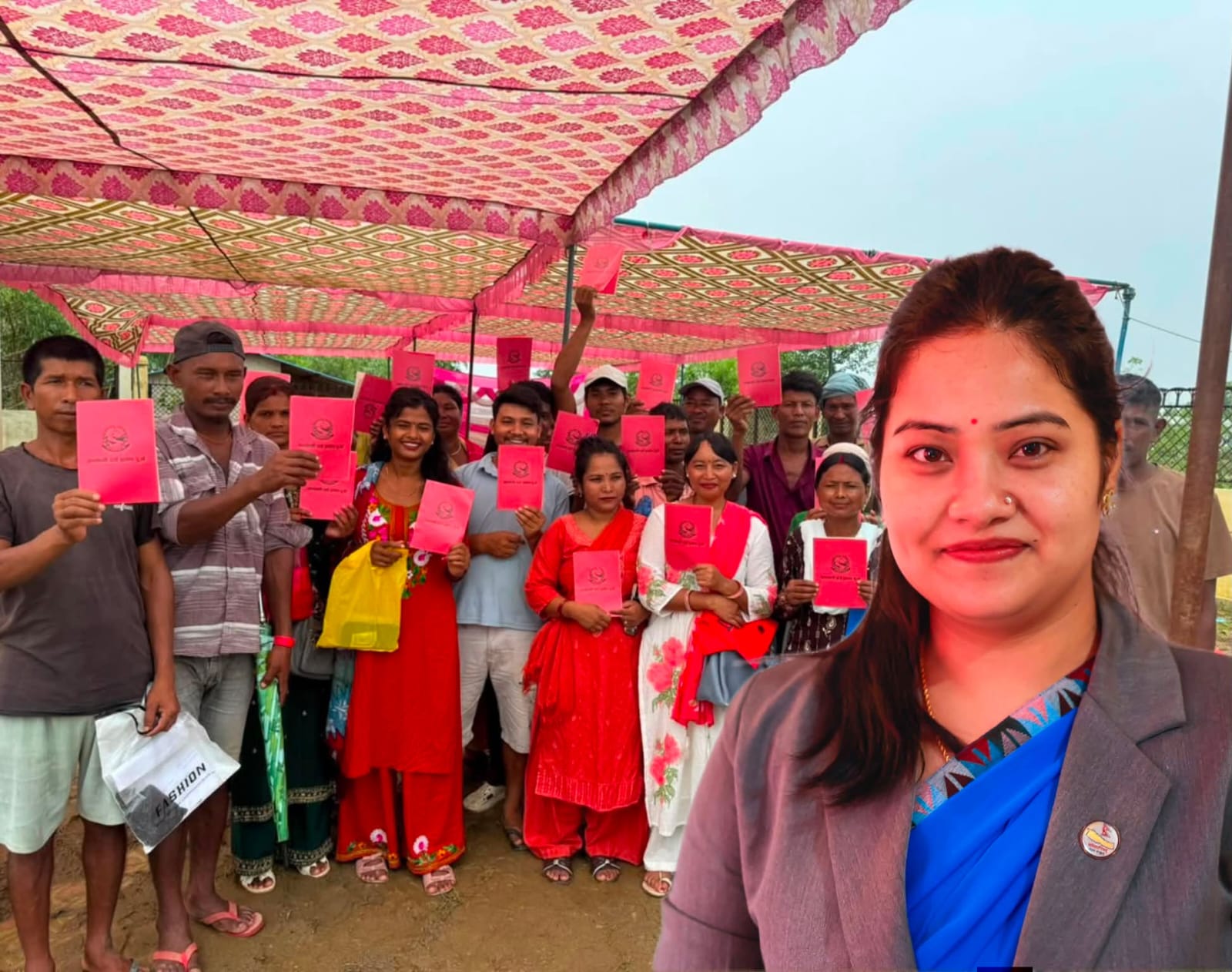
KATHMANDU: The government has formally begun distributing land ownership certificates to landless families, marking the start of its plan to address one of Nepal’s longest-running land reform issues under its 100-day governance agenda.
The initiative follows a commitment made in the government’s 100-point action plan, unveiled on March 28, a day after the current administration was formed. The 91st point of the agenda pledges to provide legal ownership of land to landless citizens.
Successive governments since the restoration of multiparty democracy in 1990 had established various commissions to resolve the problems of landless squatters and unplanned settlements. However, those bodies were frequently criticized for serving as platforms for political appointments rather than delivering lasting solutions.
Seeking to break from that approach, the present government dissolved the previous Land Commission and replaced it with a Land Management Committee.
As part of its broader effort, the government launched eviction drives in high-risk squatter settlements across the country, including the Kathmandu Valley, from April 25. Families displaced during the operation are currently being accommodated in temporary holding shelters while authorities conduct verification and collect data.
To accelerate the process, the Ministry of Land Management, Cooperatives and Federal Affairs has prepared new operational guidelines assigning the Land Management Committee responsibility for resolving issues related to landless Dalits, landless squatters and residents of unplanned settlements nationwide.
The Cabinet meeting held on June 2 appointed Balbhadra Bastola to lead the committee.
According to the committee’s Information Officer Sanjeev Kumar Sah, work on creating a digital database of eligible beneficiaries is in its final stage.
“Digital entry will make monitoring much easier, and local governments are currently working on the process. Some delays have occurred because of budget adjustments, but the work is progressing,” Sah said.
He said information on 1.248 million individuals has already been entered into the digital system, compared to around 1.12 million recorded under previous governments.
Sah acknowledged, however, that resolving the country’s landlessness problem remains a complex task.
“The ground reality is not as simple as it appears. Even at the current pace, the process will take considerable time,” he said when asked whether the government could fully resolve the issue within its target of 1,000 days, or approximately two years and nine months.
The government chose Bardiya to launch the first phase of certificate distribution because the verification process there had already been completed.
Land Management, Cooperatives and Federal Affairs Minister Pratibha Rawal had announced through social media on June 24 that land ownership certificates would begin to be distributed from July. In line with that commitment, the government on Thursday (July 1) handed over land ownership certificates to 29 families living along a riverbank in Ward No. 4 of Badaiyatal Rural Municipality in Bardiya.
Among the beneficiaries were two landless Dalit families and 27 landless squatter households, all of whom had been residing in the area for approximately 15 years.
“We provided ownership certificates to the families for the land they have been occupying,” said Gogan Bahadur Hamal, Chief Administrative Officer of Bardiya and head of the District Land Management Committee.
Under existing legal provisions, landless squatters occupying more than 2,000 square meters may receive ownership only up to the prescribed limit, while any remaining land remains under government ownership.
Hamal said Bardiya became the first district to distribute land ownership certificates under the government’s 100-day agenda because much of the groundwork had already been completed by previous commissions.
“We built on the work carried out by earlier commissions and completed the remaining verification in accordance with the new committee’s procedures and standards,” he said.
According to Hamal, Bardiya has an estimated 13,000 to 14,000 landless squatter households and 30,000 to 35,000 households living in unplanned settlements. The committee now plans to expand the distribution process to every local government in the district.
He added that since much of the necessary infrastructure had already been established under previous governments, achieving the current administration’s targets would be relatively easier.





Comment