




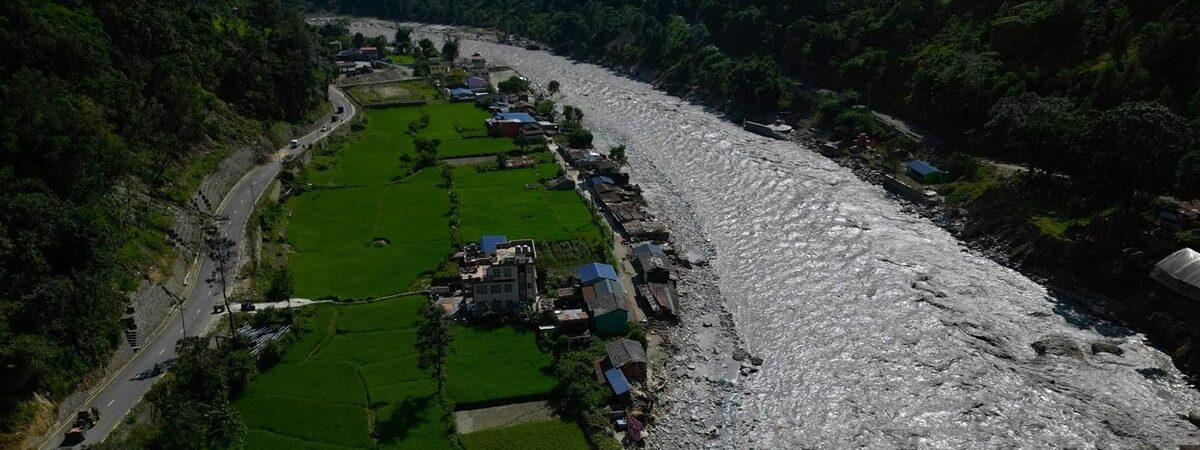
PARBAT: Until a few days ago, there were houses, barns, farmland and children playing in Farse in Parbat district. Today, the Kaligandaki River flows through much of the area, leaving behind little more than debris and memories.
The flood of September 27 in Farse, Jaljala Rural Municipality-8 of Parbat, has upended the lives of dozens of families. Houses built through years of hard work, accumulated possessions and livestock raised with care were swept away by the raging river.
Nirmala Sapkota’s family from Dhodeni, Ratnechaur-1 of Beni Municipality, had been living in Farse for years. With good transport links and easy access to markets for agricultural produce, the family had made the settlement its home and workplace.
Once considered financially well-off in the community, Nirmala now says her family has been reduced to nothing.
“Although our ancestral home is in Ratnechaur, we had built a well-managed house in Farse and were living comfortably,” she said. “The flood swept away everything except the clothes we were wearing and the livestock in the barn. The most important thing is that our lives were spared.”
There is pain in Nirmala’s voice, but also a determination to rebuild. “I now understand that all we need to survive is food, shelter, clothing and bedding,” she said.
The story of Bishnukumari Hamal’s family is similar. The family moved from Dhairing to Farse for business and had built four houses there. Her husband, Dil Bahadur Chhetri, operated the Shiva Vegetable and Animal Husbandry Farm, which produced milk.
“We had even installed solar panels at the cowshed so we could bathe the cows and buffaloes with hot water,” Bishnu said. “Now the Kaligandaki is flowing through the place where our well-equipped house once stood. We have nothing left but to look at old photographs and remember what we had.”
Around 100 families in Farse have been affected by flooding in the Kaligandaki following continuous rainfall. According to Jaljala Rural Municipality, 75 houses have been completely washed away, while another 27 are at risk.
A total of 129 women, 144 men and eight children under five from the 75 displaced families have been affected. Deepak Acharya, vice-chair of the rural municipality, said families who have no alternative homes and cannot stay with relatives have been accommodated in temporary camps with assistance from security agencies.
“Although their lives were saved, many are still struggling with the pain of losing homes and property accumulated through years of hard work,” Acharya said.
Early warning helped save lives
Sangita Sharma of Farse still vividly remembers the night of Asoj 20. Residents had remained alert for several days after warnings of heavy rainfall, but few had imagined that the Kaligandaki would enter the settlement with such force.
At around midnight, members of the Farse Youth Club issued an alert using a loudspeaker. Sangita and many other families immediately left their homes and headed for safer areas.
“We went out onto the road at around 2:00 am wearing only the clothes we had on and getting soaked in the rain,” she said. “There were jewellery, food, clothes, furniture, utensils, cash and important documents in the house, but we had only enough time to save our lives.”
Residents had to release livestock from their sheds and drive them to safety. There was no time to retrieve household belongings.
Now, displaced families visit their flooded homes once a day, where they sift through the rubble, recall their former lives and return to the temporary camps with heavy hearts.
Bina, Phulmaya and Sukmaya BK, who are staying at a temporary camp, are experiencing the same loss. They were unable to salvage anything from their home apart from the clothes they were wearing.
“It is heartbreaking to see the Kaligandaki flowing through the place where our house once stood,” they said.
Families whose houses and livestock sheds were submerged are still searching through the debris for anything that survived the flood. They wash the mud-covered belongings, dry them in the sun and move whatever can be salvaged to safer places.
The flood also swept away students’ books and notebooks along with their homes. A nearly century-old suspension bridge connecting Farse and Dhodeni in Baglung was also destroyed. With the bridge gone, students from Myagdi and Baglung who attend Jan Kalyan Secondary School in Farse now have to take a longer route to reach the school.
According to Haribikas GC, ward chair of Jaljala-8, advance warnings and the vigilance of local residents helped prevent any loss of life. The scale of physical damage, however, was immense. GC’s ancestral home was also swept away by the flood.
From a trading hub to an agricultural community
During the Panchayat era, Farse was known as a commercial centre and served as an important stop for people travelling between Baglung, Mustang and Myagdi.
The expansion of road networks gradually changed the character of the settlement. Residents shifted from traditional trading activities toward agriculture and livestock farming. With Beni, Kushma and Baglung markets located relatively close by, milk and vegetable production became important sources of income.
Khadga KC, secretary of the local Sangam Dairy Producers and Agricultural Cooperative, said farmers along the Maldhunga-Beni section of the Kaligandaki Corridor supply around 800 litres of milk daily during the peak season and between 600 and 700 litres during the off-season.
The cooperative had been collecting milk from around 40 farmers and transporting it to Baglung for sale. The flood, however, has severely affected the farmers’ livelihoods.
“Half of the 40 farmers engaged in cattle farming have been affected by the flood,” KC said. “Milk production has fallen because farmers are struggling to provide food and fodder to the livestock that were rescued.”
He said immediate arrangements should be made to provide animal feed and fodder to flood-affected farmers.
Faith remains that the devastated village will rise again
Local resident Tikaram Chhetri still vividly remembers the morning of September 27. He had safely left his home the previous evening after the floodwaters began rising. When he returned the next morning, however, his house was gone.
“The flood destroyed the growing settlement of Farse,” he said. “We will rebuild our lives with courage, but we need the government’s support.”
Ramu Subedi, chairperson of the Farse Tol Development Committee, also believes the village can be rebuilt. However, he said safe settlement and effective river control must be prioritized.
“If a concrete wall is constructed here and the river is properly managed, we can return to our previous lives through business and other occupations,” he said. “The settlement must be made safe and habitable, and arrangements should be made for families whose homes and property were swept away.”
Subedi said a comprehensive plan should be developed to protect the settlement not only on the Parbat side but also toward Myagdi and Baglung. He also called for an end to indiscriminate extraction of riverbed materials from the Kaligandaki.
He warned that failure to begin conservation and river-control measures immediately could cause the Kaligandaki to change its course, putting additional settlements and hundreds of ropanis of cultivable land at risk. He said the road connecting Korlana could also be threatened.
Displaced families await rehabilitation
Jaljala Rural Municipality has deployed staff and established a dedicated secretariat to assist families displaced by the floods. Relief materials are being distributed through a single-door system.
Floods and landslides have caused damage in several areas, including Tangwang, Lamakhet and Palsing, in addition to affecting families displaced in Farse. Rural municipality chairperson Raju Acharya said identity cards have also been distributed to affected families.
A health camp, including psychosocial counselling, was organised on Thursday by the municipality’s health division. Fourteen teams comprising elected representatives and municipal employees have also been deployed to collect details of damage caused by the floods and landslides.
Chairperson Acharya said a long-term plan was needed for safe settlement, reconstruction and protection of displaced communities. He said the municipality had submitted proposals to the federal and provincial governments seeking support for the rehabilitation and reconstruction efforts.
Gandaki Province Chief Minister Surendra Raj Pandey, who inspected Farse on Tuesday, also expressed the provincial government’s commitment to supporting reconstruction and rehabilitation.
The Kaligandaki flood has dramatically changed the landscape of Farse. Houses have been reduced to ruins, cowsheds have disappeared into pits, and courtyards have been replaced by the river.
Yet hope remains among the flood survivors.
“Floods can wash away houses, but they cannot wash away our dreams. We want to rebuild our village through our own labour and hard work,” said Chandra Darji, a flood victim from Farse. “For rehabilitation, we need safe housing, confidence that the settlement will be protected, and government support.”
RSS



Comment