




Several factors suggest that interest in liberal democratic goals will continue to grow, particularly in relation to representative government and the broader elements of the democratic tradition.
This includes efforts to align the law with the growing aspirations of sovereign citizens and to shift attention away from traditional development issues toward new constitutional arrangements and other mechanisms designed to secure democratic objectives and re-legitimize the political system.
However, this kind of politics is likely to face significant challenges in defining, developing, debating, enacting, and implementing public policies in a focused and sustained manner, as is often observed in Nepal. In this respect, it resembles what New York University professor H. Mark Roelofs describes in Schematic Politics (1996), in which political discourse is often marked by hypocrisy, personal attacks, moral condemnation, rhetorical excess, uninformed claims, emotional manipulation, and other forms of demagoguery.
Certainly, for Nepal, despite all the excitement its political processes generate—especially during election periods—the political system often falls short of fostering rational debate and delivering substantive achievements. This is due in large part to the dominance of mythic rhetoric and symbolic politics.
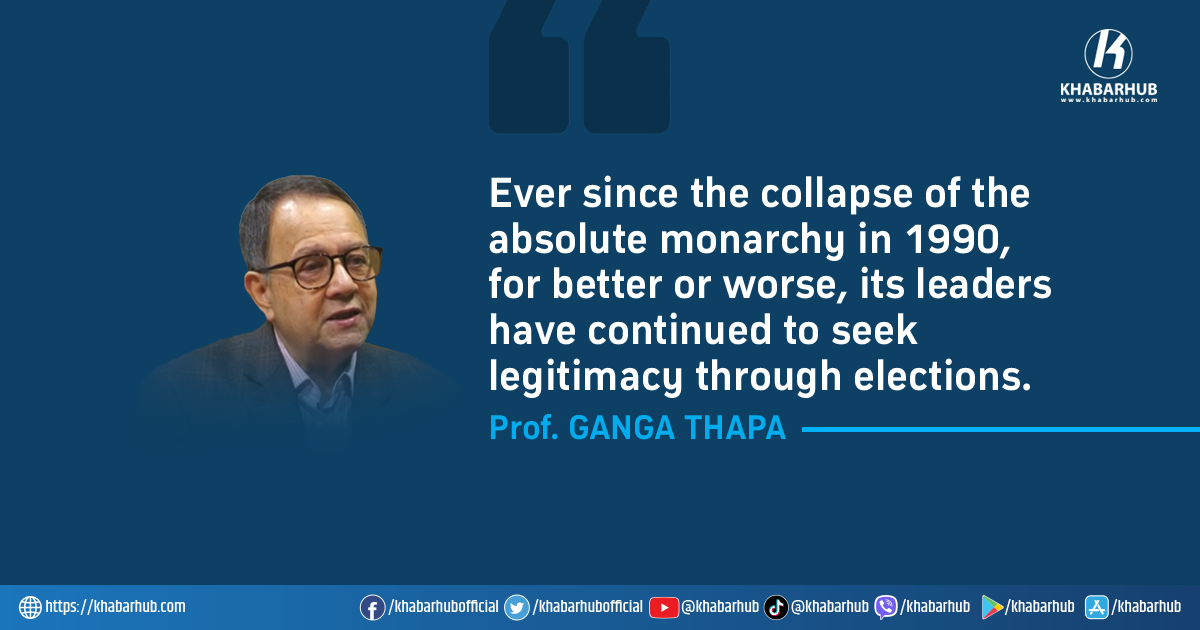
Ever since the collapse of the absolute monarchy in 1990, for better or worse, its leaders have continued to seek legitimacy through elections.
Rather than uniting the sovereign people around a common purpose, it has instead produced a society persistently fragmented into competing classes and factions, creating a condition of almost permanent political tension.
On the other hand, politics is not about cutting a cake, dividing the spoils, or simply allocating parliamentary seats among political parties. Rather, political parties must earn the trust and confidence of the people and secure electoral legitimacy through democratic competition.
The problem in Nepal today, however, is that public disaffection, disgust, and cynicism toward the political system have remained persistently high for more than two decades.
If current attitudes are becoming even more negative and visceral than before, scholars will undoubtedly continue to examine the sources of this discontent—whether it stems from the failures of the media, the ambitions of political leaders, factionalized parties, bloated interest groups, flaws in the constitutional structure, or even unrealistic expectations among the public.
Whatever the underlying causes, deepening public antipathy toward government has serious implications. It can lead to noncompliance with government decisions, encourage support for ill-conceived or populist reforms, and erode the public trust and cooperation that any democratic system requires to function effectively.
A close examination of the implications of the 4 March 2026 elections suggests that Nepal may be entering a new phase of political awakening. Citizens increasingly appear to recognize that meaningful political reform requires a fundamental change in the political guard and the emergence of leaders capable of addressing problems defined by the needs and aspirations of society rather than by narrow partisan interests.
More fundamentally, the rise of the Rastriya Swatantra Party (RSP) reflects the widespread perception that the traditional political parties have failed to serve the public with competence, integrity, fairness, and vision. Their inability to deliver innovative policies and effective governance—particularly in the face of persistent corruption and the shortcomings of Nepal’s established political order—has eroded public confidence and encouraged voters to place their trust in a political alternative that they believe can make a genuine difference.
In this context, however, the RSP’s long-term success will depend on more than electoral gains alone. To realize the public’s aspirations, the party must champion a broader transformation of the political system by promoting a more open, accountable, and responsive form of governance. It must also advance a modern and economically viable development agenda capable of fostering greater equality, sustainable economic growth, and the provision of basic public needs.
Time and again, Nepali political analysts have asked why this country, despite having decisively moved away from the old political order, increasingly appears to be a fading shadow of democracy.
Such an approach would bring a dual benefit: not only improving the quality and effectiveness of government services but also encouraging citizens to become active and responsible participants in politics and public policymaking.
For me, the March elections, viewed in their entirety, present an almost complete, indeed nearly perfect, picture of a perceptive political transformation that should be valued positively as a whole rather than understood within narrow confines. Perhaps this is because I am an ardent believer in the proposition that a political scientist should apply his or her expertise to the ongoing political life of the community, the state, and the nation.
Over the years, the norms of democratic governance have rested on moral and political leadership, and no individual should be excluded from meaningful political participation.
A close examination of the core impact of the 04 March 2026 elections makes a persuasive case that political enlightenment began to emerge in Nepal when citizens realized the goal of reforming politics, marked by fundamental shifts in political leadership, the emergence of leaders who can make a difference, and the prioritization of issues inspired by societal needs.
More fundamentally, traditional political parties have utterly failed to serve the public with wit, wisdom, fairness, grace, erudition, and innovative projects, particularly in the context of communism and corruption in Nepal. As a result, the public has placed its trust in the RSP, which is seen as capable of making a difference.
Nonetheless, some scholars have argued that, in certain circumstances, a commitment to democracy places great emphasis on the image and cohesion of society—that is, on the centrality of the state—which need not be equated with authoritarianism. It is therefore no surprise that the institutions necessary to make democracy truly work in Nepal are still evolving.
One might argue that the RSP should promote a system that diminishes the disproportionate power of the established political elites, who have enjoyed a near monopoly in recent years.
At the same time, it should embrace a fresh understanding of modern political philosophy, with practical solutions for today’s challenges, particularly the urgent need to overcome chronic poverty, raise living standards, and mobilize a concerted national effort to implement development plans effectively.
Yet, in the Nepali context, several additional factors must also be taken into account. One important question is whether citizens have been sufficiently inculcated with a civic culture and its essential ingredients, such as moderation, tolerance, open-mindedness, respect for minority rights, political efficacy, adequate access to information, informed opinion formation, participation in political discussion, and engagement in civic and organizational processes.
Equally important is whether they are adequately prepared to become full and effective participants in democratic institutions and processes.
Another version of this argument is advanced by Kyong-Dong Kim in Confucianism, Economic Growth and Democracy (1997). Kim goes even further by arguing that the democratic process depends on whether the legislature is politically independent of the executive and whether it functions effectively as a key institutional mechanism for strengthening democracy and serving as the principal forum for public deliberation.
In Kim’s view, political parties must be sufficiently institutionalized, rather than dominated by personalism, in order to guarantee the articulation of public interests through concrete policies and to promote meaningful citizen participation in the political process. Likewise, adherence to the rule of law is indispensable for the achievement of a liberal democratic order.
Political leadership involves balancing diverse perspectives with effective governance. However, leaders often focus more on maintaining power and political advantage than on achieving meaningful policy results. This situation complicates gradual reforms aimed at balancing stability and economic growth, and it can deepen social divisions even as democratic efforts advance.
After the end of the absolute monarchy in 1990, Nepal’s political scene grew considerably. Over time, political behavior has surfaced, shaped by changing opportunities, with most benefits going to those in power.
Still, policymaking tends to be driven by political motives rather than solid evidence. Consequently, parliament frequently prioritizes electoral gains over evidence-based decisions. In response, the RSP was established to challenge political stagnation, shake up the status quo, and promote democratic debate and institutional reform.
What conclusions can be drawn about the general nature of the Nepali political system? The evidence points to deeply troubling deficiencies. The system often appears fundamentally misguided, wasteful, and at times even pathetic, generating widespread anxiety and frustration.
The ruling elites, regardless of their political affiliation, are frequently only partially right and largely wrong, reflecting a chronic inability to comprehend the broader political equation. At the heart of the problem lies a deep-rooted confusion about the kind of direction and leadership the country should pursue.
Time and again, Nepali political analysts have asked why this country, despite having decisively moved away from the old political order, increasingly appears to be a fading shadow of democracy. This is particularly puzzling given that Nepal has largely ensured orderly transfers of political power through periodic waves of democratic effervescence while remaining relatively politically stable.
Such a transformation should encourage mass participation and civic engagement conducive to stability while preventing growing social passivity and political apathy.
Ever since the collapse of the absolute monarchy in 1990, for better or worse, its leaders have continued to seek legitimacy through elections. Yet they have largely failed to promote greater social diversification and constitutionalism or to strengthen the dynamic processes of representation and empowerment necessary to embrace modernity, particularly in relation to economic growth.
It is, of course, the notion of democratization through elections that is widely affirmed in classical political science literature. However, recent empirical research—particularly by the V-Dem Institute, which has studied democracy globally for over two decades using large N datasets—does not fully support this hypothesis. Instead, the evidence suggests that elections alone are insufficient to ensure meaningful democratization in practice.
In addition, Nepal operates under a convoluted three-tier federal system. The rationale behind this structure is to decentralize public administration, distribute statutory roles and responsibilities, and make governance more efficient and effective. However, both the structure and practice of federalism have largely failed to address the root causes of conflict—political, identity-based, economic, and discursive—through meaningful institutional channels, offering little hope to those left behind.
In that sense, to achieve public aims, the RSP must situate itself within the broader political system, which is inextricably linked to more open and responsive politics, and must transform into a modern, economically viable force capable of playing a leading role in promoting equality and economic development to sustain basic needs. This would have twin benefits: improving government services and encouraging the public to take greater responsibility in politics and social policymaking.
In a country like Nepal, characterized by a heterogeneous social structure shaped by its multiclass nature, a progressive state with strong political capacity, coupled with responsible and accountable political leadership of high integrity, must seek to reconcile liberal democratic institutions with broader socioeconomic and political transformation.
It is now up to the RSP to establish genuinely democratic governance that safeguards democratic rights and makes democracy truly work for the people.
Such a transformation should encourage mass participation and civic engagement conducive to stability while preventing growing social passivity and political apathy.
Dan Dolderman, a professor of Social Psychology at the University of Toronto, suggests that life’s simple truths often go unnoticed. These truths gain significance only when recognized and valued by capable, compassionate individuals. Such recognition depends on experiencing love, care, and strong social bonds.
From this perspective, many Nepali politicians seem mainly driven by populism aimed at pleasing crowds, caught up in trivial pursuits, and lacking both purpose and the virtues needed to reach higher human potential.
In Nepal, the spread of democracy can be viewed within Samuel P. Huntington’s concept of the ‘third wave’ of democratization, which started in the late 1970s in Spain and Portugal, expanded across Latin America and Asia in the 1980s, and advanced through Eastern Europe after the Berlin Wall fell in 1989.
Nepal’s first clear sign of this wave was in 1990, with the end of the partyless Panchayat system. However, democratic transition did not automatically lead to stable democracy or political stability. By September 2025, the corrupt and criminal leadership of the communist and Congress parties appeared increasingly disconnected from reality.
Our understanding of genuine democratization must recognize that meaningful change takes time. Those who are sincere in their efforts and who lead with experience, attentiveness, and care can overcome many of the structural and political ills that continue to plague Nepali democracy. It is now up to the RSP to establish genuinely democratic governance that safeguards democratic rights and makes democracy truly work for the people.




Comment